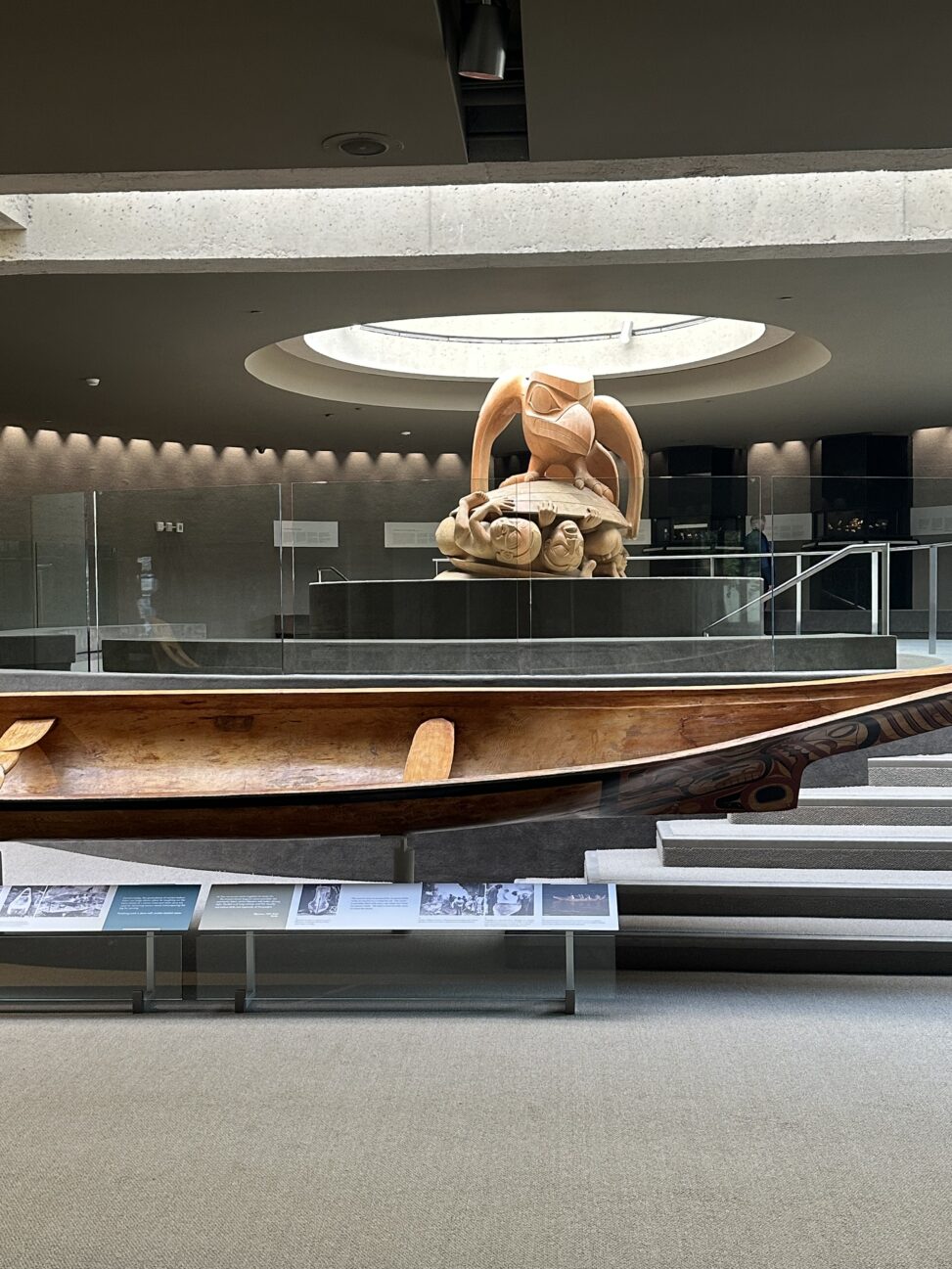
Bill Reid’s The Raven and the First Men is one of the most recognized works of indigenous art in Canada. It began as a smaller work, The Raven Discovering Mankind in a Clamshell (1970), and was later enlarged to the one located at the Museum of Anthropology at the University of British Columbia after a commission from Walter C. Koerner. According to the Haida narrative, the Raven discovers the first humans inside a clamshell and brings them into the world. Reid, a Haida artist, took inspiration from this story and created a sculpture that has been able to preserve the narrative. It is more about humanity being brought from hidden potential into visible existence by a transformative force.
The sculpture is made of 106 laminated yellow cedar beams, weighing more than 4,000 kilograms and measures 188 x 192 cm (height x diameter). At first glance, I assumed the sculpture was an owl. The face looks broad; the eyes seem frontal and watchful with a heavy posture that seems solemn. However, it displays the Raven bent over a large clamshell filled with tiny human figures. The Raven’s body covers the shell, creating a sense of closure while the tiny figures appear active, crowded, and varying in facial expression. It appears as if some are trying to climb outward, while others cling to the shell, which gives the figures a type of motion and tension. The Raven dominates the scale composition, yet because of the facial expression and individuality of the figures, viewers are drawn to them. Even though Bill Reid is widely known for this work, it is important to note that the sculpture is a collaborative effort among sculptors such as Reg Davidson, Guujaaw, Jim Hart and George Norris. It took them 3 years to work on, with Reid giving it the final touch. The carving is well refined; one can feel what the back seems like without touching it.
On April 1st, 1980, the artwork was unveiled by Prince Charles, and it has then been celebrated by Haida people and guests on June 5, 1980. Reid took inspiration from the visual and narrative tradition of the Haida Northwest Coast. Haida art is known in media such as cedar carving, poles, bentwood boxes, masks, argillite carvings, and jewelry. The Haida work was more than decorative; some of the works are tied to family identity, storytelling, and relationships between the human, natural, and spiritual worlds. Haida art is also known to have a highly distinguished visual language, mostly with the formline design, where swelling and tapering lines create rhythm, balance, and structure. Ried studied other Haida work and was particularly influenced by Charles Edenshaw, a significant Haida artist from the 19th century. In 2004, the artwork appeared on the reserve of the Canadian $20 bill in the Canadian Journey series. This was one of the factors that pushed the work from just the museum into National memory.
Philosophically, the sculpture can be understood without drifting too far. It presents a movement from hiddenness to presence. It stages the passage from concealed life to manifested existence, from shared origin to distinct form. Instead of imposing private emotions on the work, one could say the sculpture symbolizes humanity at a threshold between enclosure and world. The first Humans are not fully free yet, but no longer entirely hidden. Reid described them as having all the potential of being human, not until they come out of the shell.
In conclusion, The Raven and the First Men shows that tradition does not survive by remaining frozen in past. Reid’s sculpture gives the Haida narrative a lasting, visible, monumental presence, creating a sense of cultural memory while also serving as a major work of modern public art. The work serves not just to preserve Haida history but to demonstrate how an inherited story could be turned into artwork that continues to remain meaningful over time, while also providing humanity a message that what is latent can become visible.