Title: Encountering Art Along the Street
Artist: Unknown
Location: Kathmandu, Nepal
Visual Description
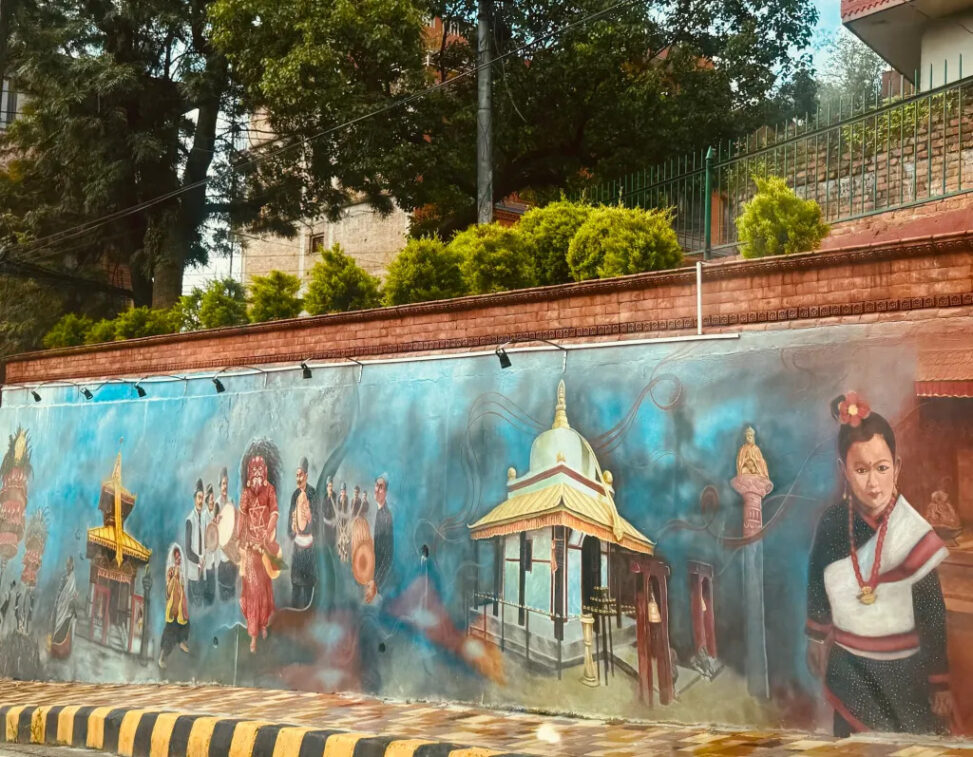
The image shows a huge art on a long exterior wall on the side of the road, which uses color blue for background, with areas of white, brown, gold, red, and green. The surface appears matte, with visible brushwork and blended paint textures. The composition is arranged horizontally, with multiple figures and architectural structures distributed from left to right.
On the left side warm color like golden, red and brown are used to portray temple and a figures appears in front of the temple. Also, on the right side of the temple some figures appears and one of them in the middle is wearing patterned clothing, accessories and a huge mask while others are depicted in simpler garments. Near the center a group of human figures seem positioned close together with some kind of instruments on their hand.
Light blue, gold, brown and white are used to paint a bigger temple structure with a domed roof in the center-right section. The structure occupies significant portion of the composition, which is shown with straight line and separate boundaries and on the right-hand side if it, there is a golden colored statue sitting on the top of the pilar. A bigger human figure is painted at the far right, taking up more vertical space and being closer to the observer than the rest. This figure is shown from the waist up, wearing jewels and layers of clothes, and for me the most noticeable thing on her is the red and yellow flower on her hair.
Interpretation & Meaning
The mural is seen to use both human and architectural shapes to showcase idea of place, culture and community. Buildings that look like temples is an indication that the constructed environment were valued and have social or communal importance. These buildings are also not clustered in either side of the mural, and this is what gives the impression of continuity and flow to the left and right directions.
The human figures have been illustrated in various size with the giant one at the far right. Such differences in size attracts the eye of the observer and creates a center of interest implying that individual identity can be highlighted along with the presence of the crowd. The arrangement of figures in the middle of the left is opposed to the more distant figures on the rest of the picture and this can imply the different relations of the subjects and common spaces.
The viewers experience of the art has a significant impact by the fact that it has been placed in public street. The viewer can experience the work when walking or riding on the road, and not going into an art gallery, which promotes short, repetitive or accidental viewing. The horizontal length of the art reflects the flow of people and traffic, which supports the concept of the walk in space.
The mural can be viewed differently by different viewers based on their knowledge of the visual elements represented. Some people may recognize certain architectural or clothing styles, while others may recognize color, size, or structure. While visitors may view the artwork as a cultural symbol or visual symbol, locals may view it as an extension of immediate surroundings. Because there is no writing, the spectator is allowed to interpret what they see by drawing on their own experience and understanding.
Space, Power, and Access
Due to the fact that the mural is painted on the outer road side wall, the art can be seen by a large and free population. Any person that is walking by the area, riding on the bike or driving a car can come upon the work without intending to do so. This is what makes the experience rather accidental, as opposed to gallery spaces of art that involve entry and admission.
Property owners or municipal authorities, whose power determines the mural’s presence and durability, most likely own the space. Even though it is a publicly visible artwork, it is not commonly owned publicly. Its duration can be influenced by its maintenance decisions, redevelopment or policy changes.
The mural is very visible because it is large and it is located in an open road with a lot of traffic. However, the actual location also affects access, those who don’t pass by this spot won’t see the work. As a result, rather than serving as a barrier between art and daily living, the mural is a part of the visual environment of daily existence.