1. Introduction
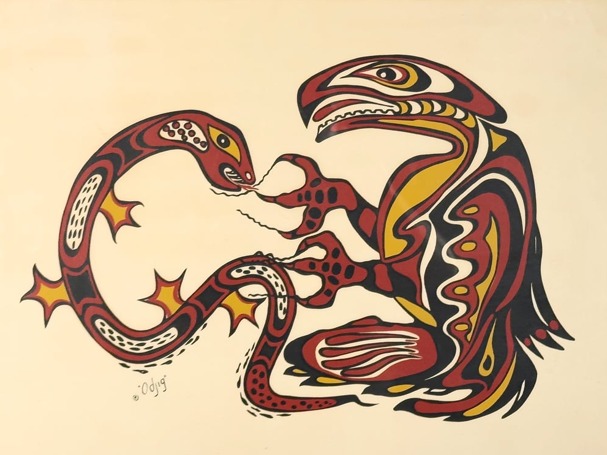
This analysis examines the work of Daphne Odjig, a contemporary Indigenous artist associated with the Professional Native Indian Artists Inc. (often referred to as the Indigenous Group of Seven). Her practice engages with Anishinaabe visual traditions while adapting them within a modern artistic context. The artwork considered here, Untitled (lecture slide image, attributed to Daphne Odjig), presents two stylized animal-like figures defined by bold contour lines and filled with patterned sections of color. The composition reflects key characteristics of Indigenous visual traditions, including flattened space, symbolic imagery, and interconnected forms.
This essay argues that Odjig both preserves and transforms Indigenous visual traditions through a hybrid approach. While the work maintains essential elements such as strong outlining, symbolic animal imagery, and visual storytelling, it also introduces abstraction, compositional balance, and expressive movement associated with contemporary art. Rather than simply reproducing tradition, Odjig reimagines it in a way that allows it to function within modern artistic spaces and reach broader audiences. The artwork demonstrates that tradition is not fixed but can evolve through reinterpretation while maintaining cultural continuity.
2. Description of the Artwork
The artwork consists of two stylized animal-like figures positioned against a neutral, light-colored background. The figures are outlined with thick black contour lines that clearly define their forms and separate them from the surrounding space. The composition is horizontally oriented, with both figures facing each other and interacting through overlapping limbs and curved body shapes. This interaction creates a strong focal point at the center of the image.
Color is used selectively, with dominant tones of red, black, yellow, and white. These colors appear in flat, solid areas as well as in patterned sections within the figures. The internal spaces of the figures include repeated shapes such as dots, curved lines, and segmented forms, which create a sense of rhythm and visual movement across the composition. The use of line is continuous and fluid, guiding the viewer’s eye along the contours of the bodies and reinforcing the interconnected relationship between the figures.
The artwork maintains a flat pictorial space, with no attempt to create depth or perspective. Instead, overlapping forms suggest interaction rather than spatial distance. The scale of the figures relative to the frame suggests that they occupy the entire visual field, emphasizing their importance within the composition. The absence of background detail directs full attention to the figures and their relationship.
Traditional elements are visible in the stylized forms, bold outlining, and symbolic interaction between figures. At the same time, the composition reflects a contemporary approach through its abstraction, controlled use of color, and emphasis on formal balance and movement rather than realistic representation.
3. Description of the Tradition
Odjig’s work draws from Indigenous visual storytelling traditions, particularly those associated with the Woodland School of painting. This tradition is rooted in Anishinaabe visual culture and is characterized by bold black outlines, flattened forms, and symbolic imagery. Historically, materials included natural pigments applied to surfaces such as birchbark, hide, and later paper or canvas. The emphasis is not on realism, but on conveying meaning through stylized forms and visual relationships.
A defining feature of this tradition is the use of contour lines to define figures and connect them within a shared visual space. These lines often indicate relationships between humans, animals, and spiritual entities, reflecting a worldview centered on interconnectedness. Animals are not only depicted as physical beings but also as symbolic or spiritual figures within storytelling practices.
Color is typically used in a limited but intentional way, often involving strong contrasts to emphasize form and meaning. The flatness of the composition reinforces clarity and directs attention to the relationships between figures rather than creating illusionistic depth.
Culturally, these works serve purposes beyond decoration. They function as a form of storytelling and knowledge transmission, communicating teachings, histories, and connections to land and community. Traditionally, such works were embedded in communal and cultural contexts rather than being produced for individual recognition. As a result, they have often been categorized outside the Western fine art canon, despite their complexity and significance.
4. Critical Analysis
Odjig’s work demonstrates how Indigenous visual traditions can be transformed as they move across time and into contemporary art contexts. While she preserves key elements such as bold contour lines, symbolic imagery, and interconnected figures, she adapts them through abstraction, compositional clarity, and modern materials. This shift allows the work to function within institutional spaces such as galleries and museums, where it is encountered by diverse audiences.
Hybridity in Odjig’s work strengthens tradition rather than weakening it. By combining traditional visual language with contemporary artistic strategies, she expands the possibilities of Indigenous art without removing its cultural foundation. The work shows that tradition can remain meaningful while adapting to new contexts, rather than being confined to a fixed historical form.
Audience plays a significant role in shaping interpretation. For Indigenous viewers, the imagery may carry cultural and symbolic meanings connected to shared knowledge and traditions. For non-Indigenous audiences, the work may be understood more in terms of formal elements such as composition, color, and abstraction. This difference highlights how meaning changes depending on the viewer’s perspective and cultural background.
Ultimately, Odjig’s work both preserves and reimagines tradition. It maintains essential visual and cultural elements while transforming them into a contemporary form, demonstrating that tradition continues to evolve through artistic practice and changing contexts.