Introduction
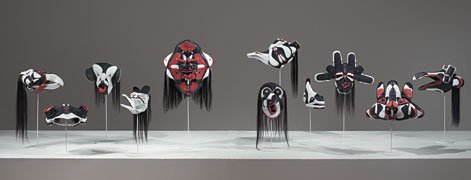
At first glance, the object appears to be a Nike shoe. On closer inspection, it is a Northwest Coast ceremonial mask. This dissonance is not accidental. Canadian artist Brian Jungen, of Dane-zaa heritage, constructs his Prototype for New Understanding series (1998–2005) entirely from deconstructed Nike Air Jordan sneakers, reassembled into forms that unmistakably reference the carved wooden masks of Northwest Coast Indigenous peoples. Jungen places two powerful visual systems , one rooted in millennia of ceremony, the other in late-capitalist consumer culture , in direct, uncomfortable conversation.
The thesis of the Prototypes series is deceptively simple but critically sharp: Indigenous culture is not a static artifact of the past, preserved under glass and available for consumption. Rather, it is a living, evolving force , one capable of colonizing modern consumerism just as easily as consumerism has historically tried to colonize it. Jungen does not mourn tradition; he weaponizes it. Through material transformation, formal reclamation, and sharp conceptual critique, the series hybridizes tradition without destabilizing it, ultimately arguing that Indigenous visual language is resilient enough to survive , and absorb , even the most aggressive symbols of global capitalism.
Description of the Artwork
The Prototype for New Understanding sculptures are made from deconstructed Nike Air Jordan sneakers. Jungen dissects the shoes , cutting away rubber soles, peeling back leather panels, separating foam midsoles , and reconstructs these components into mask-like forms. The medium itself is the first layer of meaning: these are readymades in the tradition of Marcel Duchamp, where the found commercial object is stripped of its original function and recontextualized as art. But Jungen goes further. He does not merely place a Nike shoe in a gallery; he transforms it into something formally and visually distinct from its source material.
The color palette of the Air Jordans Jungen selects is not incidental. The dominant red, black, and white of the sneakers align precisely with the traditional color system of Haida and Kwakwakaʼwakw art , a convergence that makes the transformation feel both inevitable and provocative. The Nike Swoosh, that globally legible emblem of athletic aspiration, is repositioned to mimic the bold, curvilinear formline , the defining graphic element of Northwest Coast design. Where the Swoosh normally signals speed and commerce, here it reads as an ovoid or U-form, echoing the interlocking geometric vocabulary of Indigenous visual tradition.
Stitching along the shoe’s seams becomes fine incised line work; foam padding becomes the raised relief of a carved surface; hanging laces approximate ceremonial fringe or the pendants of a transformation mask. The use of tradition is simultaneously a direct visual reference and a conceptual critique: these sculptures look like Northwest Coast masks, but the viewer cannot forget what they are made of. The mask is present. So is the commodity. Jungen refuses to let either disappear.
Description of the Tradition
The ceremonial masks of Northwest Coast Indigenous peoples , including the Haida, Kwakwakaʼwakw, and Tlingit nations , are among the most formally sophisticated and culturally complex art objects in the world. Traditionally carved from red cedar, a material of deep spiritual significance, and painted with natural pigments , ochre for red, charcoal for black, and clam shell for white , these masks were produced by trained artist-practitioners who held specialized knowledge of both technical craft and spiritual protocol.
The visual language of these masks is governed by formline design: a system of interlocking primary and secondary forms composed of ovoids, U-shapes, and S-shapes, organized according to strict compositional rules. Formline is not decoration applied to a surface; it is a structural grammar that defines the entire visual field. Every element of the design carries meaning, representing spirit beings, clan lineages, or ancestral relationships. The style is immediately recognizable yet endlessly variable, a visual language as complex and rule-governed as any written script.
Critically, these masks were not made for galleries or tourist markets. They were, and continue to be, functional ritual objects used in Potlatch ceremonies: elaborate social gatherings that affirm lineage, redistribute wealth, and enact spiritual relationships. A transformation mask, hinged to open and reveal another face within, performs the permeability between the human and spirit worlds during a dance. The mask lives through use. To remove it from ceremony and place it behind glass is, in a very real sense, to kill it, a form of cultural violence that colonial museum practices have enacted for over a century.
Critical Analysis
The first critical question the Prototypes series demands is whether hybridity, the mixing of Indigenous formal tradition with the visual language of global consumer capitalism, strengthens or destabilizes that tradition. The answer the work offers is unambiguous: it strengthens it. The Nike sneaker is arguably the most potent symbol of late-twentieth-century globalism, a product sold worldwide and endowed with quasi-tribal significance by the subcultures that orbit it. By absorbing this symbol entirely into the grammar of Northwest Coast formline design, Jungen demonstrates the formal resilience of Indigenous visual tradition. The Swoosh does not consume the ovoid; the ovoid consumes the Swoosh. The direction of appropriation is reversed, enacting a reclamation in which the structures of capitalism are quietly colonized by a visual intelligence older and more durable than the market itself.
The second question concerns how the audience changes meaning. A traditional cedar mask displayed in a natural history museum is typically framed as ethnographic evidence , a relic of a culture understood as historical and other. The institutional framing enacts its own violence: it removes the mask from ceremony and inserts it into a narrative of cultural pastness. Jungen’s Prototypes disrupt this decisively. A viewer standing before one of these sculptures cannot locate it safely in the past, because the Nike Air Jordan is emphatically of the present. The viewer may own these shoes, may have assigned them the same status-marking significance that the surrounding culture once assigned to ceremonial regalia. The discomfort this recognition produces is the work’s sharpest argument: that the distance between the ethnographic object and the commercial object is far smaller than the museum suggests, and that Indigenous culture is not a thing that happened , it is a thing that is happening.
Brian Jungen’s Prototype for New Understanding does not simply preserve, transform, or challenge the tradition of Northwest Coast ceremonial masks , it does all three simultaneously, through the sharpest possible formal means: by making the tradition visible in the very materials that have historically threatened it. The result is a work that is at once a testament to Indigenous visual intelligence and a critique of the global commodity culture that would consume it. The mask looks back.