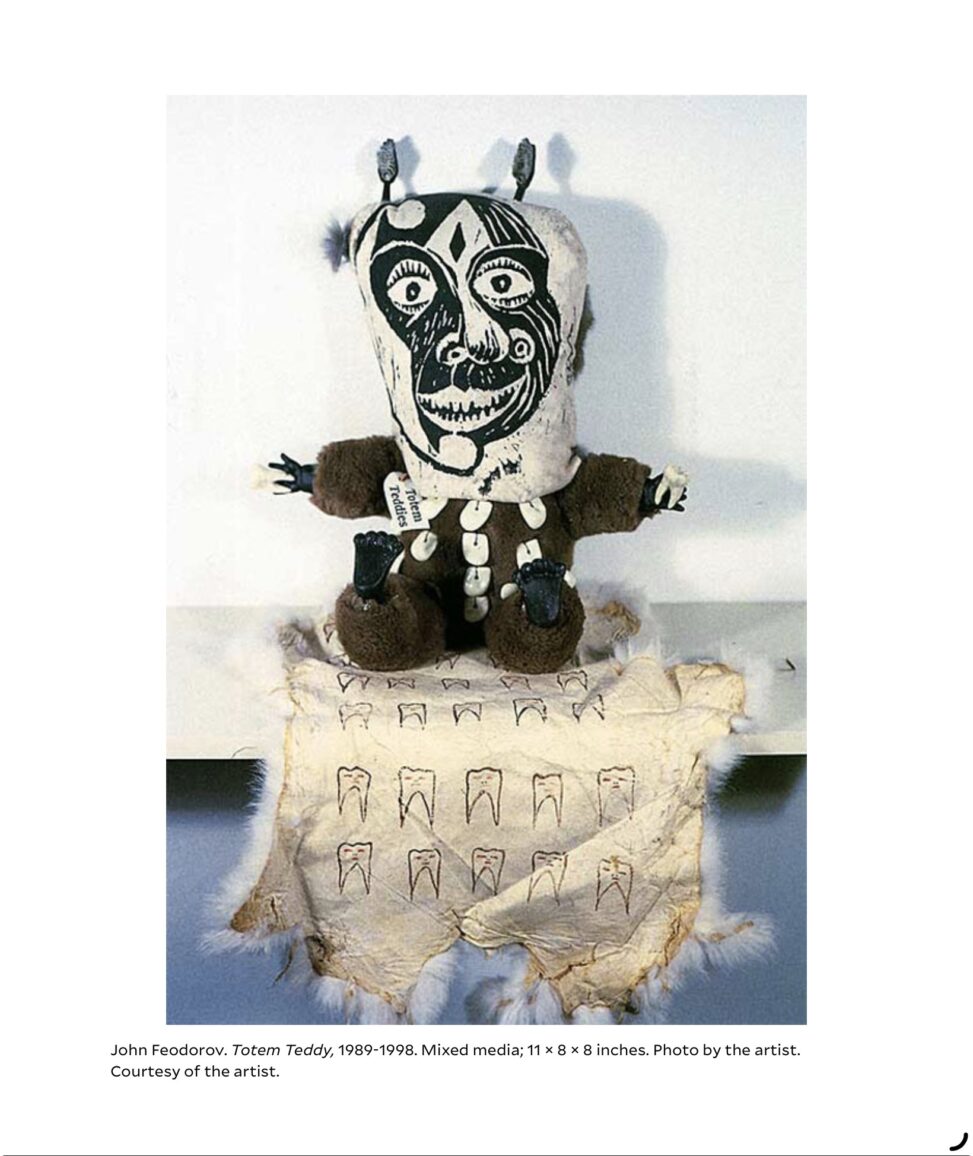
Contemporary Indigenous artist John Feodorov works on issues such as colonialism, identity, and the commercialization of Native culture. His mixed-media piece Totem Teddy offers a unique and sometimes unnerving interpretation on conventional totem forms. It initially appears to be a typical teddy bear, but upon closer inspection, you can find that it has patterns and symbolism related to Indigenous spirituality and culture.
This piece of art interacts with tradition in a nuanced way. By fusing mass-produced, Western childhood imagery with sacred cultural references, Feodorov alters and analyzes Indigenous artistic processes rather than merely maintaining them. The end product is a hybrid item that challenges the misinterpretation, appropriation, and commercialization of Indigenous culture. Feodorov has discussed in interviews how non-Indigenous audiences frequently reduce Indigenous culture to stereotypes and commercialized imagery. This issue is at the heart of Totem Teddy, where the toy like shape and retail tag represent how traditional emblems are transformed into commercially viable goods. Instead of portraying tradition as unchangeable or exclusively historical, Feodorov shows how modern consumer society reshapes and frequently distorts it. This essay contends that ,Feodorov ,not only upholds tradition but also questions and reinterprets it, illustrating the conflict that exists in the modern world between cultural identity, authenticity, and commercialization. Totem Teddy is a mixed media sculpture that resembles a tiny teddy animal. With its compact sitting position and silky brown limbs, the figure is reminiscent of a teddy bear. However, a mask like surface with striking black and white visual artwork covers its head. Large eyes, pointed teeth, and stylized patterns give the face an exaggerated, almost scary appearance. The teddy rests atop a pedestal adorned with repetitive tooth drawings and composed of stretched animal skin.
Traditional Indigenous materials are evoked by the use of animal hide, and the recurring tooth pattern lends a meaningful and rather frightening feel. Indigenous craft traditions are also referenced in little decorative features like feather like textures and bead like attachments.
Tension is created by the contrast between the powerful, almost spiritual mask and the cozy, comforting teddy bear. The teddy bear, which is frequently connected to coziness, childhood, and Western consumerism, is changed into something more nuanced and unclear. Despite being placed on a marketed item, the mask like visage conveys ceremonial or spiritual value. In general, the artwork combines modern, mass produced imagery with traditional materials and meanings. This contrast produces an eye catching work that challenges viewers to consider its cultural importance and meaning.
Traditional Indigenous totemic art frequently fulfills communal, cultural, and spiritual functions, especially in many Native American societies. Totems are more than just ornamental items they symbolize identity, ancestry, and connections to the natural and spiritual realms. A strong connection to the environment is emphasized by the frequent use of materials including wood, animal leather, feathers, and natural pigments.
In order to communicate stories, ancestry, or spiritual ideas, totemic shapes frequently include stylized human or animal motifs arranged vertically or metaphorically. These items are usually made in a cultural context that emphasizes community significance, tradition, and respect. They are meant to be significant cultural expressions rather than consumer goods. Teddy bears and other Western items, on the other hand, are mass-produced and connected to consumer culture. Rather than having spiritual value, they are made for comfort and amusement. Indigenous art forms run the risk of losing their cultural significance and turning into commodities when they are taken out of their original context and replicated or sold.
Feodorov purposefully references and modifies these features to make commentary on how Indigenous culture is viewed and consumed in modern society, therefore an understanding of this tradition is crucial to understanding his work.
By situating it within the framework of Western commercial society, Feodorov’s Totem Teddy questions traditional Indigenous art. He draws attention to the conflict between cultural authenticity and commercialization by fusing a mass-produced teddy bear with a sacred totemic style. How tradition evolves over time and in different circumstances is one crucial question. In this instance, Indigenous symbols are recreated inside a framework of contemporary art after being taken out of their native cultural context. This change has the potential to both maintain and undermine tradition. The artwork criticizes how Indigenous customs are frequently misinterpreted or trivialized while maintaining graphic allusions to Indigenous culture.
The piece’s hybridity, which combines Western and Indigenous elements, makes people uneasy.This discomfort is purposeful. It challenges viewers’ preconceptions about Indigenous art and makes them consider whether they regard it as strange, sacred, or merely beautiful. Furthermore, the audience is crucial in determining meaning. A viewer who is not familiar with Indigenous customs may find the art odd or ornamental, while someone who is knowledgeable with the culture may see its important message of identity and appropriation.
In the end, John Feodorov does not only uphold tradition rather, he modifies and challenges it, use modern art to highlight persistent cultural conflicts and promote more in depth contemplation.