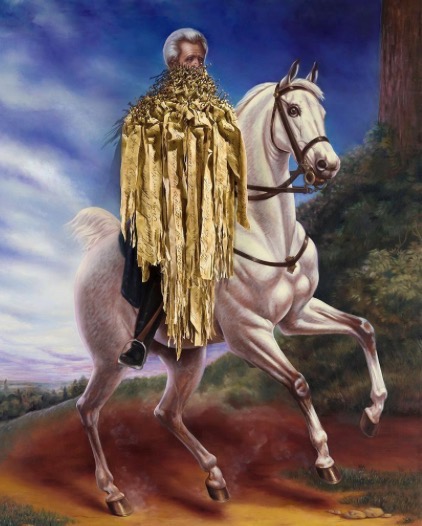
The Cost of Removal made in 2017, is a modified portrait which critiques American history. Titus Kaphar is a 50 yar old painter, sculptor, filmmaker, and installation artist who comes from an African American background. The Cost of Removal is based on “Andrew Jackson on Sam Patch” by Ralph Earl, which can be viewed at the Crystal Bridges Museum of American Art, Arkansas. The art piece critiques the agreement signed by Jackson that allowed the removal of Indigenous peoples from their lands and presidential portraitures impact on history. Today, Indigenous traditions of America are still practiced like, ceremonies, storytelling, and traditional dance and presidential partitures still happen. The Cost of Removal is a hybridized art piece, containing the following: visual context, historical context, documentation, and critique. Titus Kaphar uses Jackson Andrews’ words and handwriting in the art piece as evidence for his critique, including them in his art piece. Some critique has surrounded this art piece, as it can be seen as politically charged or forceful. But overall, Titus Kaphar has had good praise over this portrait.
Jackson Andrews is portrayed mounted on a horse during the day with nails mounted onto his face holding pieces of paper. The scenery, horse and body of Jackson Andrews are completely visible with his face covered from below the eyes. Titus Kaphar uses the medium of oil paint and mixed media within his portrait by using several materials. The portrait uses vibrant colors on the background and darker colors surrounding Andrews. Mostly, muted, and traditional colors such as white, black, and neutrals. Lots of shading surround the face and body of Andrews. The nails hold long white pieces of paper with text; they hold strong vertical and diagonal lines, which cut through the painting; disrupting it. Surrounding the long pieces of paper are softer and controlled lines. Lack of bright colors enables the paper to stand out on the canvas. The long pieces of paper protrude out of the portrait, becoming the focal point of the art piece. As the paper acts as a focal point, it guides the eyes up and down. The painting itself is smooth, while the layered materials are rough and raised. The scenery and Andrews allow the portrait to be naturalistic. Kaphar uses the portrait of Andrews to challenge and critique it, exposing what traditional portraits may leave out. Using conceptual critique Kafer can reference it while questioning the historical power of leaders.
The presidential portraiture is ongoing today. They are official portraits of U.S presidents used as documentation and representation. Historically, presidential portraits were commonly done with oil painting and canvases in the early and late 18th-19th centuries. Oil paints were chosen due to their longevity and clean look. Today, these portraits are still often done with oil and canvas, but the use of photography is more standard. The style used in presidential portraiture is naturalism and realism. The subject being painted was asked to pose formally in important or neutral settings. The direct goal of these portraits was to show authority, power, and stability. Culturally, these portraits were for history and as a visual of leadership. This allows nations to create memories and communicate values and ideas. The social context of these portraits only shows a selective version of history, leaving out impactful and crucial details.
Critical Analysis –
The evolvment of presidental portiraits is a good example of traditions moving geographically and through time. While it moves, things change but also stay the same. Oil painting and canvases are still used, but technology has allowed photography. When any tradition changes, it will adapt and get rearranged. Things like materials, appearances and techniques change but also meaning. Historically, presidential portraits had more influence on public perception. Today, I do not even know what Donald Trump’s portrait looks like. Hybridity keeps traditions alive by strengthening them when exposed to new contexts and audiences. This also allows new generations to become familiar with traditions, expanding cultural reach, and encouraging adaptation. Titus Kaphar is critiquing the heritage exposing the violence and harm associated with Andrews Indian Removal Act. Kaphar acknowledges the tradition, using it as his base to critique it. The meaning of the art piece is influenced by the knowledge of the audience on Jackson Andrews. Individuals who are not familiar with the Indian Removal Act miss the depth of the portrait. Other factors, besides knowledge on the topic, can influence meaning such as personal perspective, engagement with art, and subjective experiences.