Introduction
Rebecca Belmore (Anishinaabe/Ojibwe) is a Canadian interdisciplinary artist whose work focuses on Indigenous voice, land sovereignty, and decolonization. Her 1991 sculpture Ayum-ee-aawach Oomama-mowan: Speaking to Their Mother is a monumental wooden megaphone created in response to the Oka Crisis—a 1990 land dispute between the Mohawk people and the Canadian government. The work draws from Anishinaabe traditions of oral communication and relationality to the land, reimagining these practices through a contemporary, activist framework. Rather than simply continuing or preserving tradition, Belmore cross mixed Indigenous ecological and communicative traditions with modern protest art, using the megaphone as a tool to amplify marginalized voices and critique colonial erasure of Indigenous land rights. This hybrid form modern-traditional style lets the artwork carry on culture knowledge while also reimagining tradition in a bold new way to speak out and take part in today’s political fights.
Description of the Artwork
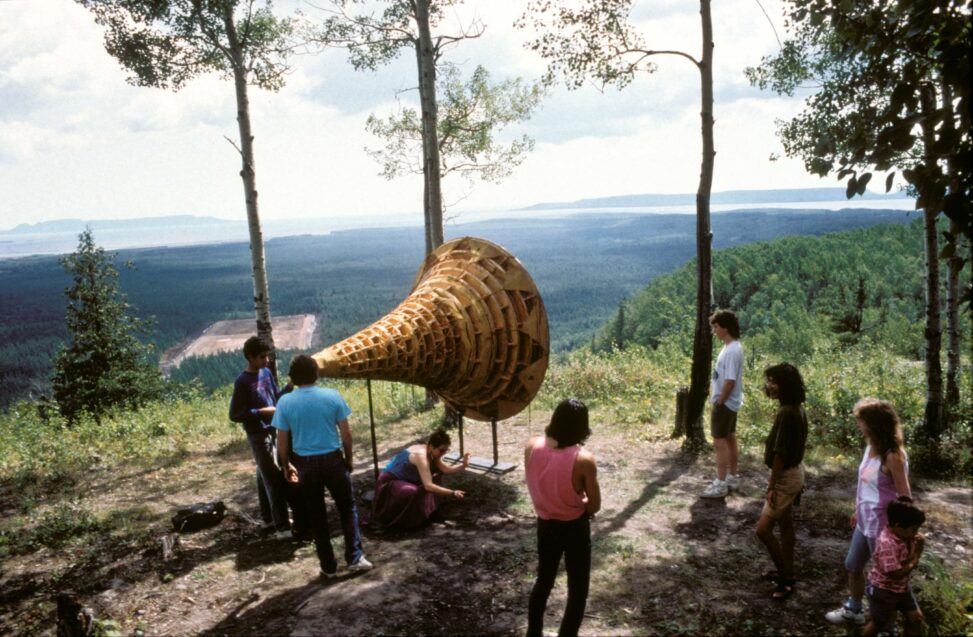
Ayum-ee-aawach Oomama-mowan is a site-specific mixed-media sculpture constructed primarily from layered wood, birch bark, and animal hide, shaped into a six-foot-wide conical megaphone. Its form echoes both traditional Indigenous horn instruments and colonial-era speaking trumpets, with a tapered mouthpiece and a flared bell directed toward the landscape. The sculpture is installed outdoors, anchored to the earth with metal supports, and positioned toward expansive wilderness area such as the boreal forest and Lake Superior visible in the photograph, reflecting the Anishinaabe understanding of the land as a living, interconnected entity.
Visually, the layered wooden structure evokes the texture of birch bark, a material central to Anishinaabe craft and shelter (wiigwaams). The megaphone’s scale and orientation transform it from a passive object into an interactive medium: Belmore invited Indigenous communities to speak into it, directing their voices toward the land as a form of ceremonial address and political protest. This interactive component reinterprets the sculpture as a living performance piece, rather than just a merely static object. Unlike traditional oral practices that circulate within small community circles, the megaphone projects voices across vast distances, blending intimate cultural expression with public, activist speech. Belmore’s engagement with tradition is both formal and conceptual: the conical shape echoes signalling horns used by Anishinaabe communities, while the wooden lattice mirrors wigwam architecture, grounding the work in Indigenous material knowledge.
Critical Analysis
Belmore’s hybrid approach both redefines and strengthens Anishinaabe tradition, challenging colonial power structures while upholding ancestral knowledge and wisdom.
When the work moves geographically—from Banff’s Rocky Mountains to sites near Lake Superior—the tradition adapts to new landscapes, its acoustic resonance shifting with each ecosystem. This mobility transforms a localized, community-bound practice into a transnational act of Indigenous solidarity, amplifying land sovereignty struggles across Canada. Temporally, the work reanimates a tradition fractured by colonial violence: where residential schools silenced Indigenous voices, Belmore’s megaphone amplifies them, turning historical trauma into a forward-facing act of resistance.
Hybridity strengthens the tradition by expanding its cultural and political purpose. The nested plastic megaphone within the wooden structure bridges Indigenous craft and modern technology, allowing the work to resonate with both Indigenous communities and mainstream audiences. This fusion does not weaken cultural knowledge but instead, it makes tradition relevant to 20th-century colonial struggles, positioning oral communication as a tool of political sovereignty rather than just cultural preservation. Belmore’s practice goes beyond simple heritage conservation, she is critiquing colonial erasure by reimagining tradition as a living, activist practice that demands recognition of Indigenous land rights and voices.