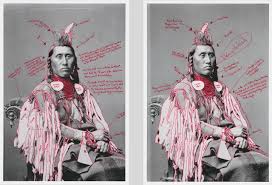
Wendy Red Star’s 1880 Crow Peace Delegation is a series of photographs originally taken by a non-Indigenous photographer. Red Star then annotates these photographs in bright red ink; she identifies the individuals, their clothing, cultural objects and important historical context that lies within these photographs. The Crow delegation included 9 Crow chiefs and 3 of their wives, the delegation traveled to Washington from Montana conducting business about the traditional Crow territory, which ultimately lead to the cessation of the Crow lands to the government.
This artwork both critiques and reimagines the original photography of the 1880 Crow Peace Delegation. While Red Star does preserve the portraits, annotations challenge the original authority and restore the cultural knowledge that was excluded from the initial portraits. By the arrows, notes and outlinings Red Star adds to these photographs, she takes back control over how the Crow history is viewed and reveals the culture behind these portraits. The 1880 Crow Peace Delegation is ultimately a hybridized series. The way Red Star mixes traditional photography with contemporary art interventions, she transforms the colonial original documents into are focused on Indigenous knowledge and history.
Red Star’s 1880 Crow Peace Delegation series combines historical portraits with contemporary interventions. The series is created by the use of black and white studio portraits of Crow chiefs. Red Star then uses these photographs and overlays them with bright red ink. Where she then annotates, outlines and marks up the portraits by hand with the red ink. The red ink adds emphasis to the cultural clothing and accessories worn by these leaders, as well as, contextual information. By adding this bright red ink, it creates visual contrast between the black and white photographs and the contemporary additional elements.
Visually, these portraits show Indigenous leaders sitting in a formal studio setting. The chiefs wore traditional Crow clothing, including headdresses and beaded accessories. With being seated in a composed position with a neutral back drop reflecting the traditional 19th century photography made by non Indigenous photographers. Producing an overall monochrome portrait. Red Star’s red markings draw attention to the elements of clothing, hairstyles and accessories. Additionally highlighting inaccuracies in the original documentation. The annotations guide the view throughout the image allowing for an in-depth reading of the portraits.
This work engages directly with the historical traditions on photography that were used to document Indigenous peoples. Instead of showcasing direct archived photographs, Red Star reinvents it as her own. Red Star’s annotations challenge the colonial perspective which the original portraits interpreted. By adding Indigenous knowledge, culture and comments, Red Star reclaims the traditional history of these portraits. This approach works as both a direct reference and conceptual critique of tradition that positioned indigenous peoples as objects to study. By combining the original photographs with contemporary commentary, Red Star transitioned these
portraits into a historical document of Indigenous perspectives.
The Apsáalooke, meaning “children of the large beaked bird” or Crow people, traditionally lived around buffalo and horses. From there, they made food, clothing, robes, tepee covers, sinew thread, containers, and shields. (Encyclopedia Britannica, September 7, 2024.). Red Stars 1880 Crow Peace Delegation was created in 2014 from when in 1880 the Crow chiefs were delegates to Washington, D.C., to discuss a U.S. government proposal to build a rail line on Apsáalooke territory (Encyclopedia Britannica, June 23, 2025.). The chiefs were positioned sitting in studio environments with controlled lighting and neutral backdrops. They were wearing traditional clothing with feathered head dresses and beaded accessories. The photography arranged these elements for the convenience of western photography rather than how the Indigenous peoples would traditionally be photographed. Resulting in images that presented indigenous peoples through the colonial lens which emphasized difference.
The cultural purpose behind these photographs differs depending on who is viewing. For non indigenous audiences, the original photographs were documentation to show indigenous culture that settlers believed were diminishing. Along with capturing political meetings between the Crow peoples and government officials, like during the peace delegation. These photographs were shown in museums, historical and government archives. By having these portraits be taken by non Indigenous people, it can be seen as a political, colonial power dynamic. Even though these photographs show indigenous individuals and their culturally significant clothing, they exclude indigenous perspectives, changing perspectives of how non indigenous audiences see this work.
Wendy Red Star’s 1880 Crow Peace Delegation does a great job at both preserving and critiquing the meaning behind the original documentation. By reusing the archived photographs of the Crow chiefs, she is preserving the historic events of the delegation meeting that took place in Washington. While at the same she critiques the way we view this work. By marking up the portraits, Red Star takes away the colonial perspective and challenges authority. The handwritten bright red annotations strongly change how we look at the portraits. Red Star adds indigenous cultural context and information back into these photographs. Allowing for the viewers to gain a deeper understanding of how indigenous voices are skewed through the western colonial lens.
The change in audience plays a major role in how the meaning of these portraits are changed and perceived. For audiences familiar in contemporary art, they may recognize these governmental archived photographs and notice how Red Star’s annotations challenge the authority of the original images. For non Indigenous viewers, they may take the time to reflect on how western art and records emphasize certain aspects in history. While Indigenous audiences may notice this work and a voice reclaiming what perspectives were changed in the original colonial work.