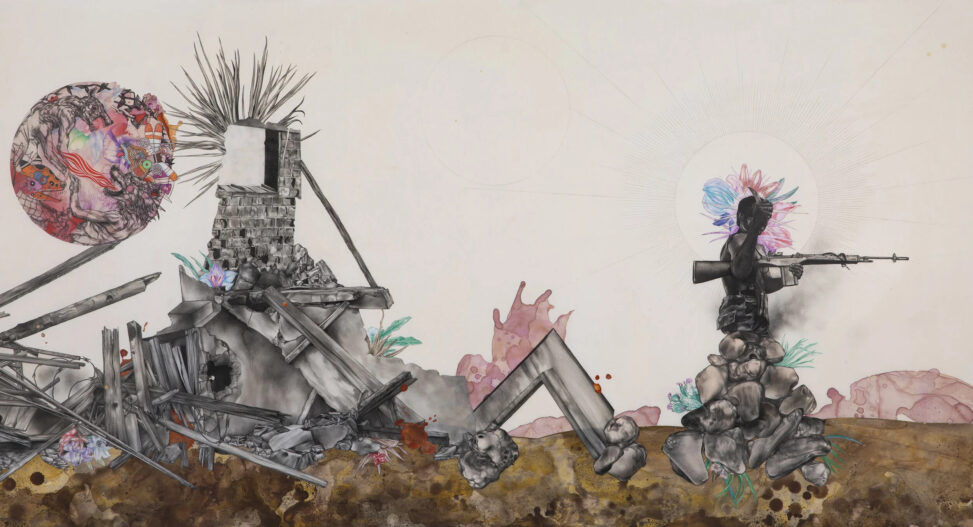
Ruins (2020)
Osvaldo Ramirez Castillo is a Salvadoran-Canadian artist whose work uses elements from the ancient visual language of the Americas to depict scenes that embody the heavy historical trauma caused by the Salvadoran Civil War. His approach in pieces like the one showcased here, Ruins (2020), reference aspects of the Mesoamerican codex tradition, a system used by Indigenous groups such as the Maya and Aztec to spread stories, combining this with more modern religious iconography.
Through the hybridization of these traditional elements with contemporary religious and military imagery, Castillo maintains the tradition alive by giving it a new purpose heavy on meaning, transforming codex into a way to deliver poignant political critique. Through a method of the past, he showcases a distorted and tragic present, exposing viewers to distressing events they have been kept away from, and taking away the glory and beauty from modern depictions of conflict and state-sanctioned violence. Castillo’s art preserves his cultural heritage while also using the artistic technique in a new way, bringing light and focus to the suffering of his people and the tragic deterioration and shattering of their shared national identity.
Ruins (2020) spreads across mylar, a see-through polyester surface that adds depth when parts are drawn beneath. Painted at the rear, some layers show through faintly, built using colored pencil alongside acrylic ink, with touches of conté and charcoal woven in. The piece was made using colored pencils, acrylic ink, conté, charcoal and oil paint. It was also made in a horizontal 27.5’’ x 78’’ canvas, giving the spectator a large area to explore.
A broken building sits on the far side, likely the ruin named in the title, boxed in by fallen beams and scattered bits. Above it floats a round shape – bright, tight, almost glowing – with swirls of wild figures crammed inside, drawn sharp in hot pink and deep red This shape seems reminiscent of the Sun Stone, a common element on indigenous cosmological diagrams.
To the right we find the focal point of the piece, shown through the piece itself and through the very intentional choice of using this part as the element centered on the thumbnails for the online gallery for the artist: a dark silhouetted soldier, standing atop a big pile of grey stones. This soldier is shown gripping a military-style firearm, a crude symbol that contrasts with the floral pattern decorating their shape behind their head. This pattern, surrounding a white ciruclar shape, seems reminiscent of a halo or headdress made with colorful petals. Thin, radiating lines surround this floral pattern, giving it a look similar to that of a sun, but made with white instead of yellow.
The picture’s landscape is desolate, empty aside from the elements previously mentioned. Its tone is muted through the use of earthy brown washes of ink that look not too dissimilar to dirt or dried out blood. These colors contrast heavily with the neon-bright floral elements of the piece and detailed lines of the charcoal-drawn figure, guiding the viewer’s eyes to these details.
The main tradition referenced on this piece is that of the Mesoamerican Codex, which used to be folding books made of bark paper and deer skin, mainly used by the Mixtec and Maya as a way to record different important cultural aspects, such as ancient versions of genealogical trees, historical events of profound importance, and tales related to their cosmological religious views and prophecies, all depicted through the use of pictograms and symbols instead of their own alphabet.
The main characteristics of the tradition is the very purposeful use of a flat perspective, the emphasis of detail contrasted by bold outlines and the depiction of present and future events as concurrent and connected to each other. This is made easier to follow through the common use of a zig-zag pattern for their sequence of events and by the occasional implementation of speech scrolls, curled lines emanating from a figure’s mouth to indicate voice.
Socially and religiously speaking, codices were sacred tools, used to study the stars for possible divinations and guidance. They were to be read and used only by elite scribes to maintain order, which made them a target during the Spanish Conquest, where a big portion of them were dispossessed and burned. By adopting an almost extinct style, one that was victim to a form of external state violence, Castillo transforms this lost style of sacred archive as a piece of media to serve as witness to the contemporary trauma of the Salvadoran people, particularly the trauma originated from the Civil War.
Castillo’s work shows how hybridity can drastically destabilize tradition while still preserving its main essence and honor it through a new purpose. The main purpose of the Mesoamerican pictorial style was that of a sacred tool, of exhibiting the myth of gods, great heroic displays and the mysticism of the stars, Castillo uses his version of the style to record the ugly nature of events he lived, of trauma and of lives that have been forgotten and deemed as disposable.
It is only through the change in perspective and focus that the style sees new light, especially after being practically wiped off the map by the Spanish colonial efforts in the 16th century. Focusing on the perspective of the Salvadoran people recontextualizes the style from a local historical and religious record to a piece of commentary on the idea of displacement, still working as a record of something meaningful nonetheless. This new purpose still makes the viewer look at things beyond what is depicted, it makes one think about the meaning and understand layers that need to be seen. In this particular piece, we can see this through the depictions of the ruins and of the strange object floating on the left side of the piece. Through symbols and pictograms, Castillo presents ruins not only as a physical space, but as a state for people living through this, as a shattered psyche victim to violence and chaos.
This shift in perspective and focus does indeed change a big part of the tradition, but it also allows it to be preserved in a new way, it is still about recording something, about exhibiting something that needs to be seen, something that doesn’t need to use words and that can go beyond just that to depict more abstract concepts. This preservation does come with some critique to it too though, that against the depictions of violence and of those in charge. It purposefully turns away from heroes of old, from divinity and from bloodlines to focus on the suffering of the people, which many ignore. A glowing sphere, usually reserved for saints or gods, frames a dark figure gripping a military weapon. Peace symbols linked to war tools making belief wobble. The image does not just show history; it questions what gets honored within it. Meaning cracks open where opposites collide.