Introduction
Fred Wilson was born in the Bronx, New York, in 1954. Although he earned his BFA from SUNY purchase in 1976, he was the only Black student in his class. He is known as a conceptual artist who focuses on challenges of history, culture, race, and conventions through his art. Especially, Mining Museum (1992) was an essential exhibition that brought attention to his work. This artwork critiques and reinterprets historical traditions of racial power and violence rather than preserving them. His objects exposed cultural and racial hierarchies and emphasized the history of slavery in America. While racial segregation has been abolished by law, discrimination against African American still exists in the United States. After the civil rights movement from 1954 to 1968, laws were passed to end segregation, secure voting rights, and expanding economic opportunity. On the other hand, one-third of blacks have experienced discrimination, for example, in employment, police interactions, and microaggressions. Thus, even though the government enforces laws and society continues to argue for equality, stereotypes do not disappear immediately. Additionally, people should not forget the history of slavery to avoid repeating the same mistakes.
Description of the Artwork
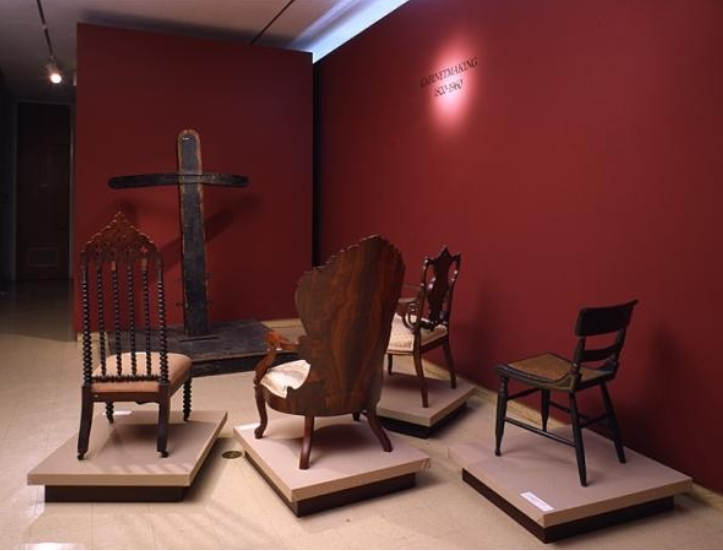
An artwork, the whipping post and chairs, exhibited in Mining the Museum, is made of wood. The whipping post is a historical structure used for punishment, where individuals were tied and publicly flogged in front of others. This artwork was displayed within the museum space. Wilson used historical museum objects, literally “mining” them and repurposing them as art. There are four different types of chairs in front of the whipping post. The whipping post is black, with some parts of the wood peeling. All antique chairs face the whipping post and are brown in color. The leftmost chair has a high, striped backrest, and the chair’s legs are short, placing it close to the ground. The second chair from the left is the largest, also with a high backrest and low legs. However, this chair has armrest, and no striped pattern. The rightmost chair has longer legs than the others and a curved design on the backrest. The fourth chair is located behind the other three. It is the smallest, with a high backrest but no cushion or armrest. These objects represent conceptual critiques. It evokes moments in history when people were punished using such structures, exposing hidden or overlooked power dynamics from the past. In addition to that, this display encourages viewers to reflect on history and cultural memory. Although these objects were never used on slaves in the past, the arrangement is enough to help viewers image how slaves were treated.
Description of the Tradition
Wilson used antique chairs for this artwork, all made of wood. He used real, historical furniture. Two of the chairs have armrests and all chairs have backrests. Especially, the chair locating center resembles a small throne due to its large backrest. These chairs represent the social hierarchy between slaves and those who controlled slaves. The audience seems “wealthier” as they are closer to the whipping post because the front three chairs appear more gorgeous and elegant than the chair positioned slightly behind them. The whipping post itself was built around 1885 but was never used on slaves. The artwork was displayed in a museum which the artist held, making it a conceptual and institutional critique. Wilson focuses on ideas and meaning of this art instead of visual enjoyment. Especially, the artwork represents history, power, and race. Its cultural purpose is to tell the story of slavery in America, reminding viewers of this terrible history and leads to removing discrimination against black people. In addition to, the whipping post and chairs prompt the audience to image how black people were treated and punished unfairly by white people, and the richness of the chairs symbolizes the social and economic status of those who watched.
Critical Analysis
If the tradition of protecting black people from discrimination spreads geographically, prejudice could gradually decrease worldwide, and societies may become more accepting of cultural and looking differences than present societies in many countries. Passing this tradition to future generations ensures that people remember this horrible history and prevents similar injustices from recurring. Because people can learn from the horrors of slavery, Wilson’s work tries to protect from stereotypes of black race who have a history of slavery. So, he is against inequality of races, history, and cultures through his arts. When audiences view the art in the museum, some who have experienced prejudice may gain courage while others who hold biases may reconsider their beliefs. This art affects both those who have treated someone with having prejudice and those who have not. Its visual power encourages reflection and understanding. At first, viewers might feel sadness or discomfort, but these emotions are essential to remembering history. Although this is not an artwork that people can enjoy visually and say beautiful or gorgeous, it conveys important messages and real stories. Those who realize this message are likely to share it with others, allowing the artwork’s significance to continue through time and across regions.