Introduction
Margaret Nazon is a contemporary Indigenous bead artist from the Gwich’in First Nation in northern Canada. Her work was featured in the exhibition Radical Stitch, one of the most significant showcases of contemporary Indigenous beadwork in North America. This exhibition highlights how beadwork connects traditional knowledge with contemporary artistic practices, emphasizing its role in storytelling, cultural continuity, and resistance.
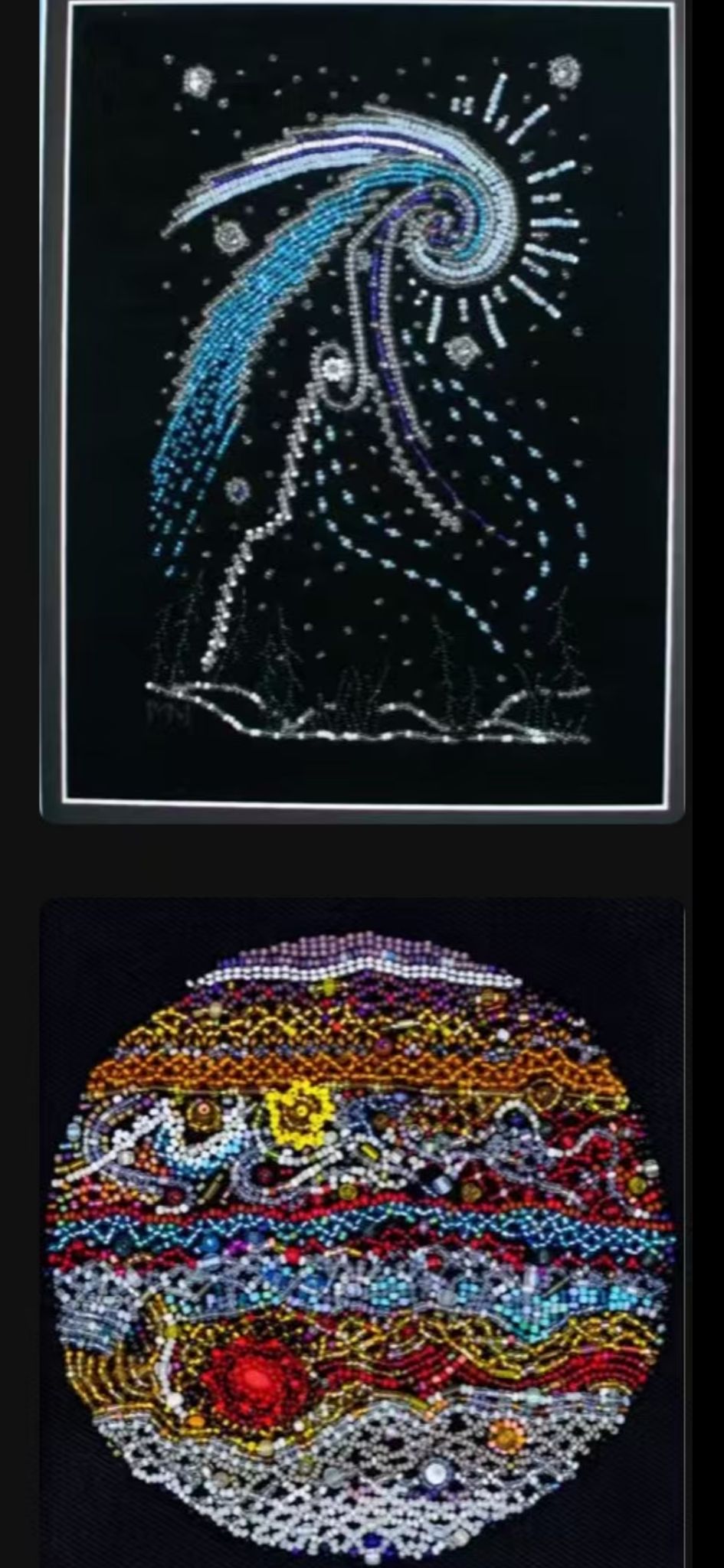
Nazon’s works, such as Milky Way Spiral Galaxy and Milky Way Starry Night, reinterpret traditional beadwork through cosmic imagery. Rather than using beadwork solely for clothing or decoration, she transforms it into conceptual visual art displayed in gallery spaces.
This essay argues that Nazon’s work hybridizes tradition by preserving Indigenous beading techniques while transforming their meaning and function. Her work both honors cultural heritage and challenges traditional boundaries, demonstrating that Indigenous beadwork is not static but evolving in response to contemporary contexts.
Description of the Artwork
The artworks presented by Margaret Nazon are composed of thousands of small, brightly colored beads arranged on dark backgrounds. One of the key works, Milky Way Spiral Galaxy, depicts a swirling, luminous form resembling a galaxy. The composition radiates outward, with white and blue beads forming a spiral that suggests motion and energy. Small bead clusters scattered around the central form resemble stars, creating a sense of depth and cosmic space.
Another work, Milky Way Starry Night, presents a circular composition filled with dense patterns of red, yellow, blue, and white beads. The circular format resembles a planet or celestial body, with layered bands suggesting landscapes or cosmic layers. The use of symmetry and repetition creates rhythm, while variations in color and density produce a dynamic visual texture.
Unlike traditional beadwork that is worn or used, these pieces are framed and displayed like paintings. This shift in format changes how the viewer engages with the work. The beadwork becomes an image to be observed rather than an object to be used. The tactile quality remains important, as beadwork emphasizes texture and material presence, but it is now experienced visually within a gallery context.
Description of the Tradition
Indigenous beadwork has long been an important cultural practice across North America. Traditionally, it was used to decorate clothing, tools, and ceremonial items, serving both functional and symbolic purposes. Before the introduction of glass beads, Indigenous peoples used materials such as shells, bone, and porcupine quills.
Beadwork often features floral patterns, geometric designs, and symbolic imagery connected to land, community, and spirituality. These patterns are not purely decorative; they carry cultural meanings and are passed down through generations. The process of beading is also significant, as it represents knowledge transmission, patience, and community relationships.
Historically, beadwork was embedded in everyday life rather than displayed in galleries. It was worn on garments, used in ceremonies, and connected to identity and belonging. It also served as a form of storytelling and cultural preservation.
However, beadwork has also been shaped by colonial history. At times, Indigenous cultural practices were restricted or suppressed, yet artists continued these traditions as acts of resistance. This history adds deeper meaning to contemporary beadwork practices.
Critical Analysis
When Indigenous beadwork moves from traditional contexts into contemporary art spaces, its meaning shifts significantly. In Nazon’s work, beadwork is no longer tied to clothing or daily use but becomes a medium for conceptual and visual exploration. This transformation reflects a broader trend highlighted in Radical Stitch, where artists use beadwork to connect past traditions with present concerns, including identity and decolonization.
Hybridity in Nazon’s work strengthens the tradition rather than weakening it. By combining traditional techniques with new subject matter—such as cosmic imagery—she expands the possibilities of beadwork. Her work demonstrates that tradition can evolve while maintaining cultural integrity.
At the same time, the shift in audience plays a crucial role. Traditional beadwork was created within Indigenous communities, where its meanings were widely understood. In contrast, gallery audiences may interpret these works differently, focusing more on aesthetics or abstraction. This change can both broaden appreciation and risk disconnecting the work from its cultural context.
Ultimately, Nazon’s work both preserves and challenges tradition. It preserves technique and cultural knowledge while redefining how beadwork is seen and understood. As emphasized by the exhibition, contemporary beadwork is not only an artistic practice but also a form of cultural resilience and innovation.