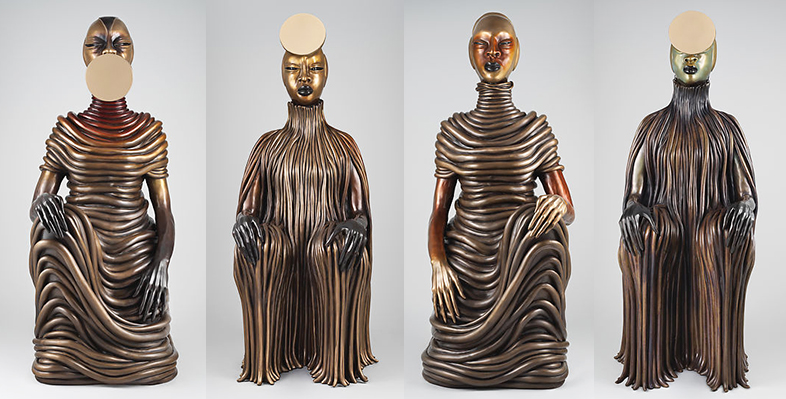
Wangechi Mutu explores themes of feminism in her statue collection “The NewOnes, will free Us.” In this collection she references both Greek architecture as well as African statues particularly those that depict women.The women in African sculpture are often sitting or kneeling, often bare and tend to hold something such as holding up a seat or a child. These seems Mutu found were repetitive throughout the history of women in sculpture and architecture. She critiques the original contents of the architecture and statues by going against what they represent. Mutu combines aspects of greek architecture with african sculpture and culture, she reimagines those same depictions of women in a more powerful pose and clothing. Mutu mainly does this by giving these women items that signaled status and having them free of the weight of holding something up, this criticizes the way we have both viewed and depicted women throughout the history of sculpture.
The 4 statues part of “The NewOnes, will free Us” are designed to look like women with normal human features without hair. The women have large black lips and narrow black eyes. The hands of the figures are long, featuring longer fingers. Each of the figures is clothed in a dress made up of overlapping 3D stripes going fully around the body, 2 of the women have dresses that the stripes are vertical rather than horizontal. The overall style of the piece is heavily inspired by african sculpture, with the only exception being the dressing taking slight inspiration from greek architecture. The women each have a shiny reflective plate visible somewhere on the front of the head with only one of the figures having it on the back, One sculpture has it covering her mouth, another covering her eyes, one above the eyes on the forehead and the 4th has it near the top of the back of her head like a bun. Each figure is posed in either a sitting or kneeling position. The two sitting women have their hands on their knees and backs straight as the two kneeling statues have one hand on the forward knee and the other off to the side. Each of these Women face completely forward with their head in a proper straight position.
The Women are made up of a shiny bronze metallic material. The sculpture’s reflective plates are african lip rings, which are a symbol of a women’s status in African culture. These rings let the viewer know these women are women of importance and wealth. The rings are reflective like mirrors, The statue with the ring on the back reflectivity cannot be seen due to it’s place ment but the other 3 call all be seen. Each of the front facing rings also share a common trait of each being in place of important parts of the human body: mouth, eyes and brain. The statues could be read as one sees the world as it is, one speaks on how the world is and one contemplates how the world is while the last one may be fully rejecting the world as is. This could be more connected to each other as part of a process. They saw how women were depicted in sculpture to begin with, they thought about it, rejected it and now speak out about it by critiquing them by existing. The style of the piece is overwhelmingly African sculption which makes the clothing appear a lot more important as the majority of women in African sculpture are depicted without clothing. In Mutu’s sculptures here each and every one of her sculptures are modestly covered from the top of their necks to the ground.
The artist appears to be criticizing heritage while keeping parts of the style, Mainly just criticizing the way women have been depicted in sculpture historically. The hybridity of the piece is subtle but effective as using clothing partly inspired by greek architecture, by covering the women they appear more respectable and powerful. There have been many respectful interactions of the nude form but for this piece it makes more sense for the women to be covered to help push status and avoid sexualization as well as pushing women down. Part of the tradition has remained, the sitting of kneeling position however in this case they are completely different in how the poses are constructed. The kneeling is more similar to a knight kneeling rather than submission and the sitting pose is more strong, more powerful like a king on a throne. These poses as well as clothing are extremely important as they are the only indicators of status and power that someone detached or obvious to the african culture to understand these women are meant to be women of status or power. Without those indicators depending on the culture, knowledge or background of the viewer the understanding of the statues may shift. The Statues with all their signifiers may still be quickly dismissed by an audience not taking time to look thoughtfully into the poses, clothing and reflective rings but a majority of the audience who takes take to view the statues should be able to come to some conclusion that these are women of status, power or great importance. The audience who would best understand these pieces are those who have knowledge of African statues as well as African lip rings.