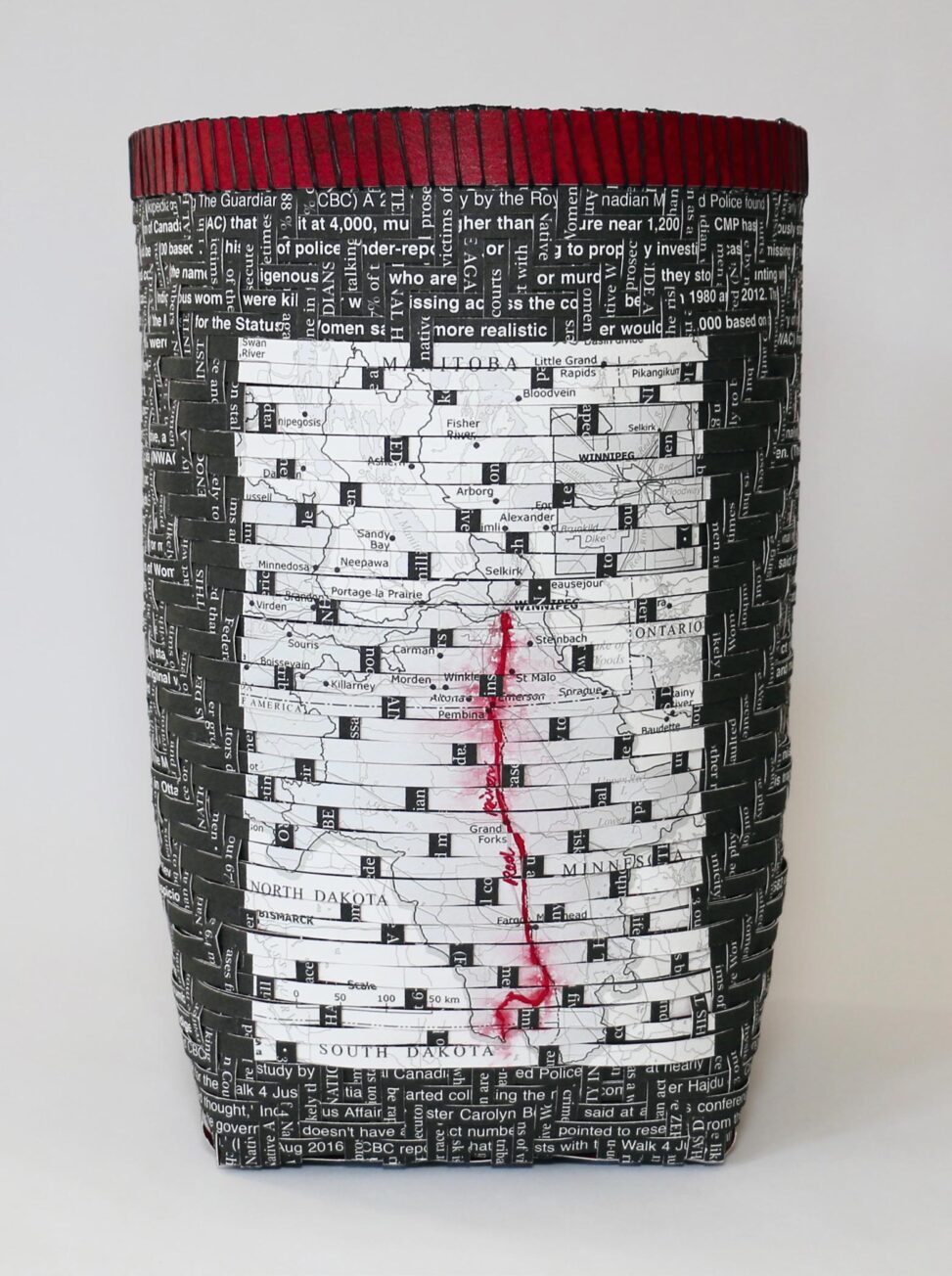
This is a Cherokee-style single-woven basket called ‘This River Runs Red’, created by Shan Goshorn in 2018, that blends traditional Indigenous craft with contemporary social issues. Goshorn, an artist of Eastern Band Cherokee descent, was known for using traditional basket-weaving techniques while incorporating modern materials like paper. Basket weaving has long been an important cultural practice for Cherokee communities. When the baskets are finished, they are used not only for functional purposes but also for storytelling and passing knowledge across generations. Goshorn transforms this tradition by weaving together non-traditional materials that help her discuss violence against Indigenous women. In doing so, she both continues and critiques tradition, maintaining the form and technique of the Cherokee basket weaving while reimagining it as a powerful medium for political and social awareness. Through this hybrid approach, this basket demonstrates how Indigenous artistic traditions can be shaped by artists to address contemporary injustices while still honouring cultural practices.
Goshorn used watercolour paper splints printed with archival inks, acrylic paint, and artificial sinew (strong, flat, waxed synthetic cord) woven into the traditional pattern called “Water”. The basket maintains the recognizable form and technique of Cherokee basketry while incorporating contemporary printed materials. Through this approach, Goshorn directly references Cherokee weaving traditions whilst implementing modern visual content, presenting information about violence against Indigenous women through the basket’s structure and surface. The woven strips form a layered surface revealing fragments of words, numbers, and map imagery.
As viewers observe the object, different text and map details emerge through the weaving. The vertical splints are printed with high statistics regarding violence directed toward Indigenous women in the U.S., while the horizontal splints compile discrepancies while gathering similar numbers in Canada. The interior splints are printed with names and tribes of 306 murdered and missing Indigenous women, which have been dismissed as ‘solved’ by the RCMP. On the front of the basket, we see a map, lined in red, which depicts The Red River, which runs through Winnipeg, Canada, to South Dakota and is unfortunately known as a place where bodies of Indigenous women are commonly found. The red splints on the interior of the basket create a strong visual contrast with the black-and-white splints woven throughout the exterior. This colour difference makes the inside of the basket visually distinct from the outside and directs attention toward the interior splints where the names are printed. When viewed from above, the basket’s cylindrical shape allows the audience to see the red interior surface and the printed text simultaneously.
The Cherokee people have been creating rivercane baskets for thousands of years (Cherokee Traditions | Arts and Crafts | Pattern Index). These baskets are traditionally made from River cane, which is harvested, split into thin strips, and smoothed to create flexible splints that can be woven together. Cherokee baskets are commonly made using either a single-weave or double-weave technique, in which vertical and horizontal splints cross over and under one another to form a tightly structured surface (Basket Weaving – Portal to the Past). The woven strips create repeating geometric patterns that wrap around the body of the basket
Historically, weaving patterns did not have names, instead, basket makers described them according to the structure of the weave itself, such as “over-five-under-five” (Cherokee Traditions | Arts and Crafts | Pattern Index). Over time, many patterns began to receive descriptive names based on their visual appearance, including Casket and Cross-on-a-Hill (Cherokee Traditions | Arts and Crafts | Pattern Index). Baskets were historically used for harvesting, storing, and transporting crops, catching fish, and playing games. They also had ceremonial purposes, protecting ritual tools and clothing in storage (Museum of Anthropology 2024). Basket weaving knowledge has historically been passed down between generations, often from mothers to daughters, preserving both the technical skills and the cultural knowledge associated with the craft (Museum of Anthropology 2024).
Hybridity can definitely strengthen traditions by allowing them to adapt to contemporary contexts while maintaining their core forms and techniques. When creating ‘The River Runs Red’, Goshorn combined traditional basket-weaving techniques with modern materials such as watercolour paper splints. While the structure and weaving pattern remain consistent with Cherokee weaving practices, the materials introduce contemporary information related to violence against Indigenous women. This combination allows the traditional form to communicate present-day social issues while still directly referencing cultural practices. In Goshorn’s work, hybridity does not replace the tradition but extends its capacity to convey meaning within modern society.
In the same way that Goshorn uses hybridity to strengthen tradition, she also preserves pieces of Cherokee history through her artwork. Her baskets maintain recognizable structure, weaving technique, and pattern associated with traditional baskets. Although the materials differ from the river cane traditionally used to make baskets, the weaving method and overall form remain consistent with Cherokee practices. By using these technical aspects, the artwork maintains the visual and structural characteristics of Cherokee baskets, demonstrating how the tradition can be preserved even when new materials or subject matter are incorporated. Through this balance of traditional techniques and adaptation, Goshorn ensures that the Cherokee basket-weaving heritage is both honoured and made relevant for contemporary audiences.