Introduction
Titus Kaphar, born in 1976 in Kalamazoo, Michigan, is a contemporary American sculptor, painter, and installation artist whose entire practice is grounded in a single compelling tension: he learns the visual language of Western art history with enough mastery to then turn it against itself. His 2017 public sculpture Impressions of Liberty, commissioned by the Princeton University Art Museum as part of the Princeton and Slavery Project, takes direct aim at the tradition of the American commemorative monument. This is a tradition that has spent centuries honoring founding fathers in stone and bronze while leaving entirely invisible the enslaved people who lived, worked, and suffered in the same spaces those monuments now occupy. The work places a monumental bust of Reverend Samuel Finley, the fifth president of Princeton University, carved in negative relief into a block of sycamore wood, alongside life-sized glass portraits of an African American man, woman, and child who represent the enslaved people sold from Maclean House after Finley’s death in 1766. This essay argues that Kaphar is not preserving this tradition, nor simply reimagining it. He is critiquing it at its foundation, using the monument’s own formal logic as the instrument of that critique, in order to expose what the tradition was always built to hide.
Description of the Artwork
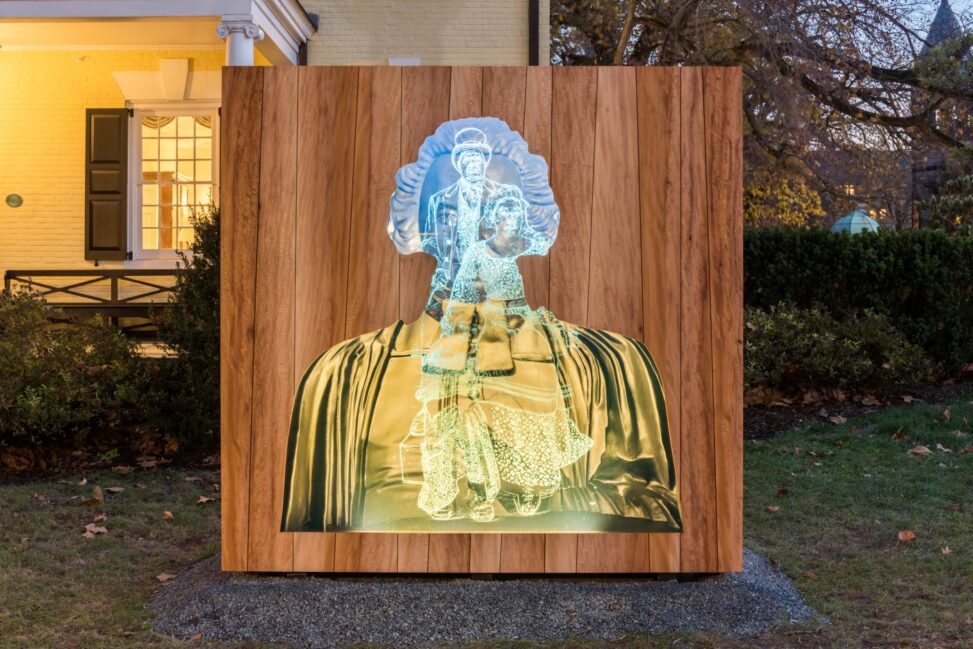
Impressions of Liberty stands approximately eight feet tall and is made from American sycamore wood, etched glass, sculpting foam, graphite, and LED lighting. The choice of materials is not incidental. Where traditional monuments reach for marble or bronze to signal permanence and authority, Kaphar builds with warm sycamore planks arranged vertically in a broad grid panel, something closer in feeling to the walls of a house or the planks of a floor than to the cold grandeur of a civic pedestal.
Into this wooden structure, Kaphar has carved the bust of Samuel Finley in negative relief. The figure does not project outward as monuments typically do. Instead, it recedes inward as a cavity, a hollow coated in graphite that gives it a dark and shadowed quality. The absence is clearly intentional and formally precise. Laid over this carved void is a large etched glass panel, backlit by LED lights, on which three figures are rendered in fine delicate linework: a man, a woman, and a child in the period dress of eighteenth century domestic servants. In the upper portion of the sculpture they glow in cool blue and white tones, and toward the base the light warms into amber and gold. Because the figures are translucent rather than opaque, the hollow bust of Finley remains visible through and beneath them at the same time. He is there but empty. They are there but luminous.
This layering is the conceptual heart of the work. Every formal convention of the commemorative monument, the centralized subject, the elevated position, the permanence of material, has been deliberately reversed. The title itself carries this reversal. Impressions of Liberty refers at once to the physical impression carved into the wood and to the sycamore trees that Finley himself planted on the Princeton campus, trees that were called Liberty Trees in celebration of the repeal of the Stamp Act, and which now, Kaphar observed, can no longer hold their own weight without steel supports hidden inside them.
Description of the Tradition
The tradition Kaphar is working against is the Western commemorative monument, and particularly the American version of it that flourished from the late eighteenth century onward. This tradition drew its visual roots from ancient Greco-Roman sculpture and was carried into the modern era through Neoclassicism. Its defining characteristics were durability of material, marble, bronze, carved stone, and an idealized approach to the human figure. Subjects were depicted upright, composed, and dignified, often in formal dress or classical robes, with expressions that conveyed gravitas rather than individual personality. The physical language of these monuments communicated a moral claim: this person deserves to be remembered, and remembered in this elevated way.
In the American context, the tradition was bound up with nation building from the start. Busts and sculptures of university presidents, military generals, and political founders were commissioned to anchor a particular story about who had created the country and what values that country stood for. The genre presented liberty, reason, and democratic virtue as the exclusive property of a small group of white landowning men. What the tradition systematically excluded was not accidental. Enslaved people, servants, and anyone outside that narrow circle of recognized civic personhood inhabited the same physical spaces as these celebrated figures but were given no place in the visual record. When people of color did appear in formal portraits or sculptural programs of the era, they appeared at the margins, positioned to confirm the importance of the central white subject rather than to exist in their own right. The monument tradition was not simply reflecting the social hierarchy of its time. It was actively constructing and reinforcing that hierarchy by deciding, in stone and bronze, whose life counted as history.
Critical Analysis
The first question worth pressing on is whether Kaphar is preserving this monument tradition or genuinely critiquing it. The answer is clearly the latter, but what makes his work interesting rather than merely oppositional is that he does not work outside the tradition or ignore it. He steps inside it completely. He uses the correct scale, the correct public siting, the correct formal vocabulary of the commemorative bust, and only then does he begin reversing it from within. Finley is not missing from the work. He is there, carved with care and precision, but he exists as a void rather than a presence. The enslaved figures are not added as a footnote or a secondary element. They are in the foreground, illuminated, taking up the visual space that the monument form has always reserved for its celebrated subject. Kaphar is not replacing the tradition with a different story. He is using the tradition’s own grammar to ask who it has always been written for, and who has been paying the price of that grammar all along.
The second question, how audience shapes meaning, is especially important for this particular work because it was never designed to live in a gallery. Impressions of Liberty was installed directly in front of Maclean House, the building where Finley lived and where, on July 31, 1766, six enslaved people were auctioned off as part of his estate after his death. The building is still standing. The sycamore trees Finley planted still grow around it. A viewer standing in front of the sculpture is not engaging with a historical abstraction. They are standing on the same ground where that auction took place, looking at glass figures of an enslaved family in the exact location where real people were sold. The institution whose history the work is excavating is not a symbol in this context. It is the physical campus surrounding the viewer on all sides. This is what makes site specificity so critical to understanding Impressions of Liberty. The same object placed in a museum would be a powerful artwork. Placed here, it becomes something closer to a reckoning, because the tradition it is critiquing is not safely in the past. It is present in the architecture, the trees, and the continued prestige of the institution built in part on that history.
What Kaphar ultimately achieves is something harder than a counter-monument. He does not ask viewers to replace their admiration for one set of figures with admiration for another. He asks them to look at what the monument form itself has always been doing, and to sit with the discomfort of understanding that the language of liberty and commemoration in America has, from the beginning, depended on making certain lives invisible in order to celebrate others.