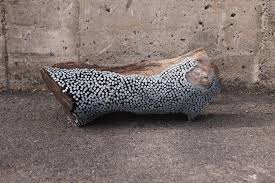
Rebecca Belmore is an Anishinaabe (Lac Seul First Nation) Woman where her people have lived around the Ottawa River Valley west across Northern Ontario and to the plains of Saskatchewan south to the northeast corner of North Dakota, northern Minnesota and Michigan, as well as the northern shores of Lakes Ontario and Erie.1 Rebecca Belmore is widely recognized as one of the most prominent, influential, and well-known contemporary Canadian Indigenous artists in the world. The artwork I have chosen 1181 art piece which is a tree log that has 1181 nails lodged into it that represent the amount of murdered and missing Indigenous women from a report in 2014.2 The artwork is a hybridization of traditional wood carving of the Anishinaabe peoples, and the inclusion of the 1181 nail pieces shows a combination of modern material sculpting with the industrial materials used to express a political and social stance.
This art piece is a mixed-media sculpture that is made from natural wooden logs and metal nails. The section of the tree trunk has the base material and shapes it while leaving much of the wood’s natural structure intact. Hundreds of nails are embedded into the surface of the log, creating a dense layer across much of the piece. It also shows the combination of organic wood and industrial metals showing a stark contrast between the two materials. Visually, the sculpture shows and emphasizes texture, pattern, and form. The natural curvature of the log appears to have a feminine shape, despite still being able to see all of the organic qualities of the wood much like its grain, knots and uneven surfaces. In contrast, the nails are tightly packed together in a repetitive pattern that covers much of the surface of the log. This repetition creates an illusion of either an armour or scalelike effect around the art piece. The shape of the log also suggests an abstract shape that it is laying down or in a reclining figure adding and reinforcing the 1181 Indigenous Women. This work clearly engages with traditional wood carving, but instead of following the traditional methods of the craft, Belmore reimages the tradition by the inclusion of nails in it as a sculptural element. This allows for the wood to transform into something new and with a powerful message in it, blending both the natural world and contemporary art. The nails act as a decorative conceptual layer, altering the surface of the wood. As a result, the artwork hybridizes the traditional craft with modern sculptural practice, creating a piece that respects the history of wood carving while also pushing it in a proactive political way.
The materials of the art piece are wood, and steel nails are what in the art piece, Belmore’s style is a multitude of things, Sculptures (Like 1181), video or photographic is performance based. She does this to address the politics of representation, and to invert or subvert official narratives, while demonstrating a preference for the use of repetitive gestures and natural materials. The cultural purpose of 1181 is that Indigenous women need more protection and support from their respective communities, and the social context is that as a society we must not push this aside as a one-off moment, and it needs to gain the leverage it deserves; as stated “… after placing the final nail, Belmore began to shout out, in an agonized but clear voice, the number. She repeated it over and over, until it began to take on some of the weight it deserves.”3
Hybridity strengthens tradition by allowing traditional cultures to mesh and mold with new and other cultures allowing for the hybridization of both. This does not erase one culture or another but allows for both cultures to exist on the same level and importance to the people as part of that culture. It also allows the people part of that culture to pay homage to it and embrace it with other cultures they may be part of. The audience changes the meaning of this piece by a lot, for indigenous people as a whole it represents the colonial and systemic oppression, they face for being second class citizens within their lands that they have existed in for thousands of years. For Indigenous women it shows the fear and consequences for being simply an Indigenous woman, where you could be abducted and (or) killed where the likelihood for the RCMP (who have systemically and generationally oppressed your people) to find you is slim and not a top priority to them.