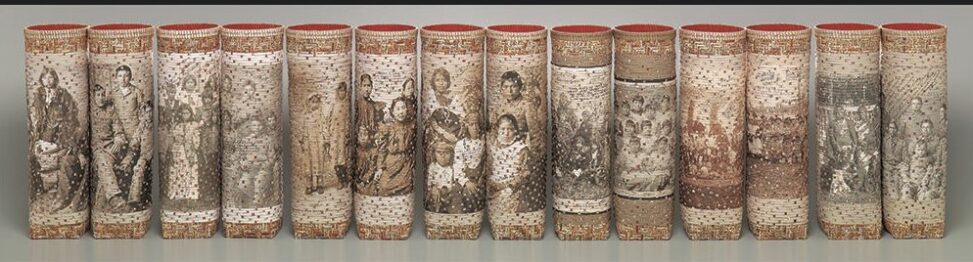
Shan Goshorn (1957–2018), an Eastern Band of Cherokee artist, photographer, and activist, transformed traditional Cherokee basketry into a powerful medium for addressing historical trauma, cultural erasure, and social justice. Born in Baltimore and deeply connected to her Cherokee heritage, she found most of her artistic inspiration in her teenage years when she worked for a summer at her tribe’s Qualla Arts and Crafts Mutual cooperative in Cherokee, North Carolina.There, she became familiar with leading Eastern Band Cherokee artists and art forms. This experience led to a job with the Indian Arts and Crafts Board, where she helped organize Native art exhibitions and photographed the harvesting and preparation raw materials for Cherokee basketmaking, carving, and other cultural art forms. Her series Resisting the Mission: Filling the Silence (2017), comprising 14 woven baskets (seven pairs, each approximately 21 inches tall by 6.75 inches wide and deep), directly confronts this history. Created in her final years, the work uses archival “before and after” photographs of Native children—originally propaganda by photographer John N. Choate—to highlight the violent transformation imposed at Carlisle.
Goshorn preserves the intricate techniques and forms of Cherokee river cane basketry while radically transforming its role from practical and ceremonial objects to activist memorials that incorporate community voices, student names, and critiques of assimilation. The thesis is that Goshorn hybridizes the tradition: she maintains the technical mastery and cultural symbolism of Cherokee weaving but reimagines it as contemporary conceptual art that critiques colonial policies, fills historical silences with Indigenous testimonies, and asserts resilience and remembrance.
Description of the Artwork
The medium consists of woven baskets using traditional Cherokee double-weave techniques, but executed with paper splints instead of natural materials. These splints are cut from archival watercolor paper printed with ink, archival pigment, and acrylic paint; polyester sinew reinforces the structure. Each of the seven pairs features two baskets: the first shows children from various tribes arriving at Carlisle in traditional regalia—long hair, beaded clothing, moccasins, and cultural adornments; the second depicts the same children months later with cropped hair, military-style wool uniforms, starched collars, and blank expressions, stripped of visible Indigenous identity. Goshorn enlarged these historical photographs (approximately 15 by 19 inches), circulated them to Native communities for handwritten personal messages and responses, then cut the annotated photos into splints. These are woven into the exterior walls alongside quotes from Pratt’s “Kill the Indian, save the man” speech along the rims. The baskets’ interiors are printed with names from the Carlisle student roster (over 8,000 children attended) on a deep red background—symbolizing Native blood and people—and painted red for protection and reverence. The tall, cylindrical or slightly tapered forms feature repeating patterns of faces, braids, beads, uniforms, and text that wrap around the surface, creating a textured, three-dimensional narrative of loss, violence, and resistance. The double-weave allows the interior names to be “held” securely, while the exterior confronts viewers with the transformation. Community contributions of cedar, sage, sweetgrass, tobacco, and notes were later placed on student graves at Carlisle during a sage ceremony, extending the work’s ritual dimension.
Description of the Tradition
Cherokee basketry, particularly river cane (Arundinaria gigantea) weaving, has ancient roots in the Southeastern U.S., with evidence dating back thousands of years. River cane, a native bamboo-like grass from river valleys, is harvested, split into thin splints, peeled, trimmed, and sometimes dyed with natural pigments (e.g., butternut for black, bloodroot for red). Weavers use single-weave (simple over-under) or double-weave (interlocking layers for durability and reversible patterns) to create forms like storage baskets, winnowing trays, sieves, and burden carriers. Styles emphasize geometric precision: diagonal twills, herringbone, chevrons, or plain weaves in natural cane tones (yellow-brown) with contrasting dyed accents. Baskets served essential cultural purposes—gathering berries, nuts, grains, or fish; storing food; preparing meals; and trapping. In social and religious contexts, they embodied women’s artistry, matrilineal knowledge transmission, and harmony with the land on ancestral territories (now including the Qualla Boundary of the Eastern Band). Before 20th-century market shifts toward tourist items, baskets were integral to daily sustenance, ceremonies, and community life, symbolizing resilience, reciprocity with nature, and cultural continuity passed generationally.
Critical Analysis
Relocating Cherokee basketry from its Southeastern origins and pre-colonial utilitarian/ceremonial roles to contemporary global museum contexts (e.g., National Museum of the American Indian) and across time to address 19th–20th-century U.S. policies profoundly alters its significance. Once tied to local survival and spiritual balance, the form now memorializes nationwide intergenerational trauma from boarding schools, exposing assimilation’s lasting impacts on language, identity, and family structures. Hybridity strengthens tradition here: integrating archival photos, handwritten community texts, and printed names into sacred double-weave techniques honors ancestral skills while expanding their capacity for activism and healing, evolving the form to resist cultural erasure without dilution. Goshorn critiques rather than merely preserves heritage—she exposes assimilation’s violence, counters historical propaganda, and fills imposed silences with Native voices and names, transforming baskets into protective vessels for memory. Audience reception further shifts meaning: Indigenous viewers often experience reverence, recognition of shared trauma, and empowerment through cultural continuity; non-Native audiences confront uncomfortable histories, moving from ignorance to reflection on reconciliation. This accessibility—baskets as “familiar” and “nurturing” objects—draws people in for dialogue.