1. Introduction:
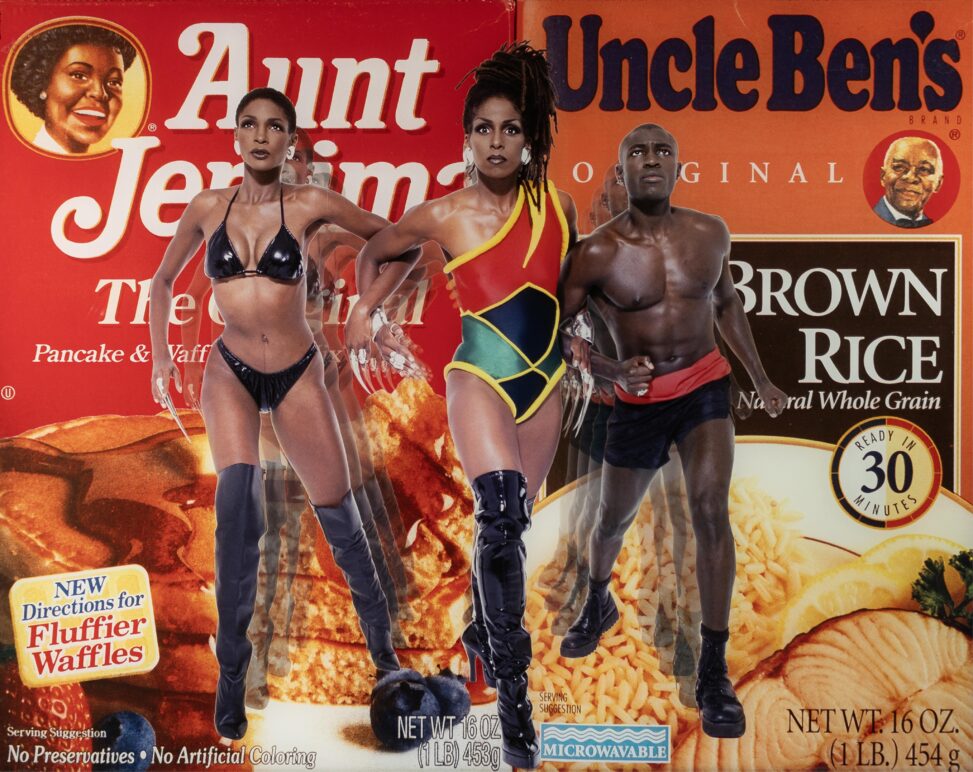
This is the work of Renee Cox, a Jamaican-American artist that uses mediums of collage, video, and photography to portray black autonomy, individualism, history (told from her perspective and the perspective of other black individuals), and freedom (Delaina Dixon 2024, 1). Her art challenges narratives of white supremacist traditions and the commodification of black people (with an emphasis on black women in much of her work). This particular artwork is part of the Raje series that started up in 1998 featuring the current art piece, The Liberation of Aunt Jemima and Uncle Ben (1998). The Raje series is a collection of photographs that feature the superwoman Raje, a Jamaican-American woman portrayed in a number of heroic and affirming scenarios, much like that of heroes in comic book panels. Raje embodies black heroism in various fashions, as each piece within the collection features depictions of an empowered black superhero reshaping her own history and how it should be told. However, in regard to the current project, The Liberation of Aunt Jemima and Uncle Ben (1998) is the artwork of focus. It portrays Raje, and two other individuals depicted as ‘Uncle Ben’ and ‘Aunt Jemima’, as she hoists them out of their all too familiar prisons of commodification.
2. Description of the Artwork:
The Liberation of Aunt Jemima and Uncle Ben (1998) uses the medium of photography to convey its message. Raje (Renee’s character) is depicted in what resembles a superhero-suit composed of brightly saturated hues of red, green, yellow, and black, or rather, the colours of the Jamaican flag. Raje is shown actively pulling both Aunt Jemima and Uncle Ben out of their brand name pancake and rice boxes with linked arms. However, both individuals, once pulled out of their prisons of commodity, are portrayed as young and attractive individuals in highly saturated black undergarments, instead of the old and ‘nurturing’ look forced upon them through racist marketing techniques. Here, traditional colonial culture is critiqued, as Aunt Jemima and Uncle Ben are depicted as more than mere racist ideologies of what black people should be (stems from colonial times, when white people took black people as slaves, forcing them to act/talk/be nurturing/servicing to white people). Instead they are attractive and ambitious young people, representing African-American history, as well as the future, told from their perspective instead of the colonizers’.
In terms of visual literacy, there is a certain depth to the image, as all three individuals (Raje, Aunt Jemima, and Uncle Ben) are moving out from the flat background of the food boxes, and out into the foreground, or the reality beyond it (another cultural critique of white supremacy through a display of moving from past to future). Moreover, the individuals themselves are of great proportion to the details of the food boxes within the background, suggesting importance and heroism, with Raje and her colourful super-suit being the focal point of the piece.
3. Description of the Tradition;
In Renee Cox’s The Liberation of Aunt Jemima and Uncle Ben (1998), there are two traditions at play. One being colonial white supremacist culture, or rather, the culture being critiqued, and the other being Jamaican-American culture, or more broadly, African-American culture as a whole. An example of note is that of the Raje’s superhero-suit, which is representative of the colours of the Jamaican flag. This is a direct reference to Renee Cox’s Jamaican-American culture. Moreover, Raje is seen as saving Aunt Jemima and Uncle Ben by liberating them from their prisons of white supremacy, representing themes of culture and connection within the African-American community. Additionally, through her inclusion of racist food brands such as ‘Uncle Ben’s’ and ‘Aunt Jemima’ within the background of her art piece, countered with images of younger and seemingly confident and powerful (standing tall, looking out, in only modern/stylistic black undergarments, highly saturated, large scale, etc.) versions of the characters being pulled out of the brands, Renee challenges the perpetuating Western colonial tradition of the commodification of black identities. Through her imagery, Renee is able to critique said colonial culture and bring about discussion of African-American individualism and identity. Moreover, due to the fact that brands like Uncle Ben’s and Aunt Jemima are so commonplace in Western grocery stores and households, The Liberation of Aunt Jemima and Uncle Ben (1998) speaks to the vast majority of Western Society and consumers.
4. Critical Analysis;
It is important to note that the term ‘African-American culture’ encompasses a wide variety of individuals, traditions, and geographies, as it is an umbrella term comprising the blend of numerous African cultures, as well as Western/American culture. Therefore, depending on one’s heritage, Renee Cox’s The Liberation of Aunt Jemima and Uncle Ben (1998) may connect differently for African-American individuals of different ethnic backgrounds. However, one thing that affects all African-American individuals is the commodification of black identities by way of Western colonial culture throughout history. This is the issue that Renee challenges through her art work, using familiar brands to represent its modernized version of perpetuation. Through this analysis of Renee Cox’s, The Liberation of Aunt Jemima and Uncle Ben (1998), it is apparent that not only is she challenging traditional white supremacist norms, but also preserving African-Jamaican heritage, and moreover, African-American culture as a whole. Through this mesh of critique and preservation, the overall duality of the message of the artwork is strengthened, and reaches both white and black audiences in separate ways. Thus, how I view The Liberation of Aunt Jemima and Uncle Ben (1998) (a protest piece in defiance of the western-colonial tradition of the commodification of black identities) is entirely different in comparison to how someone of African-American heritage may view it, bringing about a new message based on varying audience perspectives.
Bibliography
Dixon, Delaina. “Woman Art Warrior: Renée Cox Uses Her Body (of Work) to Change the Black Narrative.” Ebony, March 15, 2024. https://www.ebony.com/woman-art-warrior-renee-cox-black-narrative-uta-artist-space/.
Park University. “Chicago Style: In-Text Citations.” Park University, December 17, 2024. https://library.park.edu/chicago/in-text.