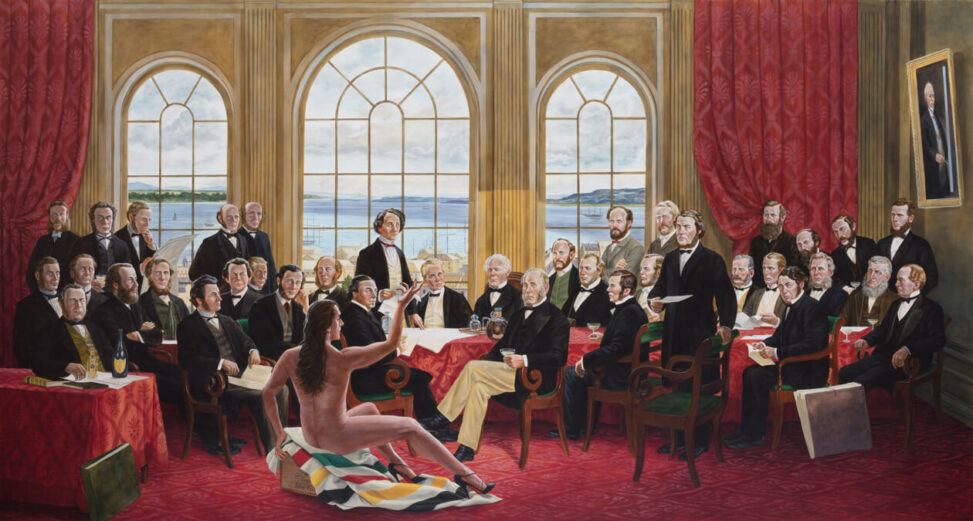
Contemporary artists often revisit historical traditions in order to question the cultural narratives they helped create. One artist who does this is Kent Monkman, a Cree artist whose work challenges colonial representations of Indigenous peoples in Western art History. His painting The Daddies draws heavily on the visual tradition of nineteenth-century European history painting, a genre that historically celebrated colonial power, exploration, and empire. Artists such as Eugène Delacroix and Théodore Géricault created large, dramatic paintings that placed European figures at the center while Indigenous people were often shown as secondary or exotic figures. Monkman borrows many elements from this tradition, including the large scale, dramatic composition, and theatrical poses of the figures. However, instead of reinforcing colonial ideas, he changes their meaning. Through humor, role reversal, and the inclusion of Indigenous perspectives, Monkman critiques the historical narratives found in traditional European paintings. In this way, the Daddies both references and reimagines this artistic tradition, using it to challenge the colonial views that shaped much of western art history.
The Daddies by Kent Monkman is a large-scale contemporary painting that references nineteenth-century historical art. The work is created using oil paint on canvas, a traditional medium often used by academic painters in Europe. Monkman uses this medium intentionally to connect his painting to the tradition of grand historical paintings that were commonly displayed in museums and galleries. The composition is dramatic and highly detailed, with several figures arranged in a theatrical scene that immediately draws the viewers attention. The figures are carefully posed, and the lighting highlights the bodies and expressions of the characters, creating a sense of movement and tension within a scene. Rich colors and soft brushwork give the painting a polished and classical appearance, which further connects it to older European art traditions.
At the same time, the subject matter introduces a clear critique of those traditions. The painting features Indigenous figures interacting with powerful colonial men, but the power dynamics appear reversed compared to many historical paintings. Instead of Indigenous people being portrayed as passive subjects, they appear confident and in control of the situation. Monkman also includes elements of humor and exaggeration, which give the scene a satirical tone. This approach challenges the seriousness and authority that traditional history paintings often tried to communicate.
Through these visual choices, Monkman directly references European history painting while also transforming its meaning. By using the same medium, scale, and dramatic style, he shares the traditional form, but the content and relationships between the figures question the colonial values that those historical paintings once supported.
The tradition that Kent Monkman references in The Daddies is a nineteenth century European history painting. This genre was considered one of the highest forms of art in the Western academic tradition and was often displayed in major museums and salons. These paintings were typically created using oil paint on very large canvases, allowing artists to include detailed figures, dramatic movement, and complex compositions. Drapery, armor, and architectural details were rendered with meticulous attention to light, shadow, and perspective, creating the illusion of three-dimensional space on a flat surface.
Culturally, these paintings served as both education and propaganda. They were displayed in State galleries, palaces, or churches and were intended to communicate moral lessons, national pride, or the legitimacy of rulers. Scenes often depicted military victories, royal ceremonies, or mythological events, reinforcing social hierarchies and European dominance. In cases involving non-European peoples, such as indigenous groups, figures were usually presented as decorative elements or symbols rather than active participants, emphasizing difference and reinforcing colonial power structures. Religious and historical iconography was also common, linking contemporary events to moral or divine authority. This combination of careful technique, grand scale, and ideological messaging created a highly codified tradition, one that later artists like Monkman could reference, invert, or critique through both visual style and content.
When a tradition like nineteenth-century European painting moves through time and is reinterpreted by an indigenous artist, its meaning and function can shift dramatically. In The Daddies, Monkman not only changes the cultural context but also introduces new narratives and audiences. The original tradition celebrated European authority and moral ideals, often reinforcing social hierarchies. Monkman’s adaptation transforms this narrative. The painting becomes a platform for indigenous storytelling, satire, and critique rather than a display of colonial power. By situating Indigenous at the center of a style traditionally used to glorify Europeans, he challenges the authority of the original historical narratives.
Hybridity plays an important role in this transformation. Monkman blends classical techniques, such as dramatic lighting, careful perspective, and detailed rendering, with elements drawn from Indigenous oral histories, contemporary queer culture and mythology. This mixture destabilizes the original tradition, showing that a single visual language can hold multiple, even conflicting meanings. The formal beauty and technical skill of the painting preserve aspects of the European tradition, but the content and cultural perspective subvert its historical purpose.
Audience also shapes how the work is received. Contemporary viewers are encouraged to question both the historical assumptions in traditional history painting and the power dynamics depicted. In this sense, Monkman’s work does not merely preserve or imitate the tradition; it reimagines it, creating a dialogue between past and present, Europeans and Indigenous, that forces reflection on history, identity and representation.