Micheal Nicoll Yahgulanaas is a contemporary artist who is known for his paintings, sculpture, and carvings. He was born in Prince Rupert, British Columbia and grew up in a fishing village near Massett on the island of Haida Gwaii. His passion for art started when he was a child he covered his walls and ceilings of his room with drawings. When Yahgulanaas turned 22 he began to aim his artwork towards a change in community. He did his formal art training in the classical forms of Haida art, after several decades he became a full-time artist working to protect the rich diversity of Haida Gwaii. How his artworks can be seen in public spaces, museums, and in private collections around the world. Collections include the British Museum, National Museum of the American Indian, Vancouver Art Gallery and many more.
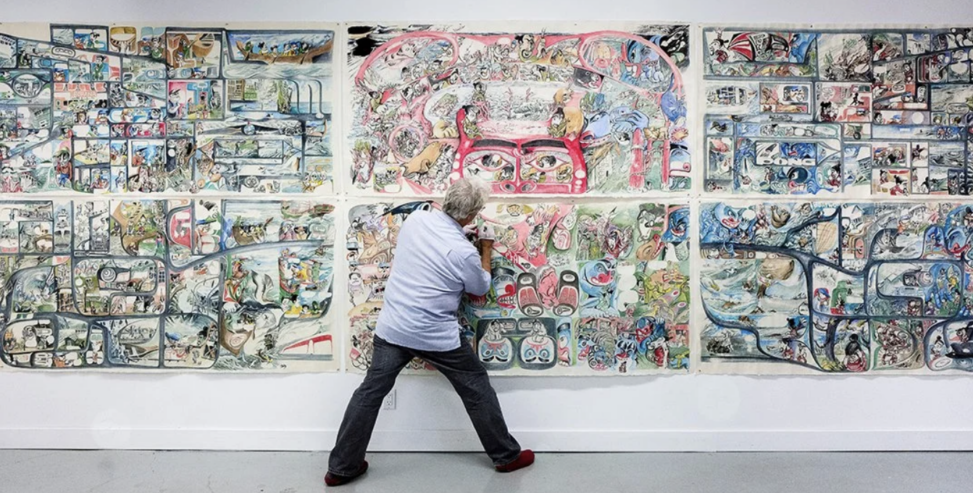
“Carpe Fin” created by Micheal Nicoll Yahgulanaas is a visually complex work, intertwining traditional indigenous art with contemporary graphic storytelling. “Carpe Fin” that comes from Latin language roughly means “seize the end” and “fin” meaning fish which reflects the ocean-centred story themes. The art work is created using ink and watercolour on paper forming a series of comic like panels like a Japanese manga, that call also be formed into a large mural. Yahgulanaas primarily uses black ink lines to make the figures and shapes, watercolour as well as painted colour washes where also used within the artwork. Colour is used selectively, mostly being reds, blacks and natural tones that reference the traditional palette of Northwest Coast Indigenous art. The use of the different art styles create a cohesive visual composition that emphasized the emotion of the story. The stylized fsh characters move through swirling shapes that evoke ocean currents, giving the artwork a sense of rhythm and smooth motion. Line, shape and colour all play an important role and work together to create both narrative clarity and symbolic depth.The work represents and respects traditional haida aesthetics while using them to address contemporary themes sch as conflict, greed, and community responsibility.
The visual tradition reference in Carpe Fin comes from the artistic practices of the haida people of the Northwest Coast. Traditional Haida art is created using a mix of natural materials. Using natural materials is deeply integrated into their cultural, spiritual, and environmental identity linking the artists to their ancestors, land, and stories. Historically, the artists would carve into red and yellow cedar wood using natural pigments commonly in black, red, and sometimes blue-green tones. Haida art serves important traditional cultural purposes such as carved poles, masks, and ceremonial objects, that help tell family histories, display clan crests, and represent important animals such as the raven, eagle, or bear. In this context, the art is just not decorative,The story consists of a group of fish whos society falls into conflict. One of the fish becomes greedy, he begins to hoard resources and separates himself from the others. This selfish behaviour cases the once peaceful community to collapsed into utter violence and chaos. This story is connected to identity and the passing down of knowledge through visual story telling. Carpe Fin shows how greed and division can destroy a community, while cooperation and balance helps societies survive.
Micheal Nicoll Yahgulanaas uses hybridity, the blending of two very different artistic styles to create the Haida Manga. In this case, the hybridity strongly enhances and strengthens the tradition rather than destabilizing it. Hybridity allows the tradition to evolve though time. Artistic traditions are not static; they evolve and develop as artists respond to new materials and audiences. By creating Haida Manga, Yahgulanaas demonstrates that tradition can still function within contemporary media such as graphic novels and murals. The meaning of the artwork can also shift depending on the audience and who is viewing it. Yahgulanaas presents the story though traditional haida art in the structure of manga, different viewers may interpret these elements differently. For example, a Northwest Coast Indigenous audience make take note and connect with the cultural knowledge of the artistic traditions, such as the thick black line work, the shapes, thick and thin curved lines and ovoid designs that appear in traditional carvings. The viewers will recognize how Haida Manga continues cultural practices and symbolic representation. For a global audience, viewers who are more familiar with comics or manga may focus on the layout and the panels of the art work and instead of focusing on the cultural importance of the artwork, they may primarily read the work as a graphic novel. As a result, the meaning of Carpe Fin is not solidified, it continues to evolve depending on the cultural background and knowledge of the viewer.