Introduction
Traditional art forms often carry important cultural meaning and connect people to their history and identity. One example of this is Hawaiian featherwork, which was historically used by Hawaiian royalty and had strong spiritual and political significance. These objects were not only beautiful but also symbolized power, status, and a connection to ancestors and the gods. Today, some contemporary artists look back at these traditions and use them in new ways in their work. By doing this, they help keep the tradition visible while also bringing new interpretations to it.
This essay looks at how contemporary artists reference traditional Hawaiian featherwork and how the meaning of the tradition changes in modern art. Historically, feather cloaks, helmets, and standards were used by chiefs and members of the royal class in Hawaii. These objects represented authority and sacred power. In contemporary art, however, these traditions are often reimagined rather than used in the same ceremonial way. I argue that contemporary artists transform Hawaiian feather traditions by keeping their visual and cultural symbolism but presenting them in new artistic contexts. This allows the tradition to continue while also reflecting on history, identity, and cultural change.
Description of the Artwork
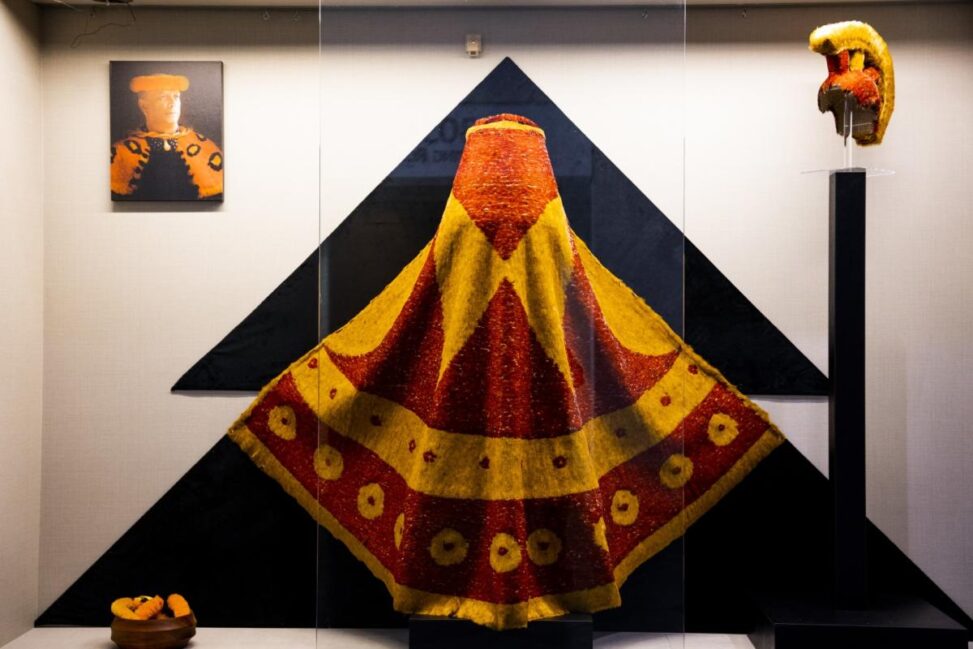
Many contemporary artworks that reference Hawaiian feather traditions visually connect to traditional feather cloaks. These cloaks, known as Ahu ʻula, were worn by Hawaiian chiefs and were made from thousands of carefully attached feathers. Contemporary artists sometimes reference these cloaks through color, shape, and texture rather than recreating them exactly.
One of the most noticeable visual elements is the use of bright red and yellow colors. These colors were very important in traditional featherwork. Yellow feathers in particular were extremely rare and were usually worn only by the highest ranking chiefs. Because of this, the colors themselves carry strong symbolic meaning even when used in contemporary artworks.
In some cases, the form or shape of the feather cloak is also referenced. The rounded shape and layered feather texture can appear in paintings, installations, or sculptures. However, contemporary artists often use different materials instead of real feathers. Some may use textiles, synthetic materials, or other artistic media that imitate the look of feathers. This creates a visual connection to the tradition while still allowing the artist to experiment with new forms.
Another important difference is the way the artwork is displayed. Traditional feather cloaks were worn during ceremonies by chiefs. Contemporary artworks referencing these traditions are usually displayed in museums or galleries. Because of this, the audience experiences the work in a different way. Instead of seeing it as royal clothing, viewers see it as an artwork that communicates cultural history and meaning.
Description of the Tradition
Traditional Hawaiian featherwork was one of the most respected art forms in Hawaiian culture. Feather cloaks, helmets, and standards were worn by members of the ruling class known as the aliʻi. These objects symbolized power, protection, and spiritual authority. They were also believed to contain mana, which is a form of sacred spiritual energy.
The cloaks, called Ahu ʻula, were made using a very detailed and time-consuming process. Skilled artisans created a net base using strong plant fibers such as olonā. Small bundles of feathers were then tied onto the net to create dense patterns and bright surfaces. Because each feather had to be attached individually, these cloaks could take years to complete.
Many of the feathers came from native Hawaiian birds such as the mamo and ʻōʻō. These birds had bright yellow or red feathers that were highly valued. Bird catchers known as kia manu collected feathers by capturing birds, taking a few feathers, and then releasing them back into the wild. This method helped protect bird populations and showed how the practice was connected to knowledge of the natural environment.
One well-known example is the feather cloak belonging to Kamehameha I, the first ruler to unite the Hawaiian Islands. His cloak contained hundreds of thousands of yellow feathers, showing the incredible skill and labor involved in creating these objects.
Overall, featherwork was not only decorative but also deeply connected to Hawaiian social structure, religion, and cultural identity.
Critical Analysis
When traditional Hawaiian featherwork is referenced in contemporary art, its meaning changes because the context is different. In the past, feather cloaks were worn by chiefs during ceremonies and represented royal authority. Today, similar visual elements might appear in artworks displayed in museums or galleries. Because the audience is different, the way people understand the tradition can also change.
Another important factor is hybridity, which happens when artists combine traditional ideas with modern artistic techniques. Contemporary artists often mix traditional Hawaiian symbolism with modern materials or artistic styles. This can actually strengthen the tradition because it allows it to evolve instead of staying fixed in the past. It keeps the cultural knowledge alive while also making it relevant for modern audiences.
At the same time, contemporary artists may also be critiquing history. Many traditional Hawaiian objects were removed from their original cultural context during colonial periods and placed in museums around the world. By referencing featherwork in their art, Indigenous artists can reclaim these traditions and present them from their own perspective.
Because of this, contemporary artworks inspired by Hawaiian feather traditions both preserve and transform the tradition. They keep the visual and cultural meaning of featherwork alive while also adapting it to modern artistic and social contexts.
Bishop Museum. Hawaiian Featherwork: Nā Hulu Aliʻi. Honolulu: Bishop Museum Collection.
Smarthistory. “Hawaiian Featherwork (Ahu ʻula).” Smarthistory Art History Resource.
Stillman, Amy Ku‘uleialoha. Hawaiian Featherwork: Tradition and Transformation. Honolulu: University of Hawai‘i Press.