Section 1: Visual Description
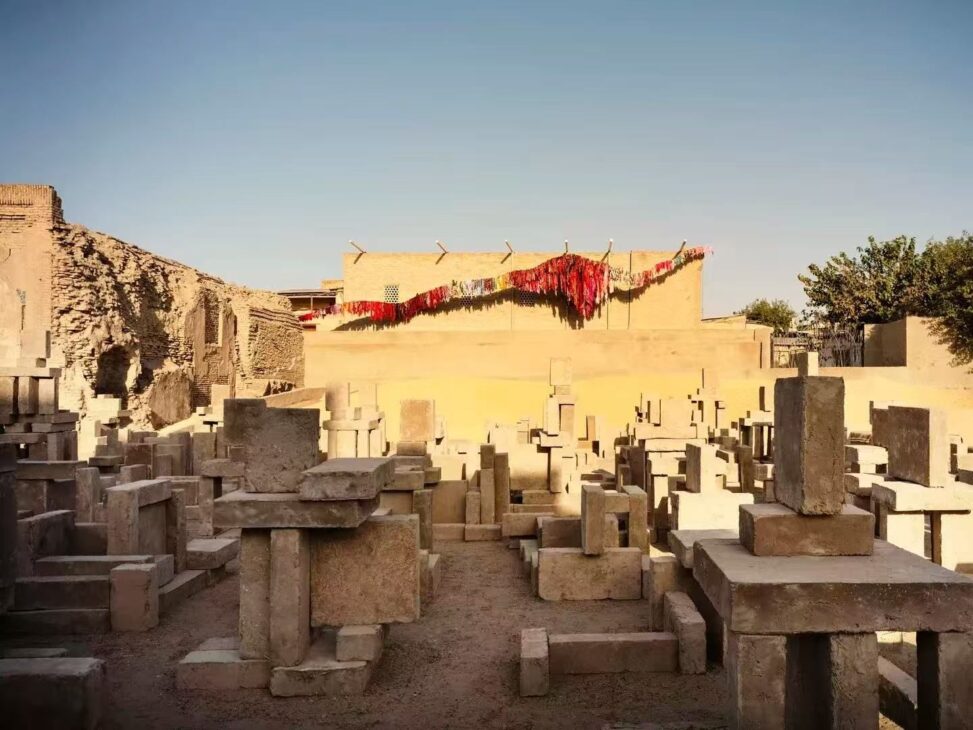
Situated within the ruins of the Khoja Kalon mosque built in 1598.(Close) designed by artist Antony Gormley.This is an open-air courtyard, a landscape composed of countless bricks of varying sizes and shapes. The background hue is kind of dark. These bricks are primarily beige and grayish-brown, with uneven surfaces and varying sizes. The images show that the bricks are mainly rectangular and square, stacked in the courtyard. Some are stacked into platforms, others into human shapes, and still others are decorative items. These are irregularly arranged, yet each arrangement contains passageways and areas, forming a maze-like pattern. In the background, there are a focus point is the colorful ribbon—including red, pink, yellow, blue, and orange—hangs prominently from the top of the mud wall in a wavy pattern, emphasizing the width of the space. The ribbon contrasts sharply with the surrounding mud, highlighting its aged appearance. The red ribbon is positioned in the upper third of the image, while the mud wall is in the lower two-thirds, creating a sense of layering.
Section 2: Interpretation & Meaning
The work combines Antony Gormley’s Close (2025), 104 unfired mud-brick figures made with 95 tonnes of local soil alongside collaborators, headscarves donated by Bukhara women suspended overhead in a spine- or dragon-like form. The rough, earthy brick maze echoing ancient walls, contrasted with the vibrant fabric band, suggests continuity between body, architecture, and place. Bricks link abstracted human forms to centuries-old building techniques; textiles add color and verticality, implying grounded materiality below and collective presence above.
Physical navigation through narrow brick gaps heightens awareness of scale, enclosure, and movement, evoking presence/absence within historical space.
Interpretations differ: locals may see cultural continuity and community input (bricks reused for a school, scarves from personal donations); international viewers may focus on embodiment and fragility; women viewers may connect strongly to the headscarves’ narratives of resilience. The installation suggests repair through collaboration—reassembling earth, bodies, and memories into a temporary whole.
Section 3: Space, Power, and Access
The work is encountered mainly by Bukhara Biennial visitors: local residents, international tourists, artists, and scarf donors, during its run at the UNESCO-protected Khoja Kalon Mosque site, often via tickets or guided paths from the Uzbekistan Art and Culture Development Foundation.
The encounter is planned: site-specific, heritage-responsive, with intentional craft integration and post-exhibition reuse (bricks for school, scarves ritually released). Duration is limited to about ten weeks; physical access ends with dismantling. Visibility continues through photos, media, and online archives, shifting from embodied local experience to mediated global circulation.