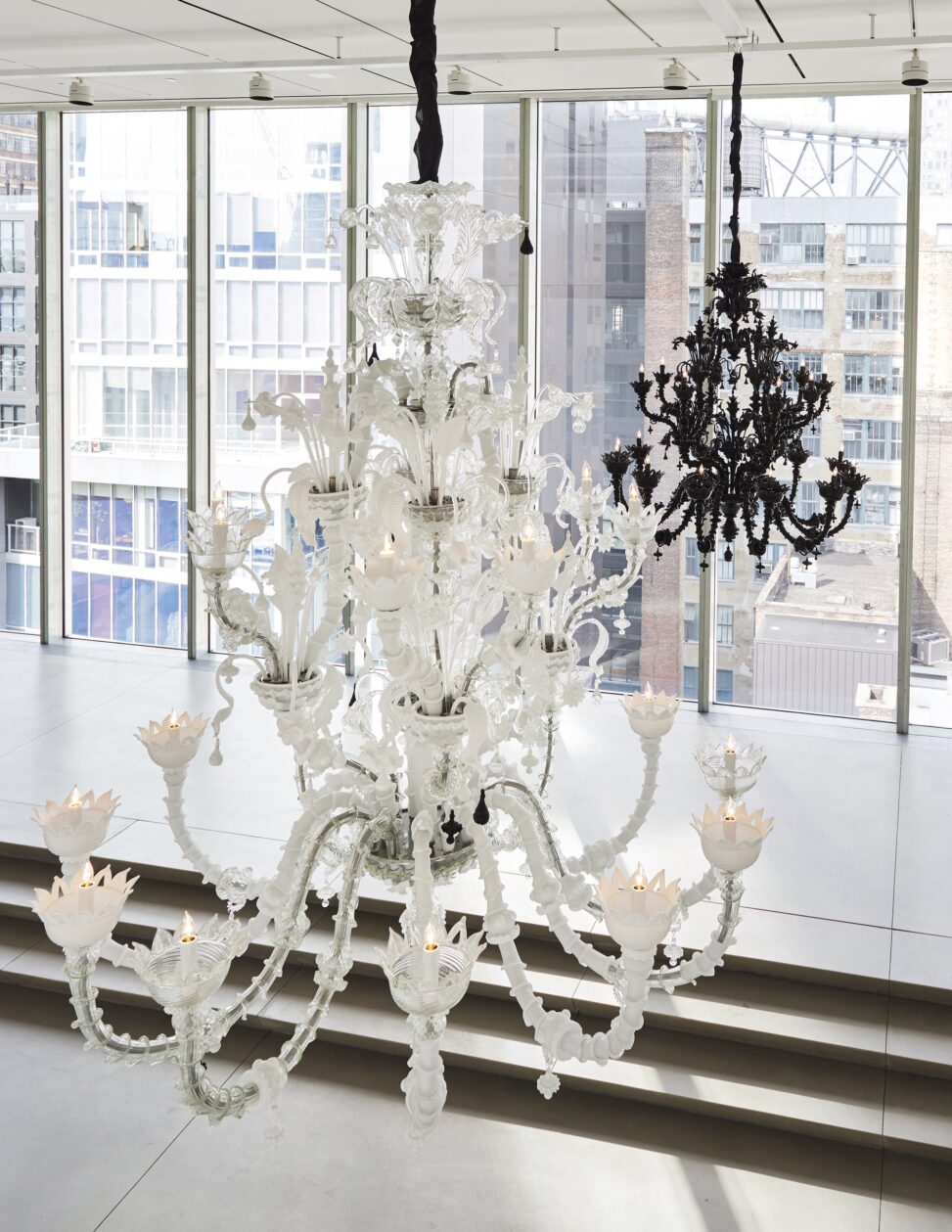
Fred Wilson’s Chandeliers is an art piece from multiple different periods coming to a collection for display in 2019. The pieces are 5 Murano glass chandeliers originally made from 2003 to 2017. Murano is the island where, in 1291, the masters of glass blowing were forced to live on the island of Murano, Italy. Fred Wilson’s pieces are a reference to this tradition. Further, Wilson’s display seeks to critique the history of the chandelier by featuring the first black chandelier to be created in the history of Venetian glassmaking. By doing this, Wilson. The emphasis of this is to subvert the white-dominated homogeneous history of the Western world, especially in places like Europe. Making something new while in the traditional form, while also using it to critique the underrepresented history of communities of African descent. As stated earlier, these chandeliers are not just an item of historical significance but a tradition spanning a time long ago. Thus altering the assumptions of the beauty of the chandeliers through tying it back to the racist past that the tradition stems from.
Chandeliers is a set of 5 chandeliers displayed in the Pace gallery global headquarters in New York City, made from 2003 to 2018. The first, originally made for an exhibition titled “Speak of Me as I Am: Chandelier Mori,” is an ornate glass all-black chandelier that has two rows of light bulbs, which is 70 inches by 67 inches by 67 inches. This chandelier was the first all-black chandelier to be fabricated by Murano. The light bulbs are attached to protruding, long U-shaped arms attached to the center of the chandelier. These arms are ribbed in a non-organic fashion, with each ridge being bent or off-center. Furthermore, the chandelier is very spiky in its design and has a lot of small ornate features resembling crosses and a singular one in the center resembling a pinecone dangling off of it or a small semi-circle protrusion that almost resembles a bird. These small ornate features are shared across most of the chandeliers in the exhibit. Another one of the chandeliers that stands out is “To Die Upon A Kiss” manufactured in 2011 this chandelier on a first glance greatly resembles “Speak of Me as I Am: Chandelier Mori” in its textures and overall design with the key distinguisher being instead of all black this chandelier features a black to white gradient on the chandelier where at the top the chandelier is the standard white-clear glass and becomes more black towards the bottom with the outer light holders being an almost caramel-brown color. Another chandelier, “A Moth of Peace”, resembles the “Speak of Me as I Am: Chandelier Mori”; however, this chandelier is entirely clear and white glass except for 4 small ornate hanging pieces that are black, 3 being on the higher layer and 1 on the lower. All of the chandeliers in total greatly resemble the traditional style of the Murano chandeliers, their key difference obviously lying in the colours being used.
The tradition the artwork stems from is clearly a well-established Murano chandelier. This tradition stems from how, in 1291, anyone who was a glassmaker in Venice was required to move to Murano and eventually led to the city becoming famous for its glassworks. This also led to Murano being the main producer of glass in Europe. This established a prominent tradition of Murano as the glassmaking capital. In fact, Murano chandeliers are still sold today. The chandeliers are further created in what is known as the Rococo style.
Societally speaking, due to its notoriety, Murano glasswork became a sign of luxury as in the 15th century, Murano became the luxury glassmaking center of Europe. By using this tradition and being the first black chandelier to have been created, Wilson shakes up the tradition.
Wilson is critiquing the heritage here by ordering the first back chandelier. And pointing attention to where it comes from Further, for the original exhibit for “Speak of Me as I Am: Chandelier Mori” Wilson, “…investigated the history of Venice’s African population, fully immersing himself in the study of how Africans were depicted in 17th and 18th century Venetian paintings and decorative arts” this critiques the well established historical precedent that the only notable artists are straight when men. Further, in the period surrounding the 15th-16th century, when Murano glass was extremely popular, the Atlantic slave trade was still taking place.
The audience can change the meaning in this piece quite a lot. The historical meaning of the entire piece is not clear without the further context required to understand the history and tradition behind the piece. I could see someone simply taking the meaning as just a chandelier. Further, the audience changes meaning through the participation of the audience. A passive short glance at these chandeliers does not do them justice. Another element of audience changing meaning is the price. A quick Google search for traditional Murano chandeliers will yield results ranging from thousands to tens of thousands of dollars per chandelier, further emphasizing the established white-dominated craft through the location, which Wilson aims to critique.