1. Introduction
Clarissa Rizal’s Resilience Robe is a contemporary textile work based on traditional Chilkat weaving from the Tlingit people. At first, it look slike a traditional robe with the usual patterns and structure, but when looking up closer, there are also some modern elements included in the design. Now this makes it not traditional but not fly modern either.
Chilkat weaving from the Tlingit and the north west coast people has been practised for a long time and is usually done only by women, and some formline imagery is done by men. The robe follows that structure, but it also includes new symbols and ideas which make the work not just preserve the tradition.
I think this work by Clarissa is much more about continuing the tradition with a slight transformation of the tradition at the same time. However, the technique and form are still traditional, but the message is more expressed as sovereignty for indigenous people.
2. Description of the Artwork
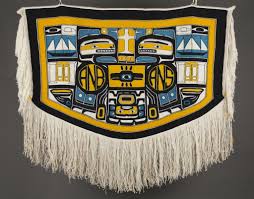
The resilience robe is a woven textile made from merino wool or goat hair that is hand spun and then woven on a loom, where the threads are attached at the top. It hangs vertically and has a wide rectangular shape with long fringes at the bottom. The surface is made with curved shapes and patterns, part of the formline design.
The colours are mainly black, yellow, turquoise, and white. These colours are commissioned by clan leaders and are used to create contrast and define shapes across the surface. The design includes an eagle and a raven, often referred to as moiety, meaning half, which is important in the culture.
At first, the design looks symmetrical and balanced, but there are also modern symbols like ANB and ANS emphasising sovereignty. We also see the Sea Alaska logo at the centre, and at the very tail we see a Sea Alaska Heritage Institute logo. These things stand out as they were not used traditionally. I also see a ship that shows trade across the region.
The traditional part includes elements of the bird, like the head, wings, claws, feather tail. The fringe at the bottom moves when worn, which makes the robe feel active instead of just something flat. So overall, the artwork looks traditional in structure, but includes newer elements inside it. It keeps the same visual language but adds new content.
3. Description of the Tradition
Chilkat weaving is a traditional form of textile making practised by the Tlingit people of the Northwest Coast. It is known for its complex patterns and requires a lot of time and skill to create. The process includes preparing materials like wool and bark, and then weaving them together on a loom-like frame.
Unlike regular weaving, the threads are only attached at the top, so the weaver has to control the tension carefully by hand. Often labour-intensive, this makes the process more difficult and requires experience
.
The designs used in Chilkat robes often include animals and clan symbols, such as the eagle and the raven. These designs are not just decorative. They represent the identity of the community, and relationships or marriages are traditionally with the opposite sex within the community.
These robes, often 7-8 pounds, are usually worn during ceremonies, dances, and important events. They are connected to movement, since the fringe moves with the body. The robes are also considered valuable and are often worn by important members of the community.
Chilkat weaving is traditionally passed down through generations, especially among women. Because of this, it is not just a technique but also a way of preserving cultural knowledge and identity.
4. Critical Analysis
One thing that changes in Resilience Robe is how tradition is used over time. Traditional Chilkat robes mainly included clan symbols and cultural imagery. In this work, newer elements like letters and modern references are added. This shows that the tradition can include new meanings.
There is also hybridity in the work. The robe still uses traditional weaving techniques and structure, but the content includes both old and new elements. At first, this might seem like it changes the tradition too much, but I think it actually makes it stronger. It allows the tradition to stay relevant instead of becoming something only from the past.
The audience also changes meaning. In a traditional setting, people would understand the symbols and their cultural importance. In a museum, viewers might not fully understand the meanings and may focus more on the design or technique.
Clarissa Rizal is not rejecting tradition. She is continuing it, but also expanding it. By adding modern elements, she shows that tradition can grow instead of staying the same, also by passing it down to generations.
Overall, the work shows that tradition can be preserved while also being adapted to new contexts.