1. Introduction
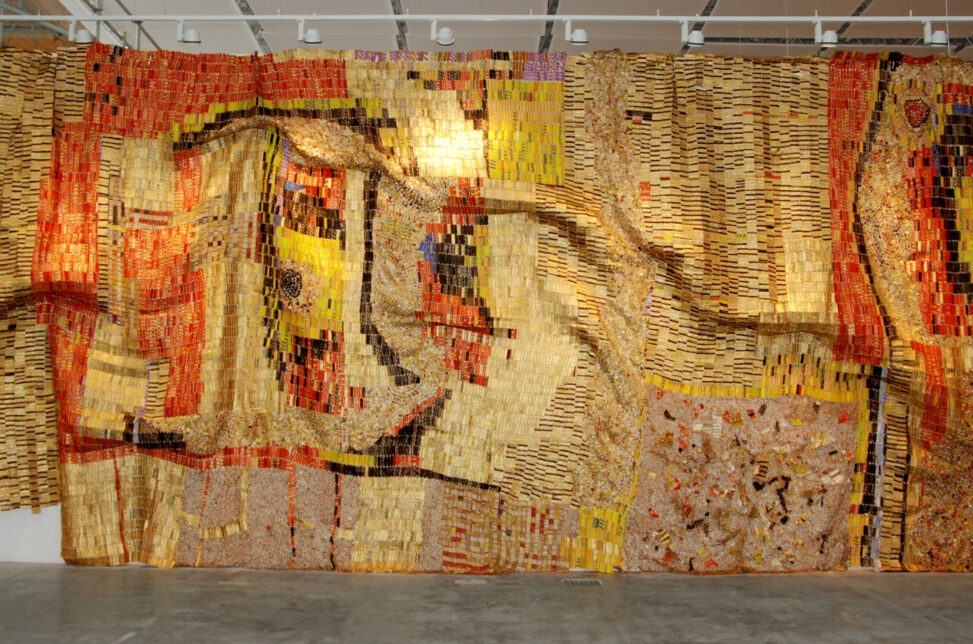
El Anatsui is a contemporary artist from Ghana who works a lot with recycled materials. One of his works, Earth’s Skin, looks like a big piece of cloth hanging on a wall, but when you actually look at it properly, it’s made from small metal pieces like bottle caps joined together with wire. At first I thought it was fabric, but then it becomes clear it’s not, which kind of changes how you see it.
This connects to traditional African textile practices where cloth is made by weaving and used in cultural settings. But at the same time, this is not exactly the same thing. The material is different and also where we see it is different.
I think El Anatsui is not just preserving tradition, but more like changing and reworking it. The idea of cloth is still there, but the meaning and use are different now. So instead of tradition staying the same, it feels like it is being continued in another form.
2. Description of the Artwork
Earth’s Skin is a large artwork that hangs on the wall and kind of spreads across it like a cloth. From far away, it really looks like a textile or fabric that is draped, but when you get closer you can see it is actually made from small flat pieces of metal.
These pieces are connected with thin wire, and you can see how each part is attached. It doesn’t look perfectly smooth. The surface has folds, wrinkles, and uneven parts, so it doesn’t sit flat. Because of that, it feels more like a sculpture than just something flat.
The colours are mixed, like gold, brown, silver, and some darker shades. Some areas reflect light more, while others look dull or used. It kind of looks both new and old at the same time.
The pattern comes from repeating these small pieces again and again. It reminds me of weaving, even though it’s not actually woven with thread. The way everything is joined together gives that same feeling.
So the connection to tradition is there, but not in a direct way. It doesn’t copy a textile exactly, but it feels like one. The material changes everything though, since it’s metal and not fabric.
3. Description of the Tradition
The tradition connected to this work is textile making in West Africa. In many African cultures, cloth is important and not just something people wear. It can show identity, culture, or even status depending on the design and how it is used.
These textiles are usually made by weaving threads together. The patterns repeat across the surface, and they are often planned, not random. People who understand the culture can read these patterns and know what they mean.
The materials are usually soft, like cotton or fibre, so the cloth can move with the body. This is important because the cloth is often seen during movement, like in ceremonies or gatherings.
Textiles are used in different social situations, like weddings or festivals. So they are not just objects to look at, but part of how people interact and express culture. The making of the cloth is also important because it involves skill and tradition being passed down.
So overall, textile tradition is both about the object and how it is used in real life.
4. Critical Analysis
One big change I notice is how the work is used. Traditional cloth is worn or used in daily or cultural life, but Earth’s Skin is placed in a museum. So instead of using it, people just look at it.
This changes the experience a lot. In traditional settings, people already understand what the patterns and materials mean. But in a museum, not everyone knows that. So people might just focus on how it looks instead of what it represents.
Also the audience is different. Before, it was more local and connected to a specific culture. Now it is global, and people from different backgrounds see it in different ways.
There is also a mix happening here. The work is kind of between a textile and a sculpture. It uses a method that feels like weaving, but the material is metal and recycled. At first it might feel like this changes the tradition too much, but I think it actually makes it stronger because it brings it into a new context.
El Anatsui is not just keeping tradition the same. He is changing it. The use of bottle caps also makes me think about things like consumption or trade, even if it’s not directly said.
So the tradition is still there, but it’s not exactly the same anymore. It’s more like it has been reshaped.