Shahzia Sikander is a world renowned artist. Her artwork is widely known in South Asia, and has been exhibited all across the world. Shahzia Sikander is from Lahore Pakistan, and her work is a representation of South Asaian cultures and traditions. Her artwork is truly captivating and contains presences of a hybrid of traditional art and societal conflicts. Sikander’s artwork is intricately layered with deep themes of the past and present illustrating a remarkable story and is absolutely revolutionary. Sikander’s work allows her to preserve traditional art styles while expressing herself through her art.
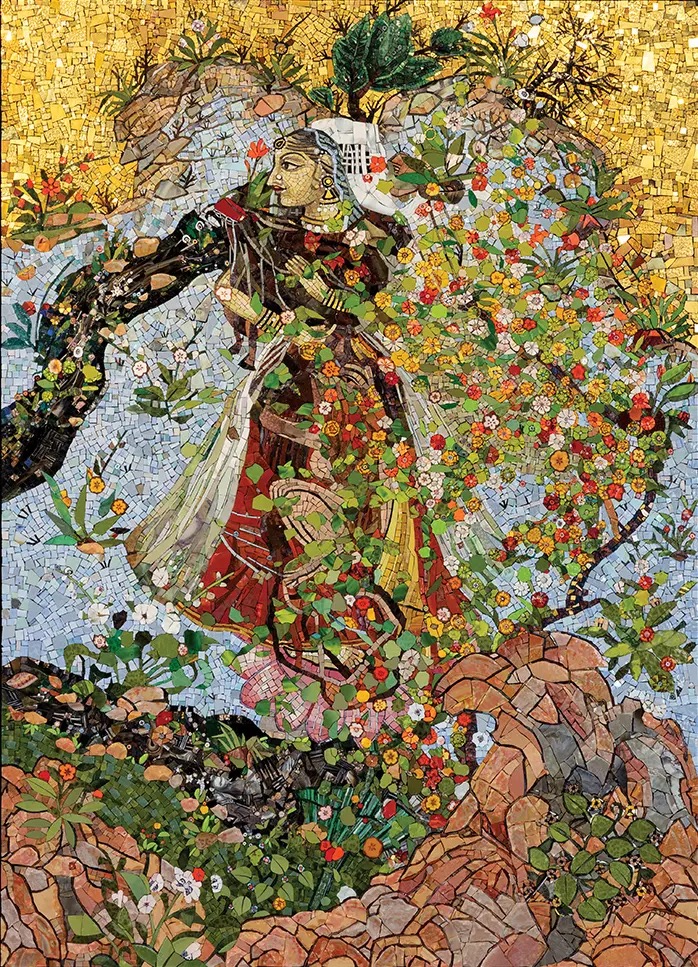
This specific piece it’s called Touchstone. Touchstone was created by using pieces of broken glass that were placed together to create a mosaic. The mosaic contains colorful pieces of glass and is highly saturated. The colors predominantly used are shades of yellow, red, green, blue and brown. The main focal point of this mosaic is the woman in the center. Though she is a focal point the usage of color on her compared to the rest of the artwork is dull. The jewelry illustrated on the character is a reference to South Asian culture. The traditional clothing also has ties to the traditional fashion of Southern Asia. The colorful glass shapes have geometrical elements that create the asymmetrical effect. Organic elements such as the background being placed in nature as well as the women’s presence are also contributing to this work of art. The mosaic itself is very layered with intricate details. This artwork is also very crowded in terms of details, evidence for this is the representation of colorful flowers presented all over the work. Since this artwork uses material such as glass it is safe to say that it is very textured to the touch. This artwork’s focal point, the woman in the center, is a direct reference to Radha. Radha is a goddess worshiped in the Hindu religions.
The style of the portrait itself is very traditional, and is connected to South Asian traditional painting styles. Specifically Indian and Pakistani culture. Evidence supporting this included the use of traditional clothing on the figure in the middle as well as the jewelry illustrated on the figure. In this part of the continent individuals tend to wear very detailed and intricate jewelry, as well as clothing similar to the style the figure is wearing. This style of clothing is worn predominantly in India and Pakistan. The figure itself is important; the focal point of the art piece is Radha, a Hindu goddess. She is the goddess of love and devotion. The art style in which Radha’s portrait is made is very traditional. Her face looking off to the side is a style used in older art styles.
If or when the artist moves geographically or physically through time it is inevitable that their art will change with their perspective. Human beings are programmed to adapt to constant change. As time has progressed so has our views on society and its “norms”. Societal norms that once bound tradition break over time and develop into freedom of self expression, while still preserving their ancestor’s practices. Art is the desire of connection. So while objectively the style may change of the artist their desire to create something that connects them to the world remains. While many factors play into change of tradition one main factor is the freedom of expression.
Hybridity of time both strengthens and destabilizes tradition. Contemporary art focuses on expression of one’s true being. The moral compass of contemporary art should be used to make traditional art easier to access for the younger generation. As well as allow artists to express themselves while still preserving the true beauty of their culture. However it is very easy to lose traditional aspects of an art when trying to create something new with the old style. Hybridity is both a negative and a positive revolution and art. The middle ground of this practice has the potential to change the world, and truly challenge one’s perspectives.
Art is subjective, meaning it is based on personal feelings and opinions. Subconsciously the audience interprets different meanings of the work based on how they connect with the artwork. This can be based on past experiences or situations that are related to the art. That is how the audience changes the meaning of the art either into a negative or positive narrative depending on their perception of the work.