Section 1: Visual Description
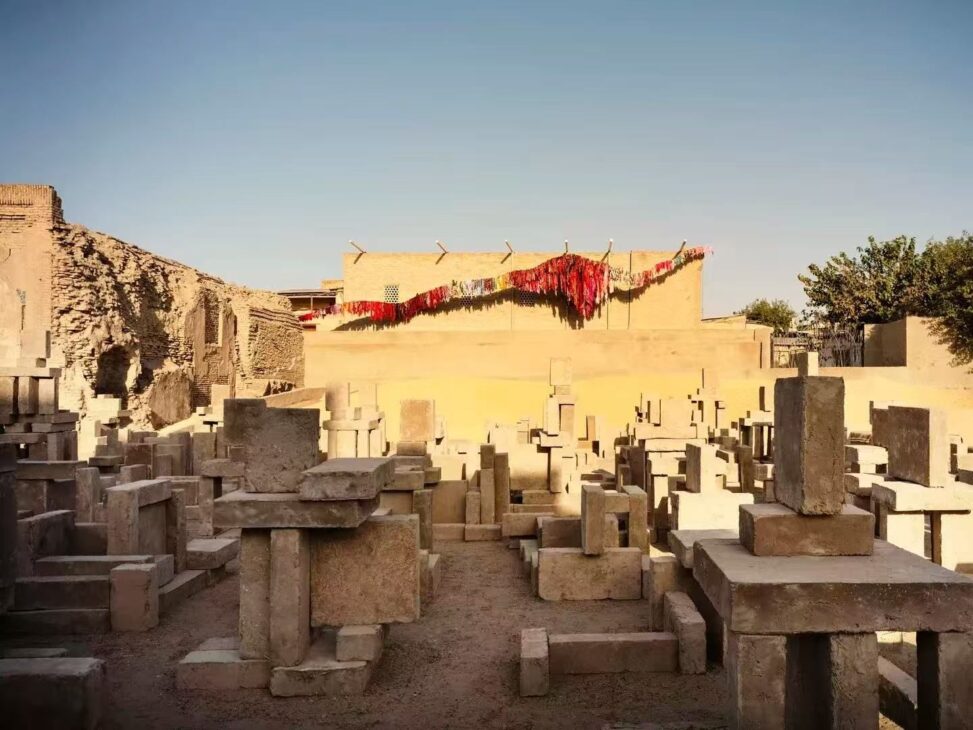
Situated within the ruins of the Khoja Kalon mosque built in 1598.(Close) designed by artist Antony Gormley.This is an open-air courtyard, a landscape composed of countless bricks of varying sizes and shapes. The background hue is kind of dark. These bricks are primarily beige and grayish-brown, with uneven surfaces and varying sizes. The images show that the bricks are mainly rectangular and square, stacked in the courtyard. Some are stacked into platforms, others into human shapes, and still others are decorative items. These are irregularly arranged, yet each arrangement contains passageways and areas, forming a maze-like pattern. In the background, there are a focus point is the colorful ribbon—including red, pink, yellow, blue, and orange—hangs prominently from the top of the mud wall in a wavy pattern, emphasizing the width of the space. The ribbon contrasts sharply with the surrounding mud, highlighting its aged appearance. The red ribbon is positioned in the upper third of the image, while the mud wall is in the lower two-thirds, creating a sense of layering.
Section 2: Interpretation & Meaning
The work combines Antony Gormley’s Close (2025), 104 unfired mud-brick figures made with 95 tonnes of local soil alongside collaborators, headscarves donated by Bukhara women suspended overhead in a spine- or dragon-like form. The rough, earthy brick maze echoing ancient walls, contrasted with the vibrant fabric band, suggests continuity between body, architecture, and place. Bricks link abstracted human forms to centuries-old building techniques; textiles add color and verticality, implying grounded materiality below and collective presence above.
Physical navigation through narrow brick gaps heightens awareness of scale, enclosure, and movement, evoking presence/absence within historical space.
Interpretations differ: locals may see cultural continuity and community input (bricks reused for a school, scarves from personal donations); international viewers may focus on embodiment and fragility; women viewers may connect strongly to the headscarves’ narratives of resilience. The installation suggests repair through collaboration—reassembling earth, bodies, and memories into a temporary whole.
Section 3: Space, Power, and Access
The work is encountered mainly by Bukhara Biennial visitors: local residents, international tourists, artists, and scarf donors, during its run at the UNESCO-protected Khoja Kalon Mosque site, often via tickets or guided paths from the Uzbekistan Art and Culture Development Foundation.
The encounter is planned: site-specific, heritage-responsive, with intentional craft integration and post-exhibition reuse (bricks for school, scarves ritually released). Duration is limited to about ten weeks; physical access ends with dismantling. Visibility continues through photos, media, and online archives, shifting from embodied local experience to mediated global circulation.
Austin
This is a strong and well-organized submission. The visual description explains what we see in the image, especially the stacked bricks and the red and yellow ribbons on top of the building. I liked how you described the different shapes, making a clear mental image, without even needing to see the photo. The difference between the brick colors and the ribbons is explained well.
In the interpretation section, you make great connections between the materials, the body, and the space. The explanation of how the bricks represent human forms and how the scarves suggest community and collaboration specifically stood out to me. You also do a good job showing how different viewers might interpret the work differently, which adds to your analysis.
One area that could be improved is clarity. Some sentences are a bit long, which makes them harder to follow. For example, simplifying phrases and breaking up longer sentences would make your ideas even stronger. In the visual description, you could also focus slightly more on what is directly visible before moving into interpretation.
Overall, this is a thoughtful and detailed analysis. With slightly clearer wording and better broken up sentences, it would be even more effective and easier to read.
Austin
Question for my Peer
How might the meaning of this work change if it were displayed in a modern gallery instead of within the ruins of the mosque?
Gursimranjeet Singh
1. What’s Working
Your description of the unfired mud bricks arranged in a maze-like courtyard helped me clearly visualize the spatial layout of the installation. In particular, the way you mention the rectangular and square bricks forming passageways effectively communicates the composition and use of space. The contrast you identify between the beige and grayish-brown bricks and the multicolored ribbon suspended along the mud wall is also a strong visual detail, as it highlights color contrast and layering within the environment.
Your interpretation is convincing because you point to specific material evidence, such as the use of local soil, unfired bricks, and donated headscarves. Linking the rough brick formations to historical building techniques and the suspended textiles to collective presence is well supported by the described textures, scale, and arrangement of elements. The idea that physical navigation through narrow gaps shapes bodily awareness is especially effective, as it directly connects spatial design to viewer experience.
2. One Area to Strengthen
You might strengthen this analysis by adding slightly more objective visual detail in the description section, especially about the spatial depth and scale of the brick formations in relation to the courtyard walls. For example, describing how densely or loosely the bricks are positioned could further support your interpretation about movement and enclosure. I was also curious about how the open-air courtyard setting influences lighting and visibility, since natural light seems to play a role in how the textures and colors are perceived.
3. One Question for the Author
How might the meaning of this installation change if it were displayed in a modern gallery space instead of within the historic mosque ruins?