Title: Rani ki Vav (Stepwell)
Artist / Creator: Unknown
Location: Patan, Gujarat, India
Date: Approx. 11th century
Space of Art: Public / Earth art
Section 1: Visual Description
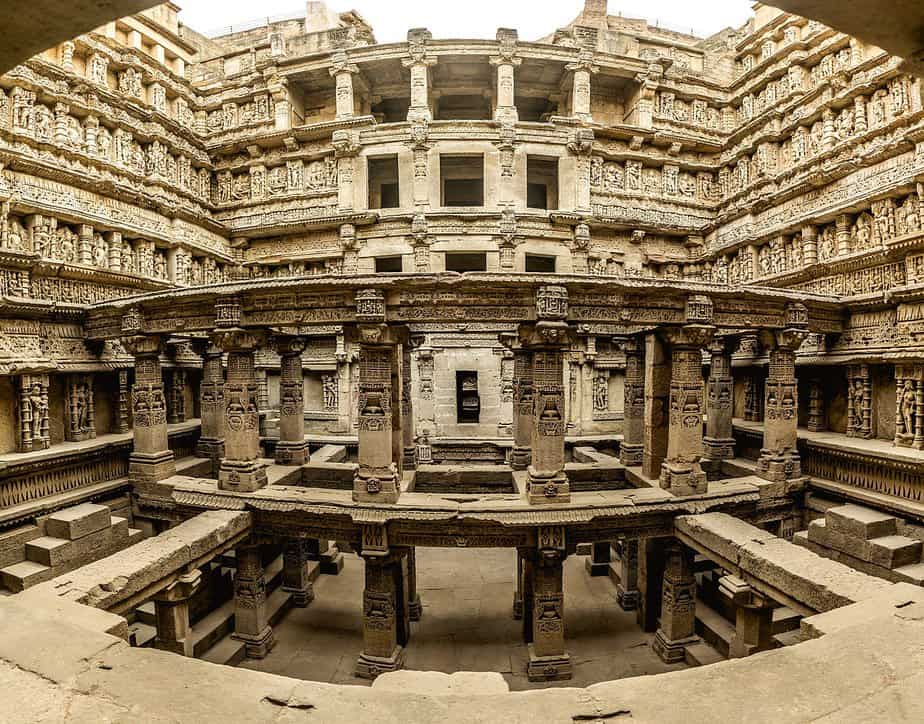
The image shows a stone stepwell composed of multiple descending levels arranged symmetrically along a central axis. The structure is built from light-colored stone and organized through repeated horizontal and vertical elements. Rectangular terraces step downward toward the center, creating a deep spatial cavity that extends below ground level. Each level is supported by rows of carved stone columns that align vertically, forming stacked corridors around the central opening.
The composition is strongly symmetrical. The left and right sides mirror each other in the placement of columns, steps, and carved surfaces. The focal point appears at the center of the image, where a rectangular opening is framed by pillars and horizontal beams. This opening aligns with the axis of descent and draws attention inward and downward through the space.
Texture is highly visible across the stone surfaces. The walls, columns, and beams display dense carved patterns, while the steps appear smoother from repeated use and erosion. The contrast between the detailed carvings and the flat planes of steps emphasizes variation in surface treatment. Scale is communicated through the size of the columns and the height of the stacked levels, which appear larger than a human body and suggest a structure designed for sustained movement rather than a single viewpoint.
The material throughout the image is stone, assembled through stacked construction rather than applied decoration. The spatial organization directs the viewer’s eye downward through layered platforms, while the repetition of columns and terraces establishes a rhythmic visual pattern across the structure.
Section 2: Interpretation & Meaning
Based on the visual description, the stepwell communicates ideas related to movement, control, and spatial progression. The repeated descent of steps and terraces suggests that the work is experienced gradually rather than all at once. Because the entire structure cannot be seen from a single position, meaning emerges through movement through space. This spatial arrangement shapes the viewer’s experience by requiring physical navigation rather than passive observation.
The strong symmetry and repetition of architectural elements contribute to a sense of order and regulation. The alignment of columns across levels visually reinforces stability and continuity, while the narrowing perspective toward lower levels increases awareness of depth. This visual narrowing may encourage attentiveness to one’s position within the structure, as each level offers a slightly different viewpoint and degree of enclosure.
The location of the stepwell below ground level also shapes interpretation. Unlike structures that rise upward into open space, this work draws the viewer downward, away from the surrounding environment. This spatial separation may influence how viewers perceive the site as distinct from everyday movement above ground. The controlled descent, marked by steps and platforms, structures how the body moves through the space and limits the speed at which it can be traversed.
Different viewers may interpret the stepwell differently based on their familiarity with similar architectural forms. A visitor encountering the site for the first time may focus on the visual complexity of the carvings and the depth of the space, while a local viewer may understand the structure as part of a broader built environment. Viewers with architectural interests may emphasize symmetry and construction methods, whereas others may focus on scale and spatial immersion. In all cases, interpretation is shaped by visible features such as repetition, depth, and enclosure rather than by symbolic reference.
Section 3: Space, Power, and Access
Access to Rani ki Vav is shaped by both physical and institutional factors. The structure can only be encountered by individuals who travel to its specific geographic location, limiting access based on mobility and resources. Within the site, movement is guided by architectural design. The stepped descent controls how far visitors can move and where they can stand, regulating access to different levels of the space.
Control over the site is currently exercised through heritage and tourism management. Barriers, designated pathways, and viewing restrictions determine which areas are accessible and which remain closed. This regulation shapes how long visitors can remain in the space and which perspectives are available to them. The encounter is therefore planned rather than accidental, as visitors intentionally seek out the site.
The visibility of the work is long-term and continuous, as the stone construction anchors it permanently within the landscape. However, its below-ground placement reduces visibility from a distance, requiring deliberate entry to experience it fully. This combination of permanence and restricted access highlights how power operates through spatial design, determining who encounters the work and under what conditions.
Yiqi Li
Your article provides a detailed description of the image’s structure, composition, and texture. The paragraph stating “The structure is built from light-colored stone and organized through repeated horizontal and vertical elements” also describes the building’s color and materials. This clear and simple description brings the building vividly to life for the reader.
Your interpretation mentions people’s sense of scale and spatial immersion. Your interpretation is very persuasive because you point out that due to visible features such as repetition, depth, and enclosure, tourists and local residents will have different experiences. First-time visitors will focus on the carvings in the stairwell, paying attention to the layers and spatial sense of the carvings, while local residents will see the stairwell as part of the larger architectural environment.
Regarding directions for improvement, you could further consider whether people’s experience of viewing this artwork differs under different weather conditions. The interplay of light and shadow on sunny days and rainy days affects the architecture, and people’s experiences will change accordingly.
Furthermore, do people’s perceptions of the stairwell also differ depending on their location and angle?