Title: What Remains
Artist: Hyuro (Tamara Djurovic)
Location: Belo Horizonte, Brazil
Date: 2018 Space
Section 1: Visual Description
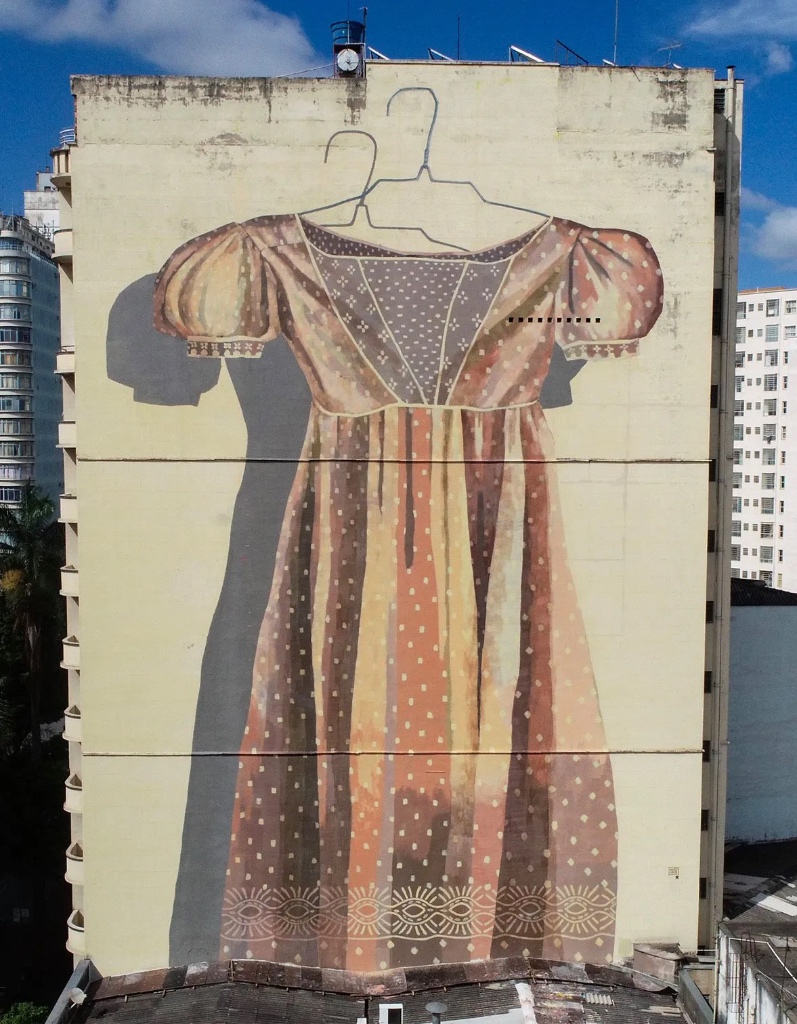
The mural features a large-scale representation of a single dress suspended on a wire clothes hanger, painted onto the side of a tall, beige concrete building. The garment is a vintage-style dress with puffed short sleeves, a high waist, and a long skirt extending toward the bottom of the architectural surface. The color palette is restricted to muted earth tones: dusty roses, ochres, and brownish-greys, accented by white patterns. The bodice and the hem of the skirt are decorated with intricate, repetitive geometric and floral patterns resembling lace or embroidery.
A dark grey shadow is cast to the left of the dress. This shadow mimics the shape of the garment but is elongated and lacks the internal patterns of the physical dress, appearing as a solid, flat silhouette. Two thin, wire hangers are visible at the top—one holding the dress and another slightly offset.
The composition is centered and vertical, utilizing the entire height of the windowless facade. The lines defining the garment are soft and illustrative, while the outline of the shadow is sharp against the light-colored wall. The texture appears matte and integrated into the weathered concrete. A row of small, dark rectangular vents punctuates the right side of the bodice, serving as the only architectural interruption to the painted image.
Section 2: Interpretation & Meaning
“What Remains” serves as a commentary on the absence of the female body and the lingering “shadow” of those lost to systemic issues. The choice to paint an empty dress—a garment traditionally associated with femininity and domesticity—suggests a person who is no longer present. The title implies a vestige or a memory left behind. The dress acts as a stand-in for the human form, but its hollowness emphasizes a sense of loss or erasure.
The central meaning is tied to the socio-political climate regarding reproductive rights and the high mortality rate of women in societies with restrictive laws. The dress is not merely clothing; it functions as a shroud or a monument. The shadow is evocative; while the painted dress is stationary, the shadow suggests a ghostly presence that persists in the public eye. The repetition of the hanger may symbolize the precariousness of life or the “hanging” nature of political progress.
The urban space shapes this meaning by placing an intimate, private object on a massive, public scale. By inflating a domestic item to the height of a building, Hyuro forces “private” tragedies into public discourse. Different viewers engage with this differently: a local resident may see it as a specific political statement on Brazilian legislation, while an international observer might interpret it as a broader meditation on grief. The lack of a physical body allows viewers to project diverse identities onto the empty fabric, making a political message feel personal.
Section 3: Space, Power, and Access
This mural exists within an “everyday” urban space, making it accessible to anyone traversing the streets of Belo Horizonte. Unlike art in a gallery, which requires a conscious decision to enter a curated space, this work is encountered accidentally. This democratizes the art, allowing the message to reach those most affected by the laws the work critiques, regardless of their socio-economic background.
The power dynamic is centered on visibility and control. The building’s owners or the city hold the power to allow or remove the work, making its existence a negotiated presence. However, the artist exerts power by reclaiming the vertical skyline—usually reserved for commercial branding—to display a message of mourning. Because it is outdoors, the work is subject to natural light; the “real” shadow cast by the sun changes throughout the day, interacting with the painted shadow and making the encounter a dynamic experience that varies based on the time and the viewer’s physical position in the street.
By transforming a towering facade into a site of collective memory, Hyuro’s work ensures that the “shadows” of the marginalized remain visible in the heart of the city.
Hanna Edwards
What’s Working:
Your description of the artwork helped me clearly visualize the mural’s composition and scale without needing to look at the image much at first. In particular, I think the way you described how the muted earth tones contrast with the flat, dark shadow beside it. This clear attention to colour and line makes the absence of a body feel more noticeable.
Your interpretation of the piece is well done as you consistently connect visual elements to a larger meaning. Your interpretation of the empty dress as a stand-in for the female body is well supported by your discussion of femininity, domesticity, and absence. I also found your interpretation of the shadow quite strong, especially the idea that it represents a lingering presence rather than a physical form.
One Area to Strengthen:
One way to strengthen this analysis is to elaborate on the viewer’s physical experience when encountering this mural in public. While you did address some effects of the piece being in a public area, adding detail on how the piece’s size affects the viewer’s perception of the image when standing beneath it at street level could have added to your analysis of the piece. Some of these aspects could include its height, distance, and how it may loom over the public, and how this affects the viewer’s feelings when looking at the piece.
One Question For Author:
My question is, how would this work be interpreted differently by somebody who is unaware of the political context behind the piece? And without knowing this context, do you think that the mural still communicates loss?