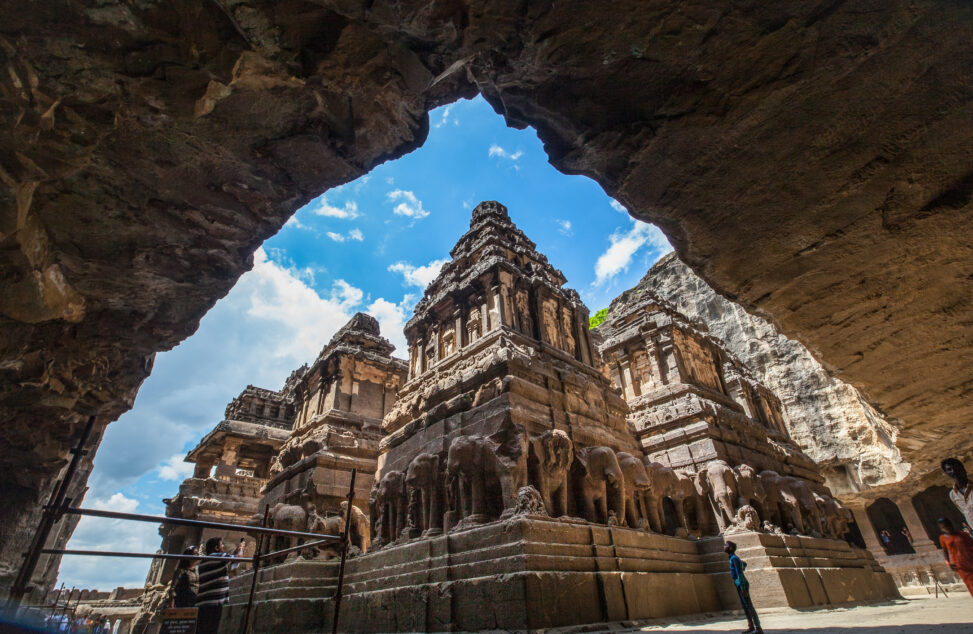
Title: Kailasa (Kailasanatha) Temple, Cave 16
Artist/Creator: Unknown rock-cut artisans (Rashtrakuta period patronage)
Location: Ellora Caves, Maharashtra, India
Date: 8th century CE
Space of Art: Public / Earth Art (site-specific rock-cut architecture and sculpture)
Section 1: Visual Description
The image shows a large stone temple structure positioned within an excavated rock courtyard. The temple rises from a stepped rectangular platform that occupies the lower center of the frame. Along the base of this platform is a continuous row of elephant sculptures carved in high relief. The elephants are arranged side by side, each facing outward, forming a repeating horizontal band.
Above the platform, the temple is composed of stacked stone volumes that decrease in size as they rise upward. The surfaces include carved columns, recessed niches, and layered horizontal bands. The stone appears textured, with visible tool marks, surface irregularities, and areas of erosion. The color of the stone ranges from warm brown to gray, with variations caused by light and shadow.
The composition centers the temple while steep rock walls surround it on three sides. An irregular rock opening frames the upper edge of the image, revealing a section of blue sky with scattered white clouds. Light enters from above, illuminating the upper portions of the temple and creating shadowed areas along the lower edges and inside carved recesses.
Several human figures appear near the base of the structure. Their small scale in comparison to the temple emphasizes the size of the carved environment. Metal railings are visible along the left side, marking a pathway. The overall scene combines solid carved forms with open sky and enclosed stone walls.
Section 2: Interpretation & Meaning
The temple’s central placement and large scale organize how the viewer experiences the space. Because the structure rises from a carved-out courtyard rather than being constructed from assembled materials, the work appears integrated with the surrounding rock. The contrast between the solid temple mass and the excavated void emphasizes the transformation of natural stone into an architectural environment.
The row of elephant sculptures along the base creates a visual foundation. Their repeated forms produce a rhythmic horizontal line that stabilizes the structure above. This repetition draws attention to the platform as a structural and visual support for the upper levels. Above this base, the stacked architectural tiers guide the viewer’s gaze upward. This vertical movement shifts attention from the ground to the sky framed above, linking the temple’s carved stone surfaces with the open space overhead.
The enclosing rock walls shape the viewer’s bodily orientation. To see the full height of the structure, the viewer must look upward, which changes posture and directs attention vertically. The opening in the rock ceiling frames the sky and creates a contrast between the carved stone and the open air. This contrast highlights the temple as a focal point within a space that is both enclosed and open.
Different viewers may interpret this environment in different ways. Some may focus on the scale difference between the small human figures and the large carved forms, understanding the site as a demonstration of extensive labor and technical skill. Others may be drawn to the dense carved surfaces and repeated architectural patterns, reading the site as a carefully organized visual system. Because the structure is inseparable from its geological surroundings, the site can also be understood as a transformation of landscape into architecture rather than a building placed onto land.
Section 3: Space, Power, and Access
Encountering this work is usually a planned experience. Visitors must travel to the Ellora Caves and enter a managed heritage site to see it. Access is regulated through pathways, barriers, and preservation rules, which shape how closely viewers can approach the structure and where they can stand.
This setting affects who encounters the work. People with the time, resources, and mobility to travel to the site can experience the scale of the temple in person, while others rely on photographs and digital reproductions. Unlike artworks in urban public spaces that may be encountered accidentally, this site requires intentional effort to visit.
The temple is carved from living rock, making it physically permanent, yet its visibility is shaped by modern systems of cultural preservation and tourism management. Light conditions, visitor flow, and site regulations influence how it is seen at different times. The space therefore connects ancient artistic production with contemporary structures of ownership, protection, and access.

Mayank Mehan
Peer Feedback
One part of your analysis that works especially well is your visual description of the elephant sculptures at the base of the temple. Your explanation of how they are arranged in a continuous row and carved in high relief helped me clearly visualize how the platform is structured. The way you connect this detail to scale, especially by contrasting the elephants with the small human figures nearby, effectively communicates the massive size of the site. This descriptive moment grounds the reader before moving into interpretation.
Your interpretation of vertical movement is also convincing. You support this idea by pointing to the stacked architectural tiers and the opening in the rock ceiling that frames the sky. By explaining how the viewer must look upward to see the full height of the structure, you clearly show how composition and space shape the bodily experience of the site. The connection you make between carved stone surfaces and the open sky is well supported by visual evidence from the image.
One area where the analysis could be strengthened is in the discussion of audience experience. You might expand on how different viewers move through the space at ground level versus elevated viewpoints, or how pathways and railings influence how long viewers remain in certain areas. Adding a bit more detail about how the space is navigated could deepen the discussion of access and control.
One question I had while reading was: How might the meaning of this temple change if it were encountered through a photograph rather than in person, especially given its scale and vertical orientation?