Title Can’t Help Myself
Artist/creator: Sun Yuan and Peng Yu
Location or platform: Guggenheim Museum, New York, New York
Date: 2016-2019
Materials: Industrial robot, rubber, cellulose ether in coloured water, Cognex visual sensors
Section 1: Visual Description
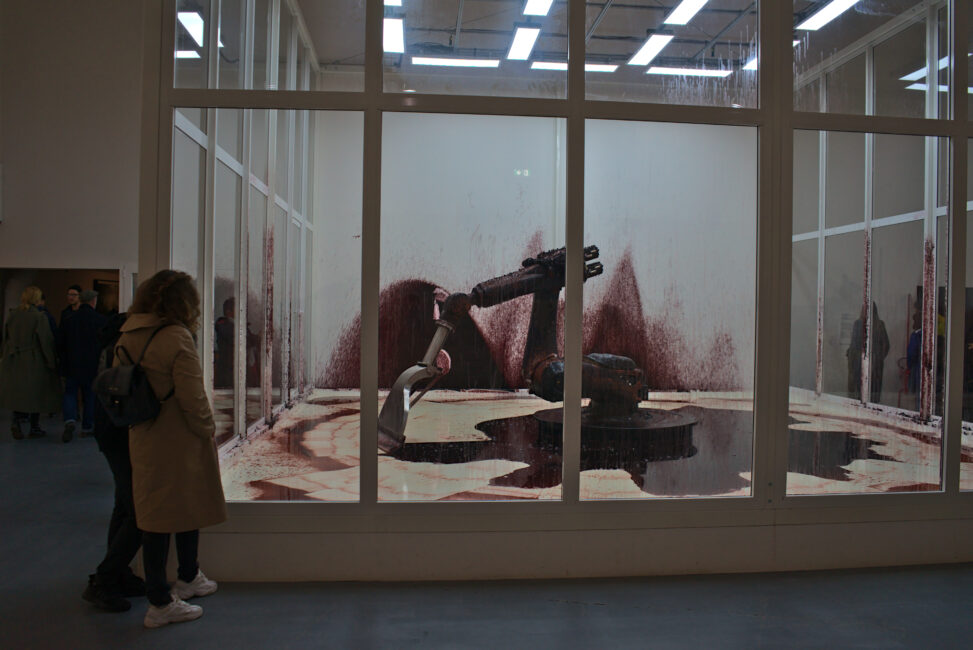
The kinetic sculpture or performance lies within a seven-by-seven metre white box with clear acrylic viewing panes on three sides of the robotic arm, with one wall being plain white. The central KUKA industrial robotic arm that has been painted black and is around three meters long while fully extended, lies in the center of the box on a circular platform, making it the focal point of the sculpture both in its centralization in the box, along with its size and black colour. The arm sports a large squeegee blade attached to the end, and the arm and the box it lies within are both very geometric and unnatural shapes. The robot is programmed in the KUKA robot language, and all of its wiring lies below its platform. The seven-by-seven metre
box’s floor is coated with cellulose ether in a solution of red coloured water. This makes the fluid quite viscous, and the dark red within it is the dominant colour. This dark red contrasts with the once clean white walls and clear acrylic viewing panes. The robotic arm in the center has been programmed to contain this red liquid using the arm to squeeze the red fluid back towards itself at the center when the liquid starts to ooze too far away from the robotic arm. It does this through the bright LED lights and four GigE Cognex industrial cameras attached to the ceiling. This allows the robot to “perceive” the liquid as it is moving and to move the liquid back to the center, but it does not perform this task perfectly, as the walls are eventually splattered with the red liquid. Furthermore, the robotic arm has been programmed to perform thirty-two gestures or movements, with the artist naming the movement with examples like “Ass Shake”, “Raise Hand”, “Scratch an Itch” and “cheerful.” The total set of actions is outlined on pages 42-44 of the second source.
Section 2: Interpretation & Meaning
One of the clearest interpretations one can get from this sculpture or performance is that the red viscous liquid the robotic arm is trying to keep gathered with its squeegeeing arm is that the red liquid is blood. This frames the robot as forced to endure and endless task for its life the robot is trying to contain its own leaking and oozing blood further emphasized by the pieces title of “Can’t Help Myself” the robot is apologizing for its endless mess that it is endlessly forced to contain and clean while performing its pre programmed actions as if an attempt to distract from all the blood and the mess being made.
The splattering of the red liquid on the white walls shapes this interpretation of it being blood, as the contrast of the dark dripping red invites a sense of despair for the robotic arm, as the box it lies within had to be known to eventually have this effect. Further, the clear panels on three sides of the box invite the viewers to gaze at the robot as it performs its endless task. Similarly, the gestures the robot performs also exemplify this perspective, as the gestures are for performance, the gestures do not assist the robot in achieving its goal of containing the red liquid. Therefore, the gestures are purely for performance, inviting the viewers to watch on.
Another interpretation is that of the way in which technology and bloodshed are connected. The robot appears with the “blood” showing the ties being technologized and the harm it causes. Further, the robot is cleaning up this bloodshed. The world will use more technology to mend the damage caused by previous uses of technology, perpetuating an endless cycle like the one the robot is performing in its actions. Another contributing factor in this interpretation is the sterile white wall behind the robot, as new technology is always displayed as incredible innovation and will fix the world’s problems, when the ramifications of the technology are not known until after the technology has been in service for a while.
Section 3: Space, Power, and Access
Unfortunately, the piece lies behind closed doors. Originally, the piece was commissioned for the Guggenheim Museum in New York, making it inaccessible for the average person. These conditions mean that the primary audience is those who have to visit art galleries and are seeking to engage with artworks. The fact that the piece lies within the space of the gallery means the gallery has control over the space that the piece lies within, although technical documents in the sources provide clear directions on how the space within the seven-by-seven metre box is to be maintained. Because the piece is in the gallery, this means the encounter with the artwork is planned by the museum with the room it is within and the framing of how onlookers will encounter the piece is planned. The robot was programmed to run the entire time the museum is open, and the duration that the performance runs for adds to the effect of the piece, as the longer it runs, the more time it has to progress and affect the environment it lies within
Zhijun Cai
What’s Working
The image of the robotic arm actively shoving the red fluid back toward the center of the enclosure made it easier for me to visualize this piece in motion. The contrast between the dark red liquid and the white walls is effectively described, especially considering that it presents an opportunity to use color and space in tandem toward an effect that creates tension and unease. Given such detailed visual grounding, one can imagine how the environment continues to change as the liquid spreads and stains the enclosure.
Your interpretation of the red liquid as blood is convincingly sustained because this reading would consistently link specific pieces of visual evidence to it. Indeed, the red liquid splattering against the white walls, alongside the robot repeatedly trying to contain the substance but never actually succeeding, is convincing evidence for an interpretation of despair and futility. You have also very well differentiated between the robot’s functional and performative movements, showing how such gestures contribute to the impression that it is not so much being assisted but rather is under observation. Here, description and interpretation link very tightly.
One Area to Strengthen
Greater elaboration on how bodily positioning influences meanings could have further deepened this analysis. You have already set yourself up beautifully by invoking the clear acrylic walls and what they allow regarding spectatorship; the implications of one’s distance as a viewer, perhaps even one’s immobility or inability to intervene, might have had even further implications of power relations between audiences, institutions, and machines. More attention to viewer access and spatial control would have deepened your space and power discussion.
One Question for the Author
How might the meaning of this work change if viewers were allowed to enter the enclosure or if the robot were displayed in a non-museum, public space rather than within the controlled environment of the gallery?