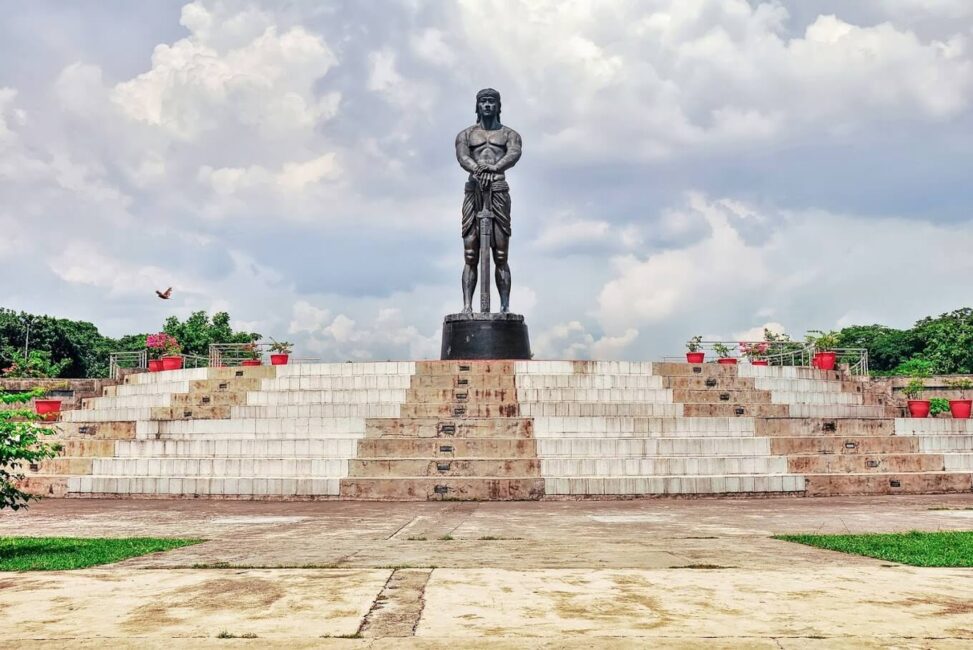
The Sentinel of Freedom
Visual Description
Juan Sajid lmao sculpted the Sentinel of Freedom in 2004. It was inaugurated by Korea as an act of gratitude for the Philippines for fighting in the Korean War (Admin, 2020). Also known as the Lapu-Lapu monument, based on a Filipino hero Datu Lapu-Lapu himself (Admin, 2020). The statue is placed in the National Museum of the Philippines at Rizal Park, Manila (Luneta Park) (Admin, 2020). This large 40-foot bronze statue stands in the center of a ten-foot-long stone pedestal (Admin, 2020). The statue is located in the center of Agrifina circle of Rizal Park separating the statue from its surroundings (Intrepid Wanderer, 2013). Lapu-Lapu is portrayed in a tense upright stance, with his hands on a large wooden axe aimed at the ground, and he faces the Manila Bay. Lapu-Lapu has a muscular, strong build that is emphasized by the bronze’s raised details. He is pictured barefoot, raised details on the bronze create a cloth wrapped around his body and head. The raised lines of the sculpture are mostly vertical and curved. There are no vibrant colours, only shades of black, white, and grey making the statue stand out in the bright hours of the day. Textures of the statue are mostly rough due to the cast bronze; visible grooves are left from the sculpting process. Due to the large scale of this statue, the audience is encouraged to look up, making the focal point his head and chest area.
Interpretation and Meaning
Learning the history of the Philippines helps us understand the significant meaning of the Sentinel of Freedom. Datu Lapu-Lapu is a known hero in the Philippines, as he was the first to resist foreign domination during the Spanish colonization (Kahimyang, n.d.). The statue purposely faces the Manila Bay, as a historical reference to the Battle of Mactan, where the foreigners were coming from the ocean (Kahimyang, n.d.). Knowing this information helps us further analyze the statue. Lapu-Lapu is built with cast bronze, a heavy, strong metal, which can signify the everlasting legacy of Lapu-Lapu, unbreakable. Facing Manila Bay also shows him protecting his people from possible invaders coming from the waters. Based on the solidity and strength of the cast bronze, the strength of the bronze may also stand for his power and resilience. The dark colours of the statue can portray physical strength, dignity, and give the statue a solid and grounded look. Dark tones also carry the representation of seriousness, showing his determination to protect his people. The dark colour catches the attention of viewers to honour and think of the hero. The strong vertical lines allow the statue to be tall, standing for stability and strength. Tactile textures on the statue also help emphasize his muscles, conveying his physical strength. With clear human proportions, the statue is solid and robust, representing power. Lapu-Lapu stands straight and tense, his clothes are flat on his body with subtle lines, suggesting no movement. His stillness could represent that he is not violent, but a protector. Lapu-Lapu being the center of Agrifina circle separates the statue from other structures and this shows that the viewers’ attention should be on the statue, signalling an important figure of history. Being isolated from other structures suggests Lapu-Lapu’s independence and courage to stand against the Spaniards. The emptiness of the space surrounding the statue allows people to reflect and think of the hero Lapu-Lapu, creating an emotional space. Overall, the monument has significant meaning in the history of the Philippines, allowing visitors to reflect on the Filipino past.
Space, Power, and Access
The National Museum of the Philippines (NMP) has free admission, allowing a broad range of people to see architecture and fine arts through the history of the Philippines. The NMP is government-owned and controlled by individuals in the Fine Arts Division (National Museum of the Philippines, 2020). The significant size also allows citizens to see the statue from further away. Locals can visit the monument as much as they would like or can see it just by walking past. With millions of visitors in the Philippines each year, the monument can be seen by anyone. Rizal Park first represented the heroes who had passed in the memorial park during the Philippine Revolution. Many Filipinos complain, finding this monument disrespectful and come across it unwillingly. Visually, the statue is easily noticeable based on its size and dark colour. Additionally, the park offers ceremonies, events, and those who attend get a clear view of the monument. The design of this monument is bold and is meant to be seen by those nearby, allowing Lapu-Lapu’s legacy to live on.
Juniper Morrison-Turley
What’s working
Your description of the size of the statue helped me visualize the total scale of the statue as well as the description of the statue in what it is wearing and where it is positioned within the National Museum of the Philippines. This very detailed description of the statue helped me obtain a clearer understanding of the artwork as a whole.
Your interpretation of the artwork within the context of the Philippines is convincing, as the historical evidence being presented seems to rely on solid evidence from the history of the Philippines, as well as pointing to the connection between the strength of the bronze and the strength of Lapu-Lapu.
One area to strengthen
I was interested in hearing more about the other ways in which this artwork could be interpreted, ed and you could strengthen this by providing more on the other interpretation one may take, provided by more evidence about the way in which the space may affect the interpretation of the piece.
One Question for The Author
My question would be how the interpretation of the artwork would change if it were placed in a different space, as said in your description, it faces Manila Bay, so I would be curious about how the location of where the statue is placed would affect the interpretations.
Chido Nicole Dube
What’s working :
The way you draw attention to the mural’s use of vivid colour and strong black contour lines to provide structure and energy is among your analysis’s best features. Your focus on how the thick outlines maintain the composition and the recurring bright tones create a sense of movement shows that you have a solid grasp of visual components including colour, line, and composition. Additionally, I thought your interpretation of the closely clustered, overlapping figures was quite well done. You provide convincing visual evidence to back up your opinion by describing how the condensed area and absence of a distinct focal point represent equality and communal identity. Your description of the viewer’s eye moving across the mural highlights how the design promotes interaction with the community as a whole rather than giving preference to any one person. It is particularly persuasive to draw a contrast between what we see with the naked eye and what it implies about social interaction.
One Area to Strengthen:
You may improve your analysis by going a little farther with your discussion of audience and space. You may elaborate on how the surrounding architecture, accompanying businesses, or foot traffic affect how viewers interact with the artwork, even though you say that the site portrays ordinary urban life. Your understanding of how public space shapes meaning would be strengthened if you took into account the mural’s scale in relation to the street and how near viewers must stand to fully experience it.
One question for the Author
Would this mural’s significance change if it were moved to a gallery or put in a new neighbourhood with a different social or economic background?
Tahiana Ramaroson
Your description of Lapu-Lapu’s posture and the axe helped me connect the text to the image. When you point out his upright stance and muscular body, I could clearly see how the scale and texture of the bronze make him look powerful. This strong visual detail works well because it shows observation instead of only background information. I also found your interpretation convincing when You explain that the dark colour and heavy bronze material represent strength and permanence. You support this by referring to visual elements like colour and line which makes your meaning feel grounded in what we can actually see.
One area you could strengthen is the analvsis of space and audience experience. Since we can see how open the surroundings are, you might describe more specifically how the empty circular space and pedestal affect the viewer’s perspective. For example, explaining how the height and placement force us to look upward could deepen your discussion of space and power. Adding a bit more direct visual evidence from the image would make this section stronger.
One question I have is: how might the message of protection or heroism change if this monument were placed indoors or in a crowded urban space instead of an open park setting?