Artist/creator: D.A.ST. Arteam
Location or platform: Sahara Desert, Egypt (near the Red Sea)
Date: 1997
Materials: Sand and earth (land art / earthwork)
Section 1: Visual Description
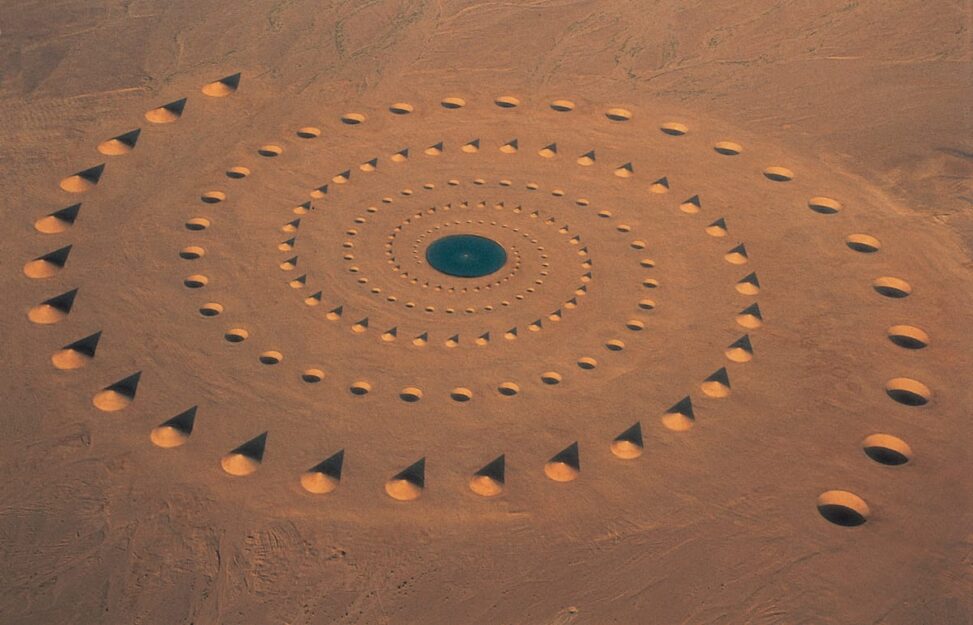
This photograph shows an aerial view of a large circular formation dug into a flat desert surface. The composition shows multiple rings arranged around a central dark circular area that looks to be filled with water. Each ring switches between raised mounds and dug out circles, creating a repeating pattern of positive and negative space. The cones appear evenly spaced and similar in size within each ring, creating a strong sense of geometric order.
The color palette uses natural earth tones. The sand appears to be mainly light brown, while darker areas come from shadows that fall inside the holes and along the sides of the raised cones. The contrast in the image is made using light and shadow rather than differences in material.
Texture is seen across the top of the sand, with smoother areas inside the circular holes and rougher, wind made textures between each shape. The scale of the work is shown by the number of repeated elements and the distance between rings, which extend beyond the central point.
The focal point of the image is the dark circle at the center. From this vantage point, the spiraling structure is seen as a symmetric design with mounds on one side and holes on the other. There is no visible border separating the art from the surrounding desert, and the artwork appears to blend in with the landscape. No signage, structures, or human figures are present within the frame.
Section 2: Interpretation and Meaning
Based on its visual structure, the art can be interpreted as an organized arrangement placed within a natural desert landscape. The repeated spacing and consistent size of the mounds and holes shows careful planning. These precise forms are very different to the surrounding sand, which appears uneven and shaped by natural forces. This contrast shows the difference between planned order and natural terrain.
The circular layout encourages the viewer’s eye to move outward from the center through the repeated rings. Instead of drawing attention in one direction, the design creates a lot of movement around the focal point. The dark circular area at the center functions as the focal point, providing a place to look at that helps organize the surrounding elements. The repeated patterns create rhythm through symmetry and repetition.
The aerial perspective of the photograph is important to show how the work is understood. From this viewpoint, the entire structure is visible at once, making its overall organization clear. People looking at the art through this image can easily recognize the full pattern. Although, a viewer standing within the site would likely see only individual mounds or holes at a time. This difference shows that interpretation can depend on perspective and distance, often requiring the full image.
Different people may respond to different visual features. Some may focus on the clear order of the forms, while others may notice the difference between the artwork and the surrounding desert. Because there is no text, or signage in the image, the art does not have just one explanation. The meaning is formed through observation of visual elements such as scale, repetition, and spatial arrangement.
Overall, the photograph presents the artwork as a system of repeated forms dug and built up directly into the landscape. Interpretation comes from how the shapes are organized and how the art takes up space, instead of coming from narrative content or symbolic reference.
Section 3: Space, Power, and Access
The space in which this artwork exists affects who can encounter it and how it is experienced. Because the work is located in a remote desert area, it is unlikely to be seen by chance. Most viewers will encounter the art through photographs rather than direct experience.
This birds eye view of the image provides a complete view of the composition that would be difficult to access from ground level. By showing the entire pattern at once, the photograph shows symmetry. Due to this, those who create and share these images have influence over how the artwork is understood by a wider audience.
Because the artwork is not displayed in a museum, it is not easily accessible. Travel, location, and visibility limit who can experience it in person. People who view the art must plan to see it rather than accidently coming across it, and its visibility depends on documentation, such as photographs rather than permanent display structures.
This raises questions about access and control. While the space appears open, the ability to see and understand the artwork is shaped by distance and perspective. The space therefore plays an active role in determining who encounters the work and how it is experienced.
Chido Nicole Dube
What’s working:
I was able to picture Desert Breath’s overall composition thanks to your explanation of the aerial perspective. Your interpretation gains credibility when you clarify that the full spiral pattern is visible from above but broken at ground level. This is because you establish a direct link between perspective and meaning. Your explanation of symmetry and recurrence struck me as very well-written. You may easily see how rhythm is produced through repeated patterns by pointing to the circular depressions and equally spaced cones.Instead of making generalizations, your explanation of how light and shadow create contrast inside the holes shows a keen attention to visual evidence. Additionally, your understanding of composition and size is strengthened when you recognize the dark middle circle as the focus point. Your argument feels rooted in the image because of your skillful use of visual literacy terms like symmetry, texture, focal point, and spatial arrangement.
Area to strengthen:
Extending the discussion of audience and space is one area where the study could be improved. You make the crucial insight that the majority of viewers see the artwork through images rather than firsthand encounters. However, by investigating how reliance on aerial evidence restricts access or shapes interpretation, this concept could be expanded.You might make this stronger by explaining how the desert location’s remoteness impacts who can see the piece in person and how that changes meaning. Extending this idea would give your perspective greater nuance beyond simple explanation.
Questions for the Author:
How do you think the meaning of the artwork changes because most viewers experience it through aerial photography rather than physically walking through the site?