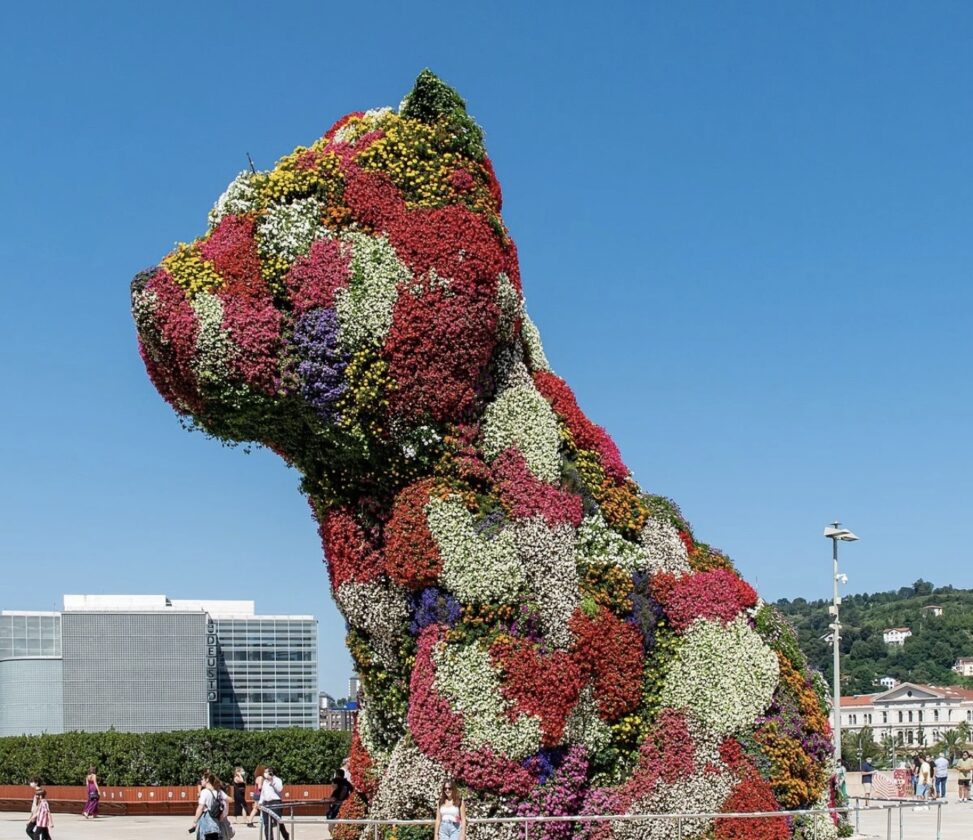
Puppy is a massive three-dimensional sculpture that resembles a sitting dog. With its small legs, round head, upright ears, and compact body, it resembles a terrier. The sculpture is far bigger than a genuine dog, standing about 13 meters tall.Living flowering plants are firmly packed throughout the entire building, covering its entire surface.
Shades of green, pink, white, yellow, red, and purple are among the many colours of the plants.Instead of being concentrated in one spot, these colours are dispersed uniformly throughout the surface. The thickness of the plant material gives the sculpture a deep, layered appearance. Even though individual flowers are tiny, when combined, they produce a surface that is textured and patterned.
The live materials are maintained via an internal irrigation system.The sculpture’s foundation is planted straight into the open plaza area. The sculpture is placed outside in front of a sizable modern structure.Because there is open space all around it, people can stroll around it and see it from different perspectives. The dog’s head and face, which face the surrounding public space, serve as the main focus point. The sculpture is visible from a distance because of its size, which dominates the surrounding area. Living plants, soil, and metal infrastructure make up the majority of the materials.
Puppy can be seen as a piece of art that blends gigantic scale with well-known iconography. The sculpture’s exceptionally huge size contrasts with the familiar shape of a dog. The increased scale transforms the experience from ordinary to remarkable because dogs are frequently observed in daily life. Viewers can suddenly come across the sculpture while strolling through a public area thanks to its outside positioning. Change is introduced over time by using real plants rather than conventional sculptural materials. Seasons, weather, and upkeep all affect the flowers’ density and colour. The way the artwork is perceived on various visits is impacted by this continuous change. Unlike sculptures made of stone or bronze, the artwork is not visually fixed.
Puppy’s placement outside a large museum influences how visitors engage with it. Access is expanded because viewers can view the sculpture without entering the museum. Tourists and locals alike may come across the piece while strolling around the neighbourhood without intending to attend an art show. Institutional fences and admission fees are eliminated in this public setting. Depending on their individual backgrounds, various viewers may perceive the artwork in different ways. While some viewers could be more interested in the outside environment and plant material, others might be more interested in the technical structure and scale. Some viewers who are accustomed to modern art would see the piece as a large-scale public sculpture, while others might see it as an eye-catching piece in an urban spa.
Because it is situated in a public area, a diverse group of visitors encounter Puppy. Residents, tourists, pedestrians, and museum visitors can all see the artwork. The sculpture is accessible even to those who do not enter the museum, which is more than the case with interior artwork.Although a cultural institution controls the area, the artwork is located beyond its boundaries. The line separating public area from institutional space is blurred by its positioning. The interaction with the artwork can be intentional, as in the case of museum visitors, or unintentional, as in the case of bystanders strolling by.
The artwork has power in the room because of its size and exterior visibility. Because of its magnitude, it is impossible to overlook and becomes a landmark in the city. Over time, the long-term placement makes it more visible, enabling recurring interactions. Instead of being a temporary display, the artwork becomes a part of the city’s everyday spatial experience because it is permanent.
Overall, Puppy demonstrates how contemporary public art can transform familiar imagery into a powerful shared experience. By combining monumental scale, living materials, and a universally recognizable form, the sculpture invites both casual passersby and intentional viewers to engage with art in everyday space. Its changing appearance over time reinforces the idea that art is not static but responsive to its environment, making Puppy an enduring and dynamic presence within the urban landscape.
Ruvarashe kuveya
Jeff Koons’ sculpture, Puppy, is instantly both happy and overwhelming. The picture makes me astonished at how something as commonplace as a puppy can be elevated to such a great height. Because of its immense size, a little terrier’s familiar shape takes on an astonishing quality. People walking close seem insignificant in comparison to it, which looms above them. The sculpture’s subject a puppy keeps it approachable and welcoming despite the contrast that gives it a sense of force. I find the usage of live flowers to be very noteworthy. A striking patchwork is produced throughout the surface by the vivid greens, pinks, reds, yellows, and purples. Soft, natural textures cover the dog instead of hard materials like metal or stone. This gives the sculpture a sense of life rather than immobility, in my opinion. Seasonal variations in the plants mean that the artwork never appears precisely the same. It intrigues me more than a conventional monument because of this notion of perpetual evolution. I also appreciate that it’s in a public area, outside. To enjoy it, people don’t need to organize a trip to the museum or purchase a ticket. All they have to do is stroll by and suddenly run into this enormous flower dog. I think this gives the artwork a friendly, inclusive vibe. All in all, the sculpture, in my opinion, turns a straightforward, well-known image into something playful, memorable, and intricately woven into its surroundings.