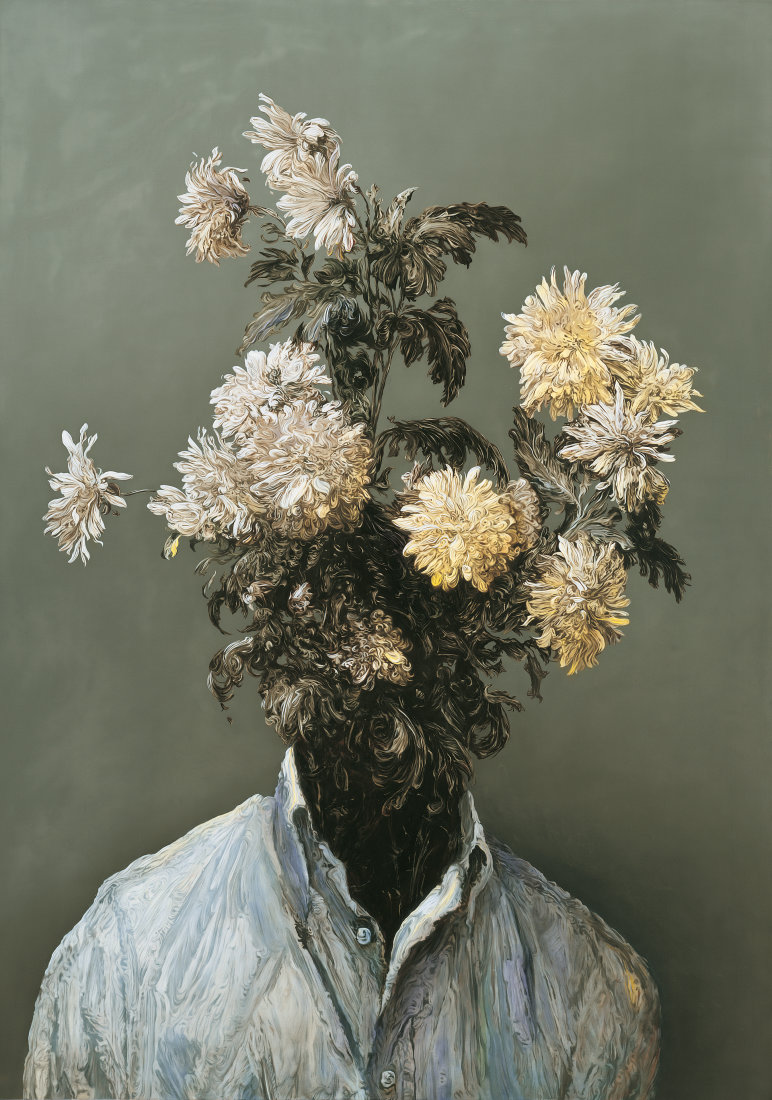
Title: Architecture and Morality Artist/Creator: Glenn Brown Space of Art: Virtual / Digital Space (contemporary digital painting) Platform/Location: Circulated through online contemporary art archives, gallery exhibitions, and digital art platforms Date (Approximate): Early 2000s (c. 2002–2004)
Section 1: Visual Description
The artwork presents a vertically oriented portrait-format image with a muted green background. In the center of the composition is the upper body of a human figure shown from the chest upward. The figure wears a light-colored collared shirt, painted with visible brushstrokes in tones of white, pale blue, and grey. The folds of the fabric are defined through layered lines and textured paint application.
Where the head would normally appear, there is a dense cluster of flowers and dark foliage. The floral forms extend upward and outward, occupying the upper half of the image. The flowers are primarily cream, white, and pale yellow, with petals rendered using curved, layered lines. The stems and leaves are darker, painted in deep green and brown tones, creating contrast against the lighter blooms.
The composition is centrally balanced, with the largest concentration of flowers positioned above the shirt collar. Smaller blossoms extend toward the left and right edges, adding asymmetry to the overall shape. The focal point is the floral mass, due to its lighter color and detailed texture compared to the darker central area beneath it.
The background is flat and untextured, with subtle tonal variation that provides negative space around the subject. The medium appears to be oil painting, with thick, layered brushwork and visible texture throughout the figure and floral elements.
Section 2: Interpretation & Meaning
This artwork presents a portrait-like figure, but the expected human head is replaced by an arrangement of flowers and dark foliage. By combining the recognizable form of a body in a collared shirt with organic plant elements, the work disrupts traditional portrait conventions. The absence of a face removes clear personal identity, which may suggest themes related to anonymity, transformation, or the limits of representation. The viewer is prompted to focus on the floral mass as the main subject, since it occupies the central space where facial features would normally provide recognition.
The contrast between the pale flowers and the darker foliage creates a strong visual emphasis, drawing attention upward. This replacement of the head with botanical forms may communicate ideas about the relationship between humans and the natural world, or the merging of bodily and organic structures. Because the flowers extend beyond the body’s outline, the work suggests expansion beyond the physical boundaries of the figure, shifting the portrait into something less fixed and more ambiguous.
The digital or virtual circulation of this artwork also shapes its meaning. Encountered on screens or online platforms rather than in everyday physical space, the image becomes part of contemporary digital viewing culture. The flat background and isolated subject enhance this effect, making the figure appear suspended in an undefined space, which can feel detached from a specific environment. This presentation encourages viewers to focus entirely on form and substitution rather than narrative setting.
Different audiences may interpret the work in various ways depending on their experiences. Some viewers may see the floral head as a comment on identity being constructed through external elements rather than facial individuality. Others might interpret it as an exploration of nature overtaking the human form, or as a surreal distortion of the portrait genre. Viewers familiar with art history may connect the piece to traditions of still life, vanitas imagery, or contemporary figurative experimentation. Overall, the work invites multiple readings through its unusual combination of human clothing, botanical structures, and the removal of a conventional face.
Section 3:Space, Power, and Access
Because this artwork is an oil painting, it exists first as a physical object that is typically encountered in institutional or gallery spaces. The people most likely to experience the work directly are those who have access to museums, exhibitions, or private collections. This limits viewership to audiences within cultural or economic systems that support fine art spaces. Those outside of these spaces may only encounter the work through reproductions online or in books.
The space surrounding the work is often controlled by curators, collectors, and art institutions, which determine where it is displayed, who can view it, and under what conditions. This reflects broader structures of power in the art world, where visibility depends on institutional support and ownership.
Encounters with the painting are usually planned, such as visiting a gallery, rather than accidental, since oil paintings are not typically present in everyday public environments. Duration of viewing also depends on access: some may spend extended time with the work in an exhibition, while others may only see it briefly through a digital image, which changes the experience of scale and surface texture.
Alexis Heggie
1. What’s Working
Your description of the floral mass replacing the head helped me clearly visualize the artwork. In particular, the way you describe the cream and pale-yellow flowers contrasted with darker green and brown foliage makes the focal point of the composition very clear. This attention to color contrast and central composition clearly communicates why the viewer’s eye is drawn upward, even before you move into interpretation. The flat, muted green background is also well described and functions clearly as a negative space, which supports your analysis of isolation and suspension. Your interpretation is convincing because you consistently point to specific visual evidence. For example, your discussion of identity and anonymity is grounded in the absence of facial features and the substitution of plant forms. This shows a strong distinction between description (what we see) and interpretation (what it may mean).
2. One Area to Strengthen
You might strengthen this by describing scale and surface in more depth. While you mention thick, layered brushwork, expanding on how the texture and painted lines affect the viewer’s experience, especially when the work is seen digitally versus in a gallery, could deepen your discussion of space and access.
3. One Question for the Author
How might the meaning of this artwork change if it were encountered only online and never as a physical painting? Especially considering the importance of texture, scale, and material presence in your analysis.
Divine Lawson
Your description of the cluster of flowers where the head would normally appear helped me visualize how abstract the nature of the painting was. I liked how your desciption of the flowers exposed the contrast the petals made against the dark foliage. It made the flowers more vivid and gave it life in a sense and made me wonder if forms of nature could be mixed.
Your interpretation is captivating because you explained how the absence of a human head could represent anonymity or limits of representation. It could make any viewer open to new discussions and open the room for more questions that haven’t been asked concerning the painting.
You could strengthen your interpretation by going a little in depth about how its transformation impacts one’s understanding of personal identity, and I’m curious about what you think concerning the absence of a head relating to the limit of representation.
How do you think the flowers replacing the face relate to the idea of identity? Do they suggest a loss of individuality, or do they represent a different kind of identity?