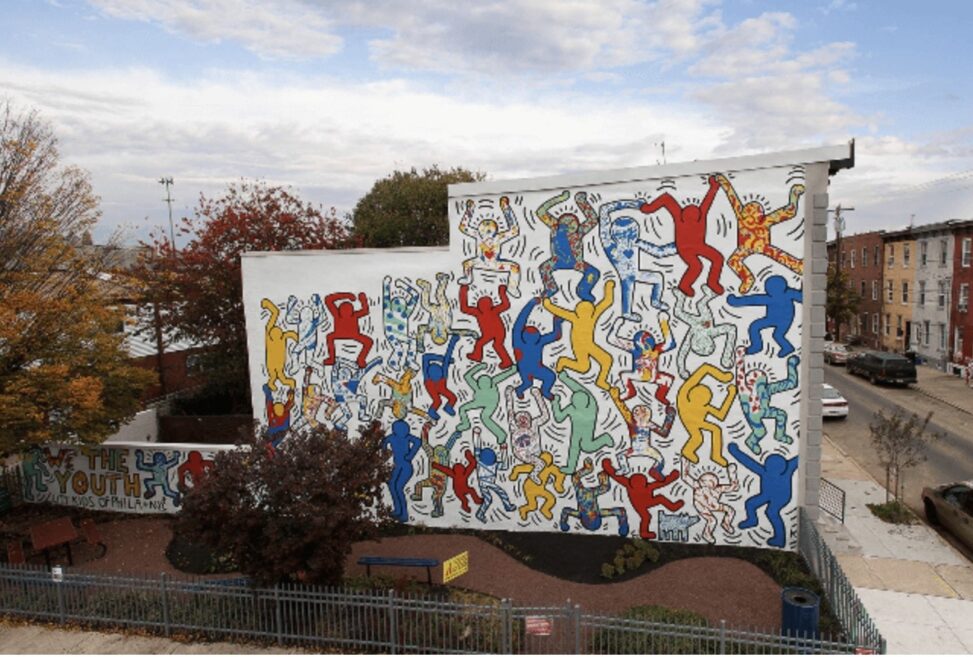
The piece of art is a sizable mural that was painted on a building’s side wall. The wall is placed horizontally and is rectangular in shape. Thick black lines delineate the flat, solid hues that blanket the surface. Because the background is mostly white, the colored figures are easily visible. The artwork repeats several simpler human-like images all over the wall. The figures are depicted in a variety of positions; some seem to be standing, while others are bending, leaping, or extending their limbs. There are no face characteristics or clothing detailing on the spherical bodies. The colors of the figurines include red, yellow, blue, green, and light blue.
Some bodies and limbs have lines radiating from them, indicating movement. Nearly the whole surface is filled with figures that overlap and interlock, leaving very little vacant area. As a result, the composition is thick and no single figure is able to dominate for very long. Covering the majority of the building’s side, the mural is enormous in comparison to a human. The figurines are grouped in rows and groups as the composition extends from one wall edge to the other. Instead of having a single focus point, the viewer’s attention travels throughout the surface as it follows the recurring lines and forms. It seems to be exterior paint that has been sprayed straight onto stucco or brick. The painting may be seen from the sidewalk and street because it is outside. The mural’s recurring human figures allude to concepts related to organizations rather than individuals. No body is visually emphasized since the figures are comparable in size and design. Ideas concerning collectivity or shared presence may be conveyed by this equitable treatment. It is possible to interpret the range of positions arms lifted, legs bowed, bodies inclined in various directions as a symbol of movement, activity, and social engagement. Strong contrast and excellent visibility from a distance are produced by the bright, flat colors arranged side by side. Because of its visual clarity, the painting is readable by those who are moving fast past, such automobiles or pedestrians. Many observers may see the images as open or flexible representations rather than distinct people due to the absence of face characteristics or clear identification indicators. Depending on their own experiences with young culture, public spaces, and communities, viewers may perceive these statistics differently. The mural’s outside placement on a building wall contributes to the perception of the surrounding community. Instead of seeing it in a museum, viewers come upon it in their daily lives. Given this context, it is possible that the mural’s topics are related to everyday urban life. The mural’s scale in relation to the human body also influences its significance. A spectator may feel as though they are part of or encircled by the mass of forms since they are smaller than the wall of figures in front of them. Some viewers may interpret the mural as demonstrating energy or expansion by focusing on the impression of motion produced by the radiating lines and dynamic stances. Others may focus more on the density and recurrence of bodies, seeing it as a statement about shared space, population, or togetherness. The piece presents a powerful visual impression while allowing for a variety of interpretations due to the simplification of the images. People that live, work, or pass through the neighborhood come into contact with this piece because it is a public mural. To see it, viewers don’t have to purchase a ticket or join a formal establishment. When compared to artwork seen in galleries or museums, this makes access easier. Nonetheless, access is still influenced by location and mobility since those who never come to this part of the city might never see the work in person. The mural is painted on a wall that is a part of a building, which means that local government and property owners own or manage the area. For the mural to have remained visible throughout time, permission would have been needed. Even though it seems to be accessible to anyone, this demonstrates how public art is subject to ownership and regulation structures. Mural encounters are frequently unintentional. While driving, strolling, or staring out a window, someone may notice it. The piece has a greater public presence since it is made to be visible from a distance. Since it is painted directly onto an external wall, weather, urban change, and upkeep all affect how long it lasts. Its visibility may diminish, be restored, or be eliminated, illustrating the ways in which time and spatial control impact public artworks.
Paige Choquet
What’s Working:
Your description of the bright vibrant colours being a repeated topic helped me visualize the energetic chaos of the community while being balanced out by the thick black lines, lining the bodies. Your interpretation of how the bodies are positioned relating to social engagement made me think deeper about this piece, and how the overlapping and tightness of the bodies reflects the closeness of a community. Your interpretation of this mural is convincing as you connect how the size and design of the figures all resemble one another to the point that there is not a set focal point allowing your eyes to travel throughout the mural with no single figure being more important than any other.
One Area to Strengthen:
A way you could strengthen your analysis is to mention how the surroundings could influence the way people may view the mural. While you did mention how the placement adds to the perception of the surrounding community and everyday urban life. You could go into mentioning how the neighborhood, surrounding buildings and businesses could influence the way someone sees and understands this mural.
One Question for the Author:
My question is, how could the way people view this mural change, depending on if the location changed? Would people living in different neighborhoods and who have different socioeconomic status have differing interpretations?