Title: Shoes on the Danube Bank
Artist/creator: A joint project between film director Can Togay and sculptor Gyula Pauer
Location: The Pest side of The Danube Promenade in Budapest, Hungary.
Date: 2005
Section 1: Visual Description
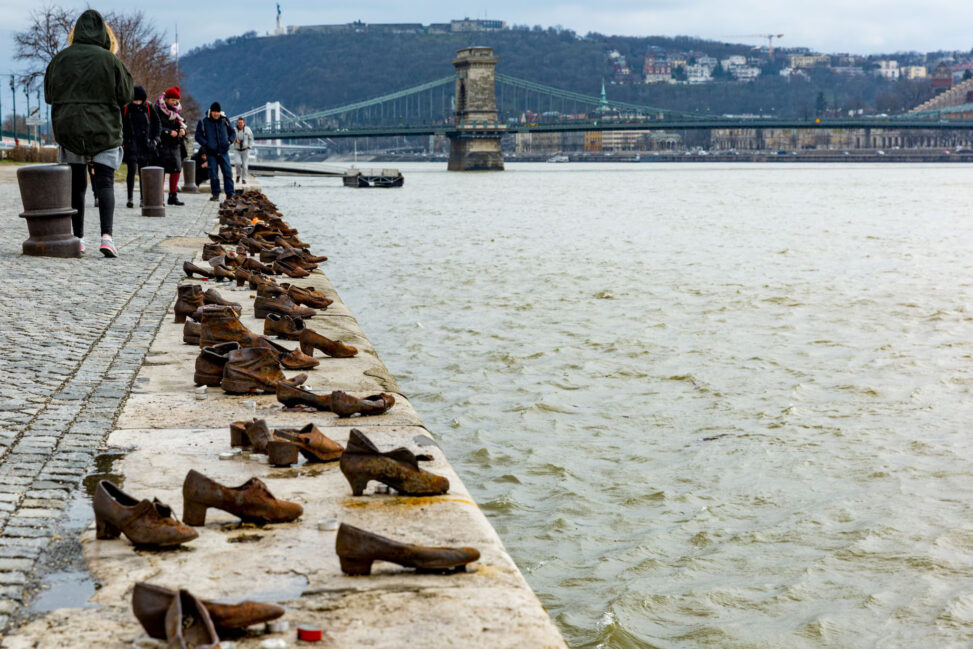
This image shows a variety of shoes arranged in a continuous, relatively straight line along the edge of a stone walkway beside a river. The shoes are staggered along the edge, angled in different directions but still facing the river. The shoes vary in size and design, including men’s, women’s, and possibly children’s footwear. Some shoes have laces; others resemble boots or even high heels. The shoes are not arranged in a pattern, and irregular gaps separate them, creating negative space. The repetition of the shoe forms visual rhythm, while slight variations in spacing and direction prevent the arrangement from appearing uniform. The shoes appear to be made of metal, and their colouring ranges from a deep brown to black, with uneven textures such as creases and dents. Each shoe, despite the repetition, is an individual piece, with its own design and texture.
Placing the shoes at ground level along a well-used pedestrian walkway makes them immediately noticeable to passersby. Their solid, dark features make them stand out in their surroundings, creating visual emphasis and drawing the eye to them. The shoes’ raised elevation relative to the river heightens the emphasis and clearly separates the sculpture from the moving water below. There is a strong contrast between the dark colours of the shoes and the lighter colours of the stone pedestrian walkway and river below. The light colours of the stone and river reflect sunlight, further emphasizing the dark shoes.
Section 2: Interpretation & Meaning
The arrangement of the shoes along the river creates both a sense of presence and absence. This absence invites viewers to question the piece and wonder who may have worn them. The different sizes and styles suggest that those who wore the shoes were of all ages and genders and came from different lifestyles. The irregular placement of the shoes feels organic, creating a sense of pause or interruption in the surrounding natural environment and makes viewers ask about the lives behind these absent individuals. Using metal as the material may have been strategic on the artist’s part. Unlike real shoes that wear and decay, these metal shoes are permanent and enduring, and symbolize the lasting impact of the lives they represent.
The placement of these shoes in a public pedestrian place by the river shapes how the audience interacts and experiences the piece. Their positioning and shape make them instantly noticeable from a distance, drawing viewers toward them. The flowing river the shoes are facing adds more potential meaning to the piece. The flowing river might symbolize the passage of time or life continuing, while the stationary shoes represent the human presence that once was or the lives lost. This relationship between the piece and its environment encourages viewers to slow down, engage with the work, and reflect on its possible significance.
Different viewers may interpret this piece in different ways depending on their personal experiences, cultural backgrounds, and understanding. Some may see it as a memorial, with each shoe representing a life lost, affected by tragedy or conflict, and forgotten by the river. Other viewers may focus on themes of identity and diversity, noticing each shoe’s differences in size, type, and texture, yet part of a large, cohesive arrangement. Additionally, the permanence of the metal shoes may prompt viewers to consider the lasting impact people leave behind and how memory and presence can endure even after someone is gone. By leaving space for multiple readings, the piece engages viewers on both individual and shared levels, allowing each person to make their own emotional connection with the work.
Section 3: Space, Power, and Access
The Shoes on the Danube Bank are located on the Danube Promenade in Budapest, a well-known public pedestrian walkway used by locals and tourists alike. The promenade is a popular leisure space that brings together people who are intentionally visiting the piece and others who encounter it unexpectedly while walking along the river. This mix of planned and accidental encounters shapes how the artwork is experienced, as some viewers arrive with prior knowledge of its meaning, while others discover it without context. As a result, the artwork reaches a wide and diverse audience, but the meaning viewers take away from it can vary greatly depending on their awareness, attention, and personal connection to the site.
The work is widely accessible, as it is a public place that does not require an admission fee or a formal entry. However, those who do not visit the promenade, such as individuals with limited mobility or those unfamiliar with the area, may never view the piece in person. Although the shoes are highly visible at ground level, some passersby may overlook them, while others may stop to interpret the work’s meaning.
Brinly Atherton
What’s Working:
Through the use of the following sentence, “Each shoe, despite the repetition, is an individual piece, with its own design and texture” you demonstrated strong descriptive language, that in turn made me consider each shoe’s individuality. By emphasizing the distinctiveness of each shoe, it forces the audience to pay attention to each shoe more closely, speaking to all of the intricate details, and fostering an appreciation for each shoe’s unique separateness instead of solely viewing the piece as a whole.
Your interpretation of the material choice and the intent behind it was a thoughtful and effective decision. Specifically, the sentence “Unlike real shoes that wear and decay, these metal shoes are permanent and enduring, and symbolize the lasting impact of the lives they represent”, was truly moving. I think there is much evidence to support your take on the piece, as the use of metal, a relatively fixed and stationary material, strongly suggests themes of permanence, which I can only assume the artist intended to convey through this piece.
One Area to Strengthen:
I think one way you could strengthen your analysis would be to use more distinctive language when describing the composition, or the arrangement of the shoes. Sentences like “This image shows a variety of shoes arranged in a continuous, relatively straight line …” and “The shoes are staggered along the edge, angled in different directions …” felt, to me, to be just slightly conflicting. I would suggest a change of words, or additional clarification between the two descriptions to enhance your analysis.
One Question for the Author:
Would you say that you’d consider the lake to be a part of the art piece itself, and if so, would the shoes still hold the same interpretive meaning for you if they were in a different location?