Visual descriptions
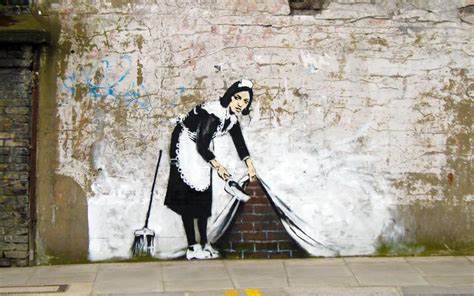
This artwork, created by Banksy in 2006, is located on a public street in London. When people look at this picture for the first time, they will see a woman who is dressed as a maid. Because this woman occupies the central area of the position. There are only a woman, a broom, a dustpan, and a white carpet. The woman is looking forward without smiling. She has a dustpan with her right hand and lifts the white cloth with her left hand. The artist used mainly white and black to draw this picture. He painted this picture on the red brick wall and covered it with white color. The wall is occupied with white color and a woman is painted in black. However, only the woman’s skin is drawn with yellow ochre. The method that the artist used for this artwork was stencil graffiti. This is one of the techniques of drawing. First, he makes a stencil which is created by cutting out a design from plastic or paper and putting it on the wall. After that, he sprayed paint onto it. And this picture is located on a public wall, so it is also street art. Overall, the lines of figures are clear and sharply defined. In particular, the white part is very clean and neat, so there is a large amount of white space. The figures are very simplified. The image appears flat, with minimal depth or shading. The figures are not rendered realistically. The size of this picture is almost the same as a human.
Interpretation & Meaning
This picture in which the maid is hiding the dirt can be interpreted as society tends to avoid touching the problems which people actually have to solve. From this interpretation, these visual elements suggest that just because people close their eyes, it does not mean the issues have been resolved. In this case, the artist drew the dust as a metaphor for social issues and claimed the individuals often do not address their true problems, much like the maid who covers the dust with the carpet. Also, there is plenty of white colored space to paint the carpet. Usually, white is the symbol of freedom, cleanness, simple, or pure, so people can interpret this color from many different perspectives in work. For instance, it may imply that the problem is more simple than people expected. The clues that suggest the problems are simple are not only color, but also the number of figures related to this. There is only a woman, two cleaning tools, and a big carpet. In addition to this, this white area suggests that society is originally imagined as clean and pure. Also, there are reasons that he painted it in public space. He makes a claim against not only the people who are interested in his pictures, but also everyone who lives in this society. Most people can understand his message as his picture is simple and stands out. The important thing is that the person who hides the dirt is a maid. It means the people who avoid solving problems are actually not those in power. On the other hand, the maid is hired by owners, so this can be interpreted that the people who let citizens do that are power holders. Thus, this work argues that both types of people have a responsibility and have to tackle the issues together. Otherwise, it cannot be fixed permanently.
Space, Power, and Access
Usually, people who walk on this street or are interested in the artist know this work. The encounter was accidental rather than planned because this work is located on the street wall. So, this picture is seen by the people who go through the street. In contrast, people who do not walk on this street can not see this unless someone picks it up on the media. However, it was written without permission, so everyone can take a picture and post it. That led to the spread on social platforms. The work is drawn in a private space, so the artist does not have the right to paint this wall. Therefore, this picture could possibly get erased by the owner. However, once it is extended through media or social networks, everyone can view it. This art would easily circulate because the artist does not use the place and way. Moreover, it means he did not make the work for money.
Joss Olcen
Your description of Banksy’s Sweeping it under the carpet is clear and vivid. I could easily visualize the maid, the broom, and the large white carpet on the red brick wall because of your attention to color, line, and stencil technique. Your interpretation is convincing, especially when you connect visual elements to meaning, for example, the white space symbolizing purity or simplicity and the choice of a maid highlighting the role of ordinary people versus those in power. These observations show a strong understanding of how the artwork communicates its social message.
You might strengthen your analysis by discussing how the space of the public wall affects the audience’s experience. While you note that passersby encounter the piece accidentally, it could be helpful to explore how the artwork’s scale or placement on a busy versus quiet street might influence its impact. This would deepen your discussion of space and accessibility, and how they contribute to the work’s meaning.
One question I have for the author would be, how might the interpretation of this artwork change if it were displayed in a gallery or museum rather than on the street? Would its critique of society’s avoidance of problems feel different in a formal setting?