Wplace July 21st 2025 – Present
Location: Wplace.live
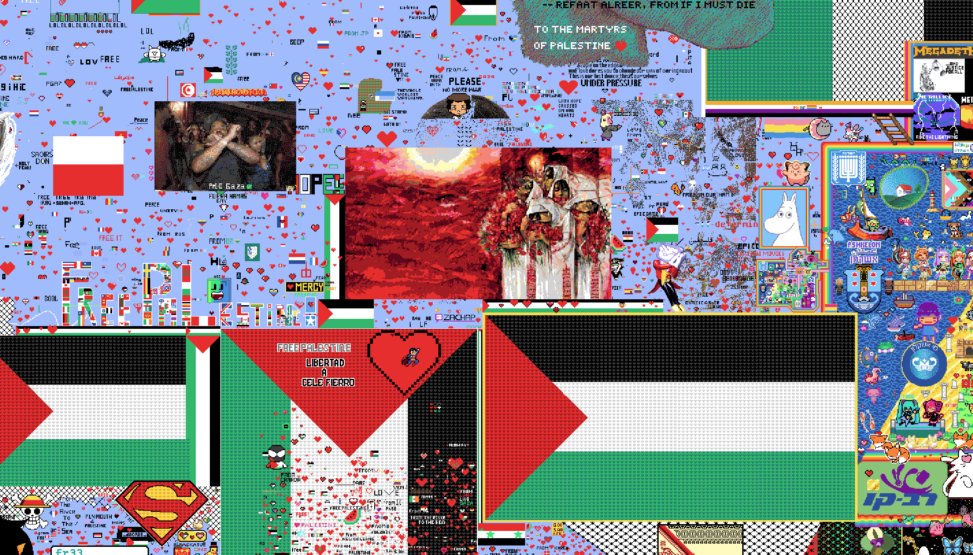
When entering the site the first thing a person will see is many coloured pixels forming together to create various images. Colours are often bright and bold with few usages of less saturated tones. When zooming out on the online website it will show more of the pixel art, depictions of humanoid creatures, sprites, logos, flags and larger more detailed art works can be found. Some of the art located in those areas even uses larger spaces to create a more realistic figure. Zooming out more, a map of the world will start to reveal itself showing real word locations. When zooming into more populated or areas of wildly known conflict there is more clutter of pixelated art where in less known or less populated areas there is more spaced out art. There is no clear focal point of the joint art; rather each contribution to the site has its own focal point. One particular image located in the waters near Gaza has a red terrain taking up 2 thirds of the left side of the image with light yellow clouds near the top of that side and a clear sky. The right side has 5 humanoid figures dressed in white robes holding bouquets of red flowers and one of 5 holding a candle. The front figure is looking down cradling the flowers while the figure to the left of it looks up and that clear sky area. The middle figure looks directly towards the viewer while the figure above it looks directly to the left and the figure on the far right looks down.
The different artworks on the site all showcase political beliefs as well as interests. They are representations of the people of the world. In peaceful areas of the world there are many references to shows, movies, video games and even communities. It’s messy but it showcases a lot of real people’s interests and allows others to showcase too. Each pixel placed is tied to a username, this implies that each add on to another piece represents human connection. Its platform furthers this as it is the only place a message like this could be made. The artworks here are able to connect people together in the same way the internet can from all over the world. The site is a reflection of the internet. The fanart depictions and such are not the only thing that has a message on the site. The area in Gaza is full of antiwar art. Large images of the Palestine flag fill that area accompanied by many many texts reading “free Palestine”. The Image mentioned early is a direct reference to the conflict. The red terrain may be symbolizing blood, referring to the bloodshed in Gaza. The blood terrain appears thick and creates a sense of unease. The yellow clouds and blue sky may represent heaven or the afterlife likely referring to where the casualties of attacks on Gaza. The Five figures in the found represent different feelings related to the war. The figure looking up to the sky may be thinking of those who have lost their lives mourning them or perhaps the figure is looking up wondering how long they have before they too lose their life. The two figures facing down appear to be filled with sorrow and loss. The back figure facing left holding the candle could be looking straight toward the bloodshed reflecting on it, or even feeling more numb to it. The candle could represent hope or a loss of life. None of the figures are looking right which could be read as none of them are looking to the future as often the left refers to the past and the right refers to the future.
Wplace is accessible for anyone with internet access to enter to view or edit. It opened on July 21st 2025 and is still open not just to view but to edit. The website gained popularity quickly among the youth and was advertised on various social media platforms. People would make posts about the site showing off their contributions as well as exploring their home towns to see what others have added. News of it spread through youth online as well as through friends as many found the site very interesting. News outlets such as USNews and Wtop News wrote articles about it. Finding the site is accidental with a higher chance of youth to find it due to its circulation online particularly on social media for younger people such as tiktok and youtube. While an older person could find it it is more likely they would find it on the articles rather than on social media. There are a handful of people that cannot see any of it and those excluded would be those who do not have internet access as well as those who do not use technology.
Bibliography
The Associated Press. “Welcome to Wplace: A Chaotic, Collaborative Digital Canvas Where Users ‘Paint the World.’” U.S. News & World Report, September 3, 2025. https://www.usnews.com/news/business/articles/2025-09-03/welcome-to-wplace-a-chaotic-collaborative-digital-canvas-where-users-paint-the-world.
The Associated Press. “Welcome to Wplace: A Chaotic, Collaborative Digital Canvas Where Users ‘Paint the World.’” WTOP News, September 5, 2025. https://wtop.com/lifestyle/2025/09/welcome-to-wplace-a-chaotic-collaborative-digital-canvas-where-users-paint-the-world/.
Stephano Gargurevich
The description you gave of Wplace as a piece of art helped me get a better idea of how it can function as such, of how the density of the imagery and the shifting nature of the landscape give it a value other pieces might not possess. The way you explain the way viewers interact with the piece through zooming in and out of a recognizable world map is quite effective, as it highlights scale and spatial organization as key visual elements. Understanding the context of location and the piece being displayed in a world map also gave me a clear idea on why areas of conflict appear visually cluttered while less populated regions feel more open, something which gives more strength to your argument on how the contributions of people reflect global attention and the current tensions.
When it comes to your interpretation of the imagery around the Gaza region, I consider that your argument is quite convincing, as you point and showcase clear evidence to the meaning you caught of this picture. The prevalence of the color red on the piece, paired with the white-robed figures and singular candle, creates a strong contrast in color and tone that reinforces your reading of bloodshed, mourning, and unease. Your observations regarding the direction the figures are looking is particularly strong, since it connects the orientation and composition of the piece to your interpreted meaning, especially the idea that the absence of rightward gazes suggests a lack of future orientation. This shows careful attention to visual literacy and interpretation grounded in description.
The main area I consider could be strengthened in your discussion is that of the space and audience. While you describe Wplace as globally accessible, you don’t really elaborate on how the shared digital space affects how viewers encounter politically charged imagery. You also could have given a bit more context regarding the story of this project, the quick mention of its predecessor r/place and a look at the area you examined for this discussion giving you a stronger argument regarding the origin of what is depicted at the time this piece was made.
One question I had while reading was: how might the meaning of the Gaza imagery shift if it were viewed in isolation, rather than embedded within a collaborative, constantly changing global map?