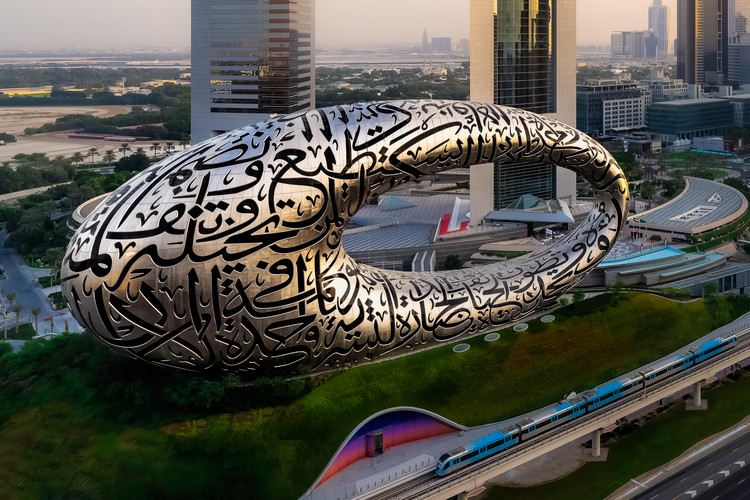
Artwork/Visual example: Museum of the future
Designed by Architect Shaun Killa of Killa Design
Calligraphy Artist: Emirati artist Matar Bin Lahej
Location: Sheikh Zayed Road, Dubai, UAE
Date: Opened 2022
Space of Art: Public/Architectural space
Section 1 – Visual Description
The Museum of the Future presents the Arabic language as a structural element. The Arabic Calligraphy is cut directly into the building’s metallic exterior. These voids in the structure allows light to pass through the structure, making the appearance of hte building across day or night and viewing conditions, what i mena by that is since its located along the Sheikh zayed road, the work is experienced in motion through the spatial encounter rather than a close reading.
The Museum of the future is a large and oval shaped structure positioned on a raised green platform adjacent to the highway. Its exterior surface is metallic and reflective. The calligraphy is placed horizontally wrapping the structure without a clear starting and ending. During daylight, the openings appear dark against the reflective surface. At night, light emerges from within the cut-out text, causing the calligraphy to glow.
Section 2 – Interpretation and Meaning
Based on the visual features described, the museum of the future communicates the idea of innovation and progress, and the green platform below signifies the value of sustainability. The oval form with the void suggests an ongoing process rather than a fixed point. However i only came to this conclusion by noticing the start and end points and also the loop being uninterrupted, now this makes the structure experience for multiple perspectives.
The Arabic calligraphy, integrated directly into the architecture, merges language with structure. Because the text is not applied as decoration but cut into the surface, it becomes part of the building’s physical identity. Does this suggest that written language and ideas are foundational rather than supplementary? The glowing text at night increases visibility and reinforces the building’s presence after dark, extending its impact across time.
Viewers often encounter it while driving or passing by rather than visiting the facility. From a distance, the building reads as a sculptural object; up close, the calligraphy becomes more legible, changing the experience based on proximity.
Different people mightinterprett it differently, like people who can and cannot read Arabic might take it differently. People who read it might resemble the poem and the meaning, and the people who cannot read them may just focus on the rhythm of the letters and admire the calligraphy and form over the text.
Section 3 – Space, Power,r and Access
The exterior is encountered by commuters by metro and car, pedestrians, and tourists traveling along Sheikh Zayed Road. Individuals who do not pass through this area or who lack visual access to the roadway do not encounter the work. Full engagement with the interior is limited to visitors who can obtain tickets and schedule entry.
The site is owned and controlled by the Dubai government and its cultural institutions. Decisions about access, presentation, and use of the space are managed internally rather than publicly.
Most encounters with the exterior are accidental, occurring during everyday movement through the city. Entry into the museum interior is planned and regulated.
The structure has visibility at all times due to its scale, location, and architectural lighting. Encounters with the exterior are typically brief, while interior engagement is time-limited and structured.
INCASE
The future is created today through imagination, innovation, and design, aiming to leave a lasting legacy for future generations.”
Chikako Minami
1. What’s working
Your description of “These voids in the structure allowed light to pass through the structure” and “structure is positioned on a raised green platform” helps me visualize how this art emphasizes nature. Also, referring to the oval shape and the metallic material leads to an image of uncommon materials and shapes for buildings. It is associated with future buildings.
Your interpretation is convincing because you point to the innovation and progress from the building’s form and color. The interpretation that it improves sustainability is understandable because of the green platform.
2. One area to strengthen
You might strengthen your discussion of progress by describing the Arabic calligraphy. In particular, you explain that the Arabic can be understood in two ways between people who can read Arabic and cannot read Arabic, and it represents this artwork accepts many interpretations. This suggests that leads to progress through diversity. However, I was curious about what the central space of this art express. In addition to this, I could understand the reason the artist chose to make it in the form of a building. It is because not only people who come to see this, but also people who encounter it can think about their future.
3. One question for the author
My question is “If people can read the poem and understand the meaning in Arabic, how do people interpret this artwork?” For example, whether the artwork promotes positive or negative emotions.