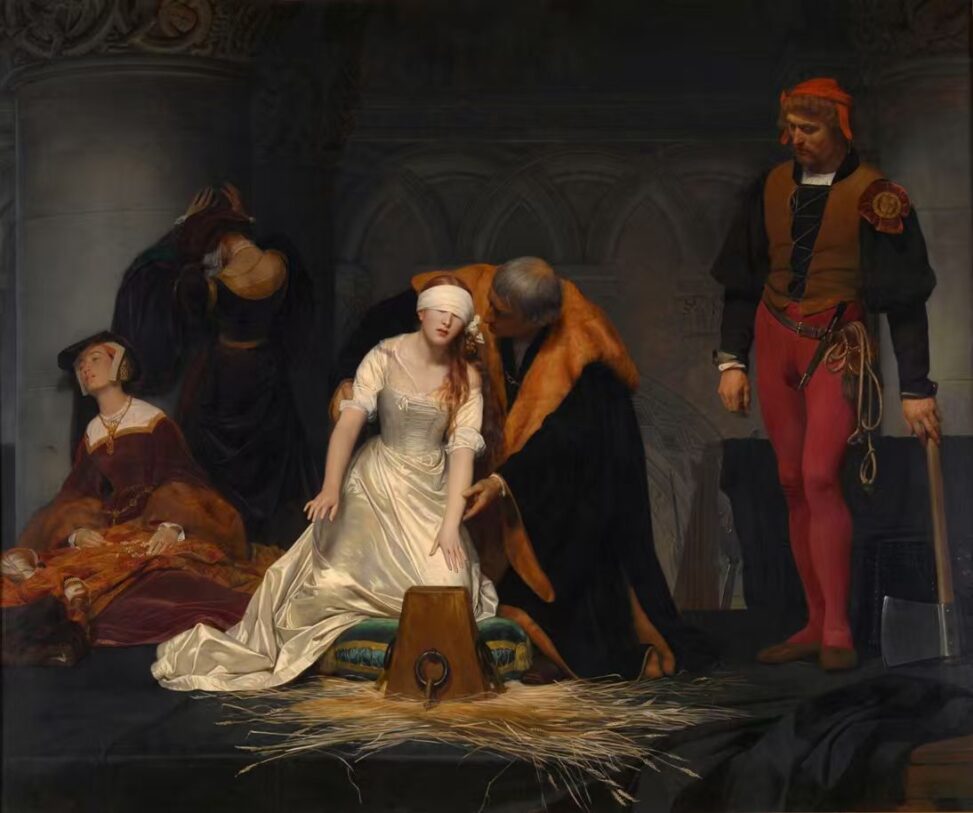
Artist/creator: Paul Delaroche
Location or platform: National Gallery, London, UK
Date: 1883
Materials: Oil paint on canvas
Context: This is a painting that has a strong historical significance; it describes a historical event that was based on a old text from1558. This text described the final moments of Lady Jane Grey, who was Queen of England for nine days. Delaroche uses spatial control and color to highlight the scene and guide the viewer’s attention.
Section 1: Visual Description
First, the most interesting aspect of the painting is its use of color. The dominant tones in the center of the painting are white, possibly a pale cream, and gold tones, which originate from the dress. The color scheme shifts to striking tones in the figures, beginning with orange and dark red, before settling into darker tones that dominate the background. However, there are also colors that create contrast or help to soften the transition between light and dark tones, such as the green of the cushion beneath the main figure, as well as brown and gray tones. The composition is organized around a standing figure dressed in light colored clothing, positioned slightly to the left of center.
The scene takes place in a closed interior space. The background loses detail as it fades into the distance from the figures, creating a sense of depth in the painting. Furthermore, most of the figures occupy a large portion of the image space. The five main figures appear at a similar and realistic scale. Objects like the wooden block and the axe are proportionally sized to the figures. This proportional scale helps to create a clear spatial relationship between the figures and the objects.
Now, the texture is handled differently. The skin and some areas of fabric appear smooth, like the young woman’s white dress, which looks like silk, while the darker areas and the clothing with shadows show a denser, heavier application of paint. The straw, the ground, and the wooden block are painted with flatter, harder surfaces.
Section 2: Interpretation & Meaning
I believe there are two main ideas with strong meanings regarding Delaroche’s intention in the painting. The first is the destruction of innocence by power. Lady Jane Grey is shown as a victim, a 16 year old girl forced to assume the responsibility of being queen of a nation for political convenience. In contrast, the message of the execution is not about violence itself, but about how power structures silently erase fragile lives.
Another idea is martyrdom. Jane’s white dress and the light tones give her an almost sacred presence, evoking the Christian image of saints of that era. Additionally, we see the emotional collapse of her ladies in waiting. The first lady, clutching her queen’s dress, while the other turns her back, unable to witness the injustice about to be committed. The fact that the painter positioned her with her back turned and revealing her neck, may have been intended to suggest how the protagonist will die.
The painting takes place in an enclosed space, so from my perspective, it has a theatrical feel, as if the viewer is part of the moment. It also conveys a sense of inescapability: the walls and the people present close in on Jane, trapping her in the instant before death. The painting pauses this moment, showing that hope still exists, but fate is inevitable.
Jane’s blindfold isolates her both mentally and visually from what is about to happen, letting the viewer feel her uncertainty. The viewers are not distant observers; they are close enough to see her hesitation, her outstretched hands, and her fear. The executioner is present but not the focus. His stillness and partial shadow move the emotional focus from the act of violence to the anticipation. The viewer experiences the tension of waiting, which can feel even more unsettling than the act itself.
This painting can be interpreted in different ways depending on one’s historical, cultural, or personal perspective. Nineteenth century audiences may have interpreted the painting as a warning about the political instability in France at that time. Modern viewers might take a psychological or ethical approach, focusing on themes of gender, youth, and injustice. And finally, religious viewers might see Jane as a Protestant martyr, her peacefully expression and luminous white dress reinforcing ideas of spiritual purity and moral rectitude. On the other hand, skeptical viewers might notice Delaroche’s idealization of the scene, interpreting the work as emotional persuasion rather than historical accuracy.
Section 3: Space, Power, and Access
The primary audience for “The Execution of Lady Jane Grey” is determined by its institutional context. This painting is exhibited in a major national gallery, and the work is typically seen by visitors who have the time and access to engage with formal art spaces.
The space itself is controlled by the museum, which determines how the painting is framed, contextualized, and preserved. Encounters with the work are usually planned, not accidental, as viewers visit galleries intentionally, often seeking cultural enrichment. However, within the gallery, the emotional impact can be unexpectedly intense.
The painting is large and has dramatic lighting, which encourages people to look at it for a long time. However, the many visitors in the museum can make it hard to spend that much time in it. The painting grabs your attention at first, but its full meaning isn’t clear right away. You understand it little by little, and it is best appreciated if you look at it slowly.
Provide Feedback