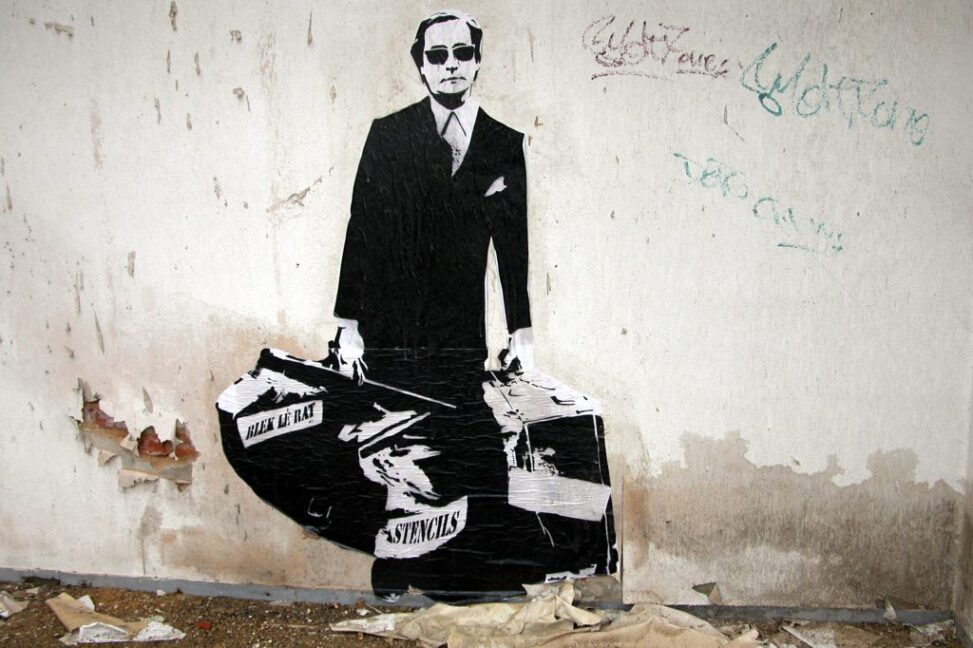
Title: The Man Who Walks Through The Walls 2008
Artist: Blek Le Rat (Xavier Prou) French, 1951
Location: Leipzig, Germany
Space: Public/Everyday
Section 1: Visual Description
This artwork consists of a black stencil image applied directly onto an exterior urban wall. The painted surface appears matte and opaque with slightly uneven edges. The wall itself shows visible texture, including uneven areas, patches of wear and subtle discolouration. No additional markings or images are visible in the surrounding area. The wall appears to be part of a street-level structure with flat planes and sharp architectural edges.
The image presents a human figure occupying a central position on the wall surface. The figure is scaled approximately to life-size and comes into sight as a flat black silhouette with no shading, gradient or variation in tone. The outline stands out against the lighter wall behind it. The image is roughly positioned at eye level for pedestrians and placed close to the edge of the wall surface with parts of the body aligned near architectural seams.
The figure’s stance is defined by an asymmetrical alignment of the body. A subtle difference in shoulder height creates a diagonal axis across the torso, allowing the forward and backward positioning of the legs to be visually inferred. The arms are arranged in opposition, with the right arm bent slightly forward and the left arm extending backwards while carrying rectangular objects in both hands near the two sides of the body. This postural deviation presents a directional movement across the surface. Small details of the figure are minimal with no visible clothing detail, texture or internal pattern within the body. Facial features are indicated only by small cut-outs, and a pair of circular shapes positioned over the face indicate eyewear.
Section 2: Interpret the work using evidence from your description
Based on the visual evidence, the possible ideas of the artwork communicated by the image are movement and passage through urban space. This interpretation is supported by the figure’s uneven bodily alignment, where a diagonal orientation across the upper body allows a shift in leg placement. These formal elements visually indicate forward motion across the wall surface rather than a static pose. The objects held in each hand reinforce this sense of transit as the positioning implies portability and movement. The absence of internal detail within the silhouette directs attention towards the overall form and posture, placing focus on bodily presence within the space.
The surrounding environment plays a central role in shaping how the work is understood. Because the artwork is installed directly on the exterior urban walls in a public, street-level location, the image is encountered as part of everyday pedestrian movement rather than through a planned visit to an art institution. The placement of the figure at approximately eye level within the viewer’s immediate visual field creates a direct spatial relationship between the image and the passerby. The humanised scale of the figure further reinforces this connection as the silhouette immerses a similar physical scale to body movement through the same space. By aligning the figure with architectural seams and wall edges, the image becomes embedded within the structure of the built environment rather than functioning as a detached picture, reshaping the wall from a neutral surface into an active element of the artwork. As a result, the work is encountered in motion, echoing the walking posture of the figure itself as viewers move alongside the wall.
Interpretations of the work may vary depending on the viewer’s familiarity with the street art and their mode of encounter. A pedestrian passing the image briefly may perceive it as a visual element embedded in the surrounding environment, registering the figure’s posture and placement without extended analysis. Viewers with prior knowledge who recognize the stencil technique may focus on the flat silhouette, sharp edges and absence of tonal variation, recognizing these features as characteristics of the medium. Others may concentrate on the rectangular objects carried by the figure, interpreting them as signs of movement. The lack of detailed facial features, clothing or internal texture prevents the figure from being read as a specific individual, allowing viewers to project different identities on the form. These varied interpretations are enabled by the artwork’s simplified visual language, its placement in a public space, and its accessibility to audiences with differing levels of visual literacy and contextual awareness.
Section 3: Space, Power, and Access
The artwork is primarily encountered by individuals moving through the street-level urban space where it is installed, including pedestrians and local residents. Encounters occur incidentally as part of everyday movement rather than through deliberate acts of attendance. Its placement on an exterior wall allows open visual access as there are no institutional barriers, financial requirement or schedules regulating viewing. However, only those who pass through this specific location are likely to experience the work, access remains geographically limited. Individuals outside this area engage with it mostly through photographic or digital representations.
The wall functions as a controlled surface within the urban environment, typically owned by private property or local authorities. The presence of the artwork therefore exists within a negotiated balance of artistic intervention and spatial authority. As a result, the image remains unstable as it depends on the tolerance or oversight from those who manage the site.
The artwork’s visibility is also temporary as exposure to weather or removal can alter or erase it over time, making its duration uncertain. This impermanence contrasts with long-term preservation associated with gallery-based artworks and underscores the conditional nature of visibility in public space.
Provide Feedback