Visual Description
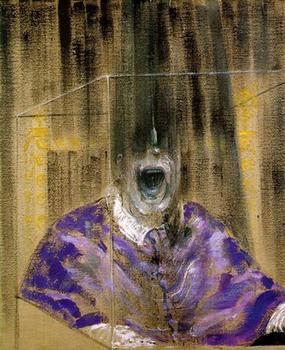
The image depicts the upper half of a human figure, centered within its frame and occupying most of the canvas. This figure is shown enclosed within a transparent, skeletal box structure, rendered only in white, thin linear strokes. This transparent box creates a boundary around the figure’s head and its shoulders, reaching half of the figure’s chest too. The figure shown in the piece is wearing a heavily saturated purple garment that covers their shoulder and torso, featuring a white circular collar in its neck, a high contrast focal element against the darker purple and muted tan of the background. Being in the center of the image, the face of this figure is the focal point. Half of this face is heavily obstructed by vertical, downwards strokes of gray and black paint, creating an effect not too dissimilar to that of a curtain and blurring its facial features.
Other details observable in the image are the rather highlighted dark, vertical, elliptical open mouth in the obscured face, revealing blueish rectangular shapes that resemble teeth. Directly above the head, a single thread descends from the edge of the painting, a small, dark, shape hanging from it right in front of where the figure’s eyes would be located. The background for the piece consists of a flat, tan-colored, undefined space on the lower half, and a that same color with the striking dark brushes on the upper half. Behind the figure and around it, situated around the middle of the canvas, faint, repetitive yellow circular patterns appear, forming the shape of the upper half of a rectangle. The paint application varies between those thin, translucent areas around the upper half of the painting, to more textured and defined stokes like those on the mouth area and the garment’s collar.
Interpretation & Meaning
Head VI appears to be focused on the idea of isolation and containment, something shown through the use of multiple elements within its framing. The transparent box-like structure around the figure’s head creates a clear boundary restricting this distorted person while also allowing the viewer a clear look inside, suggesting a condition of being both enclosed and exposed at the same time. Trapped by something unseen. Through this and the central placement of the figure itself, the trapped person is displayed as an object of direct observation, the focus of the picture and not just part of a broader image.
The message that the figure itself is trying to give the viewer is further defined by the expression it wears. Even with the upper half of their face being concealed by the curtain-like structure painted in front of it, its gaping mouth and the way it’s painted with strong, detailed strokes makes the feeling behind it rather clear. A scream of pure emotion, a desperate discharge of feelings that could be understood as anger, frustration or just, pure desperation.
This expression is given further context and different implications while taking into account the attire the figure is wearing and the way its facial features are concealed. When it comes to the attire, the purple garment, the white circular collar and the symbols depicted on the back can be pointed as similar to that of religious, more specifically Christian, imagery. The garment is not too dissimilar to what’s usually worn by people of authority within these institutions, such as popes or high-ranking clergy members. The concept of institutional or symbolic power is introduced into the scene by this visual cue. Together with the clear enclosure, the attire might imply that positions of spiritual or leadership authority are likewise scrutinized and constrained. When it comes to the curtain, the concealment of the figure’s face takes this from someone specific to a more symbolic position. Not having the full face makes the identity of the person not a factor for the average viewer.
These elements may be interpreted differently by different viewers. Some might interpret the scene as a critique of the demands of institutional authority by concentrating on religious attire. Others might react more strongly to the spatial framing and interpret the piece as an investigation of public visibility, confinement, or exposure. Because there is no set scene, the image can be interpreted in a variety of ways depending on the associations and background of each viewer.
Space, Power, and Access
This piece is most often seen in curated spaces, such as museums and galleries, or in official digital archives, the method used for observing it in this instance. This makes it so people accessing this work are most commonly people interested in either the story of its author, the themes depicted, or the style and aesthetic the piece has even without delving deeper into the meaning behind the piece.
Head VI is not a piece you just stumble upon unless you have a passing interest in what for many could be labeled as unnerving, the depiction of a figure usually seen as holy and a source of light to those who follow christianism being distorted into one that transmits despair and anguish. Therefore, this piece is one you seek, or one you stumble upon while seeking something painted in a similar frame to it.
Control over the places where this piece is depicted usually lies with the Bacon State, confirmed by family members or the artist that have tried to preserve his legacy and the multiple facets of it. Museums, galleries, and archive managers decide when and where Head VI is exhibited, shaping the narrative surrounding the painting, influencing whether it is presented primarily as a historical object, a formal study, or part of a broader discussion about power, religion, or modern art.
Bradley
Your post clearly reflects the description and the artistic reasoning for this painting. Your description of the thin white outlines of the transparent box and the curtain-like upstroakes of the art piece. That moment stands out to me because you explain how both descriptions help you explain to me that the box creates a form of restriction and that viewer looking at the photo cannot see the man’s face.
Your interpretation of the painting being about institutional and religious power felt especially effective. You point to various specific things within the painting that help to prove your point, like the man wearing a purple garment, white collar, purple tie, and the obscured face. All these details help your claims in that this painting represents the symbolic position of power like a priest. You also effectively explain how the figure is also trapped by something unseen and is exposed and enclosed, with the man in the photo being shown off with his bright colours, but as well as only his mouth agape and his expression covered by the curtain on his face.
One area you could strengthen is your discussion of space and audience. You might be able to strengthen this by two ways, one, by describing more explicitly how the viewers position, that being outside of the box, imitates the same act of surveillance and judgement imposed on the figure. The second way would be to expand on how a museum or gallery reinforces this dynamic of pushing your argument even further, with how you were talking about controlled access.
One question I had while reading this was “How might this piece of art be interpreted by people who are without Catholic/Christian imagery.”